File:
<echinodermata.htm> <Index to Invertebrates> <Bibliography> <Glossary> Site Description
<Navigate to Home>
|
Invertebrate
Zoology Kingdom: Animalia, Phylum: Echinodermata (Contact)
CLICK on underlined file
names and included illustrations to enlarge: Echinodermata
derives from the sane "spiny skin" and includes such
organisms as starfish and brittle stars.
Parts of the skeleton project through the body wall. These organisms that are found only in the
marine environment possess radial symmetry where
the rays occur in five or multiples of five.
This contrasts to Ctenophora and Cnidaria where there are 4, 6 or 8
rays. The endoskeleton is calcareous
and is derived from the mesoderm. A
true coelom is present. There is a
water vascular system called the "Ambulacral System." This is a system of tubes containing
mostly water. And is modified toward a closed syncytium. It operates the tube
feet. These organisms are interesting
for being quite different from all other animal phyla, and their origin is
obscure. They have the calcareous
endoskeleton and water vascular system.
All members have bilateral larvae that arose from some bilateral
ancestor. The radial symmetry is
advantageous to a sessile animal.
They also have a close relationship to the Chordata, which is
evidenced by the calcareous skeleton, an embryonic development that includes
a blastula and gastrula, and considerable biochemical evidence. ------------------------------------ The Class Asteriodea includes
the starfish. There is great uniformity in appearance
among the various members. They
consist of a central disc with five or multiples of five radiating arms and no
sharp demarcation. The anus is not
set off sharply from the disc and the coelom extends out into the arms. Tube feet are for locomotion and one
stomach is eversible.
A type genus is Asterias, which is found off the
east coast of North America. Most
species live offshore in shallow water among the rocks or any relatively hard
substrate. However, some genera do live
in deep water or in mud. Body
Plan.-- This consists of a disc and surrounding
arms. There is an oral and an aboral
surface but no actual dorsal or ventral surface. The madreporite is an opening to
the water vascular system on the aboral surface. A mouth occurs on the oral surface. The ambulacral groove is on the oral surface from which tube
feet project through the body wall.
There is one eyespot on the tip of each arm. The whole body surface is studded with small, blunt spines,
which are projections from the internal skeleton or ossicles. Dermal branchiae,
or gills, contain small extensions of the coelomic cavity. These may be branched. Pedicellariae are
pincher-like structures on the body surface, which cluster around bases of
larger spines. They function like
avicularia in the Bryozoa
in that they keep the body surface clean. Body
Wall.-- A ciliated epidermis covers the whole
body but these may become worn off of the older spines. The dermis is
a layer in the epidermis, which is a mixture of muscle and connective
tissue. Ossicles are borne in the
dermis and form the skeleton. Surface
spines project from them. A ciliated
peritoneum lines the coelom. A
coelomic fluid exists inside the coelom. Food
& Digestion.-- There is an oral
stomach located closest to the mouth, which is called the cardiac
stomach. There is also a second or aboral stomach
located in back of the oral stomach, which is called the pyloric
stomach. Pyloric caecae are digestive glands that
lead off of each of the five points of the pentagon aboral stomach. An anus is present but it is barely
functional. A rectal
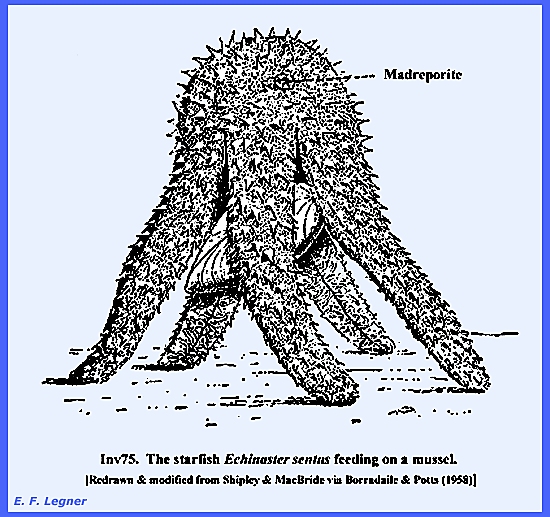
caecum occurs as a branch off of the intestine. Asterias feeds on small worms, crustaceans and other echinoderms
and mollusks. Food is taken directly
into the oral stomach. To feed on a
clam the starfish pulls open its valves by exerting a continuous pull with
its tube feet. When mollusk valves
begin to open the starfish extends its oral stomach into the opening and
begins to digest the contents in place.
The stomach is everted by contraction on the center point of the body,
and special muscles retract it. Digestion is partially extra
cellular and intracellular.
Undigested material leaves via the mouth. The anus is practically nonfunctional. Haemal
System.-- This is
nonfunctional, and it may be a remnant of a previously functioning
circulatory system. Circulation.--
movement of the coelomic fluid accomplishes this. Respiration.--
Dermal branchiae and any exposed surface, especially the tube feet, may serve
for respiration. Excretion.--
Amebocytes,
which occur in the coelomic fluid acquire crystalline wastes and migrate through
dermal branchiae to eventually end up in the ocean. These have been referred to as leucocytes. There is also some diffusion through any
exposed surface. Support
& Protection.-- The skeletal
ossicles support the organism, as well as the heavy body wall. Pedicellariae keep the body surface clean. Locomotion.--
This is primarily a function of the water vascular system. The madreporite takes in water via a
sieve. Then leading down the
madreporite to the oral side is a stone canal with
calcium deposited on its walls. The
stone canal runs into the ring canal,
which runs all the way around the mouth.
At intervals the radial canals emanate into the arms. Lateral branches of these are called transverse
canals. The transverse canals connect with ampullae,
which are enlargements at the inner ends of the tube feet. The whole system is full of seawater. There are valves that guard the
junctions with the ampullae. Suckers
occur at the distal end of the tube feet and retraction of tube feet is by
muscles. Forward motion is accomplished by
"pole vaulting" on tube
feet. Loss of water from the system
is by leakage under pressure.
Associated with the ring canal are five pair of vesicles called "Tiedemann's
Bodies, whose function is not
fully understood. Nervous
System.-- There is a poorly
developed nervous system present, which is very simple with nerves being
located adjacent to the epidermis. These
parallel the ambulacral system with a ring around the mouth and one branch
under each radial canal with subsequent branches. There is no central organ or brain. The only sense organs occur at the tips of the arms. However, all the body surfaces are
generally sensitive, with the tube feet being most sensitive. It is thought that little specialization
is needed because these animals are radially symmetrical and slow moving. Reproduction.--
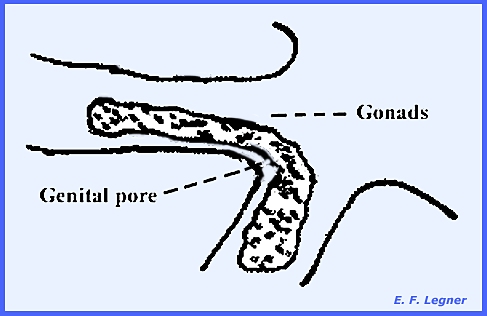
Sexes are separate and there is no sexual dimorphism. There are five gonads, each one is
branched and joined with the adjacent one.
Eggs and sperm are shed directly
into seawater. Fertilization occurs
entirely in the open water and there is a tremendous number of gametes
produced. There is no actual asexual
reproduction, but there is a high degree of regenerative ability. Development.--
This involves a blastula that gives rise to a gastrula and finally a ciliated
larva called a bipinnaria, which is bilaterally
symmetrical.. The bipinnaria possess
a complete digestive tract and feed immediately upon hatching, which is very
rapid. The larva attaches to the
bottom of the environment and becomes sessile for a few weeks. Later it swims off as a mature starfish. Economic
Importance.-- Starfish can be
slightly destructive to commercial oyster beds. ------------------------------------ Please see following
plates for Example Structures of the Asteroidea: Plate
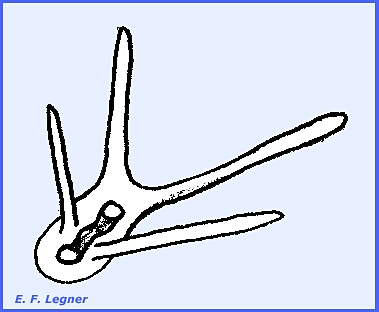
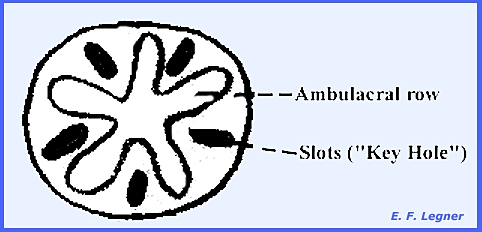
39 = Phylum: Echinodermata: Asteroidea: Asterius sp. Plate 40 = Phylum: Echinodermata: Asteroidea: Asterius sp. -- Cross-section Plate 43 = Phylum: Echinodermata -- Example
Classes: Echinoidea, Blastoidea,
Ophiuroidea ------------------------------------ The Class Echinoidea
includes the sea
urchins
and sand
dollars. Type Genera are Strongylocentrotus and Arbacia. Ossicles are fused to form a rigid
test. Aristotle's Lantern is
present. Pedicellariae are 3-jawed
stalked and sub ocular shaped and variously flattened. A Pluteus
larva is present. Habitat.--
Being offshore to 100 fathoms on hard or rocky substrates, this is similar to
the starfish.
Body
Plan.-- Sea urchins may be thought of as
starfish with the five arms brought up over the back. They are basically similar to
starfish. Dermal ossicles of the
skeleton are regularly arranged in rows and are fused into an immobile, rigid
structure called the Test or Corona. Spines are quite long and movable by
possessing ball and socket joints on
the test. The rows of ossicles are
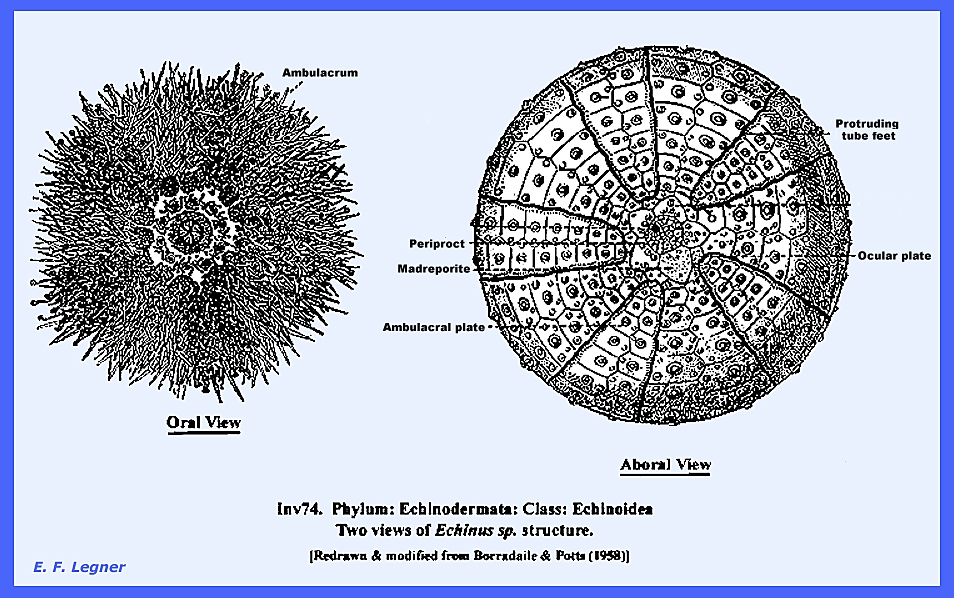
given names because they are quite regularly arranged. There are altogether 20 rows extending
from the mouth to the aboral point.
The ambulacral rows have tube feet while the interambulacral rows are
without tube feet. A periproct occurs
around the anus at the aboral end. Genital
plates
are located around the
periproct and occur at the ends of the interambulacral rows. A genital pore occurs on each plate. The plate bears the madreporite in
addition to a genital pore. An ocular plate occurs on the ends
of ambulacral rows, which corresponds to the ocular plats of a starfish. Oral tentacles,
which are modified tube feet, surround the mouth to function in feeding.
There are 10 dermal branchiae around the periphery of the peristome. The pedicellariae differ in two
ways from a starfish: (1) they occur
on long stalks and (2 they have three jaws. Body
Wall.-- The construction is similar to a
starfish in that an epidermis covers the entire surface in early stages. A dermis lies under the spines. There are no muscles and connective tissue
that serves to secrete the skeleton is practically gone. A peritoneum lines the large coelom. Food
& Digestion.-- Food consists of
both dead or living plant and animal material. The digestive tract begins at the mouth. Aristotle's Lantern
is present, which is a group of ossicles that have been highly modified into
a feeding mechanism. It appears as
a 5-sided pyramid with the point
projecting through the mouth. It is
operated by muscles and consists of about 40 parts. Five teeth project through the bottom and pick up and chew
food. The mouth and Aristotle's Lantern
lead to an esophagus. This in turn
leads to a large intestine. The
intestine runs around and doubles back on itself to give way to the rectum
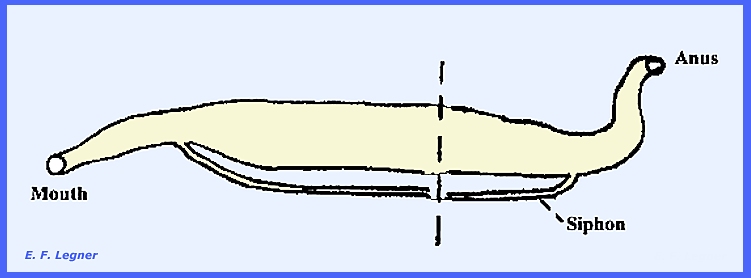
and finally to the anus. A Siphon is
present that is a diverticulum emanating from the esophagus. It parallels the digestive tract and
finally reenters the tract near the anus.
Its function is to carry a fresh supply of water. There are no digestive glands present.
Circulation.--
The coelomic fluid functions in circulation, and the haemal system is more
developed than in the starfish. Respiration.--
Dermal branchiae are inflated and deflated so that the coelomic fluid becomes
pumped in and out of the branchiae.
Tube feet and the siphon also function in respiration. Excretion.--
This process is not entirely understood but is believed to be similar to that
of the starfish with dermal branchiae and amebocytes involved. Support
& Protection.-- The test, spines
and pedicellariae serve to support and protect the organism. Locomotion.--
Tube feet, which are quite long, and the water vascular system are involved
in locomotion just as in the starfish.
The ampullae are more leaf like and not as bulbous as in
starfish. Each tube foot has two
holes by which it emerges through the skeleton. Nervous
System.-- This is similar to
the starfish and of the same degree of low complexity. Sense
Organs.--Ocular plats serve
as sense organs. Reproduction.--
There are five gonads that lie under inter ambulacral areas. The gonads may be connected with one
another to form a ring. They open to the
outside via genital pores on genital plates.
Gametes are shed into the open water.
A Pluteus Larva
is present, which has
long arms that provide locomotion. (both sea urchins and starfish have been
used extensively in embryology).
Morphological
Variation.-- There is a high
degree of variation found in the Echinoidea.
Flattening has been carried out extensively. In the san dollar the anus occurs on the edge of the
dollar. Heart urchins, sea biscuits
and other groups have distinctive shapes.
Economic Importance.--
The group has academic interest and the gonads are consumed as a delicious
and nutritious human food, often served cold and with lemon as in Chile and
other countries. ------------------------------------ Please see following
plates for Example Structures of the Echinoidea: Plate 41 = Phylum: Echinodermata:
Echinoidea: Strongylocentrotus sp. Plate 42 = Phylum: Echinodermata: Echinoidea: Strongylocentrotus
sp. -- Aristotle's Lantern Plate 43 = Phylum: Echonodermata -- Example
Classes: Echinoidea, Blastoidea,
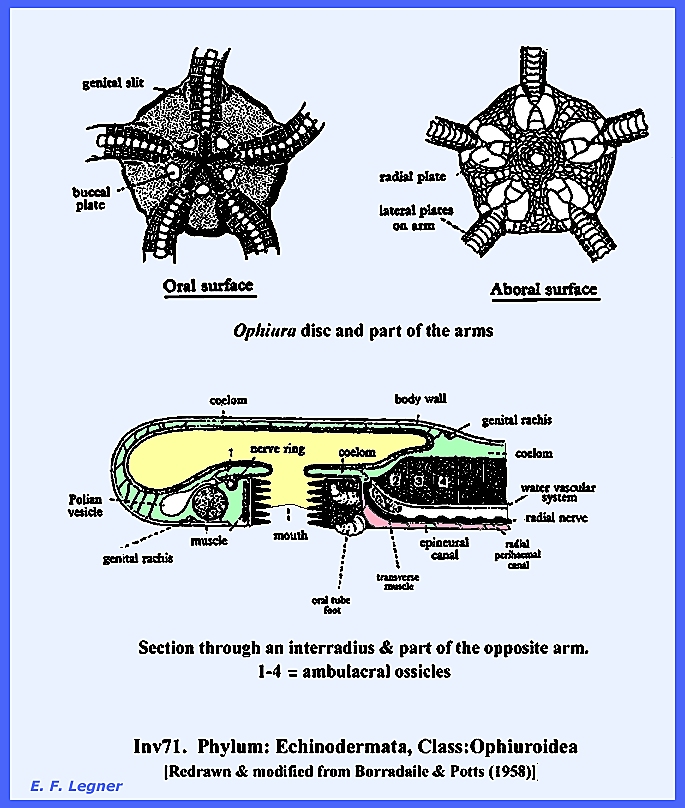
Ophiuroidea ------------------------------------ The Class Ophiuroidea
or
brittle stars and basket
stars are similar in shape to
starfish except that their whole body appears more star
shaped. This is because their arms are sharply
marked off from the main disc and supported by a long series of ossicles (=
vertebrae) for muscle attachment. The
digestive tract is limited to the disc region. The coelom is practically limited to the disc region also. They
do not contain caeca of the alimentary canal. The madreporite is on the oral side and the ambulacral groove
is covered. The size is small to moderate save
for basket stars that have arms branched of subdivided.
Their tube feet do not possess suckers
and there are no pedicellariae. These
animals do not move by means of tube feet but rather by pushing and pulling
on surrounding objects with their arms.
To accomplish the arms are sharply distinct from and freely movable on
the main disc. They are armored with
skeletal plates. The epidermis is
vestigial but there is a strong cuticle.
Spines occur on the side plates that allow for a grip. The ambulacral ossicles of each pair fuse
to form a series of vertebrae that articulate by an arrangement of knobs and
sockets and can be moved in various directions by four muscles. The vertebrae reduce the perivisceral
cavity in the arm to a canal in which there is no room for caeca of the
alimentary canal. The nerve cord has
ganglia that correspond to the muscles between the vertebrae. The tube feet have no suckers and no
ampullae and are usually provided with warts of sense cells. The alimentary canal is reduced to
a simple bag that cannot be protruded through the mouth. The mouth is armed with spines that serve
as teeth. As in the Echinoidea there is a Pluteus larva. No economic importance is attached to this
group. ------------------------------------ Please see
following plate for Example Structures of the Ophiuroidea: Plate 43 = Phylum: Echonodermata -- Example
Classes: Echinoidea, Blastoidea,
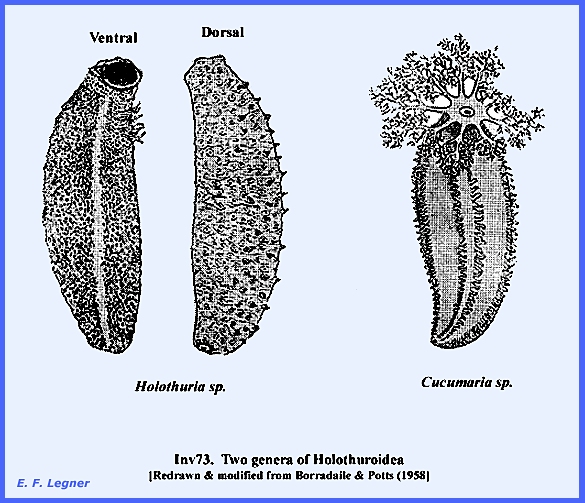
Ophiuroidea ------------------------------------ The Class Holothuroidea are
the sea cucumbers. They have a reduced skeleton, which consists
of tiny ossicles imbedded in a heavy body wall. The body is elongated along the oral-aboral axis (anterior
& posterior ends). There is a
tendency to return to bilateral symmetry.
The dorsal and ventral sides are flattened, and the tube feet are relatively
large.
Habitat.--
These animals lie on the bottom of the marine environment or they are buried
in sand with their tentacles and anus exposed. Body
Wall.-- This is pliable but very tough. Oral tentacles occur at the anterior end
and there are highly modified tube feet. Genital
Opening.-- There is a single genital
opening, not five as in the previous classes. It appears as a wart like projection just back of the oral
tentacles. A type Genus is Cucumaria. Here the anus is located at the posterior
end. Tube feet are arranged in
regular five rows typical of Echinoidea and Asteroidea. However, the ventral rows are better
developed than in the other classes.
There is a very tough dermis and a circular muscle is located underneath
the dermis. There are five
longitudinal muscles appearing as very heavy bands running the length of the
body. Peritoneum lines the
coelom. The skeleton consists of
ossicles imbedded in the dermis. They
are microscopic in size and serve no function other than to strengthen the
dermis. Food
& Digestion.-- Holothuroidea are
passive feeders. Food settles on
their tentacles or it is scooped up from the substrate by the tentacles. A short esophagus follows the mouth. A pharyngeal collar surrounds
the esophagus, which is homologous to Aristotle's Lantern. But here it is just a strengthening ring. Circulation.--
The principal medium for circulation is coelomic fluid. A haemal system exists
that consists of vessels containing red haemoglobin in some cases. There are no muscular walls and
distribution of the blood is inefficient.
Oxygen and other materials are distributed. Respiration.--
A respiratory tree branches off
the rectum and eventually takes up a lot of the space in the coelomic
cavity. The rectum is equipped with
muscles for dilation and constriction, and a valve can close the anus. Water can be pumped in and out of the
respiratory trees and thus dissolved oxygen is distributed. Additional respiratory surfaces are found
on the tube feet and oral tentacles. Excretion.--
The respiratory tree has been thought to be involved in most excretion,
although positive verification is lacking. Support
& Protection.-- The toughness and
thickness of the body affords support and protection. Some species possess cuvierian
organs, which secrete a
material that is passed through the anus.
The substance is sticky and may be ejected to entangle small
predators. Locomotion.--
Movements of the body wall in a wormlike fashion and/or tube feet enable
locomotion. Water Vascular System.--
The system functions in a similar pattern as other Echinodermata. The madreporite opens into the coelom, but
the system is not filled with seawater but rather with coelomic fluid. The polian vesicle is
a reservoir for the fluid of the system.
It appears as a large sac off of the ring canal. Five radial canals run underneath the five
longitudinal muscles. The tentacles
are operated by the water vascular system. Nervous
System & Sensitivity.-- This is the same as
that found in other Echinodermata. It
consists of a simple ring next to the water vascular ring with subsequent
branches. There are no sense organs
but the body is generally sensitive.
Especially sensitive are the tentacles, anal region and tube feet. Reproduction.-- In the
sexual reproduction only one gonad is located between two ambulacral
rows. A genital duct runs along a
mesentery. Fertilization is external
and gametes are fed into the open water.
An Auricularia larva is formed, which
is bilaterally symmetrical. There is no actual asexual
reproduction, but these animals possess a powerful regenerative ability that
is referred to as evisceration. Here the entire viscera are delivered to a
predator by rupturing the body wall at the oral and anal ends. The remaining torn portions regenerate
themselves. The process is
accomplished by internal pressure that ruptures the body wall. Economic
Importance.-- In some parts of
the Orient the dried body wall is consumed as food, which is called Tripang
or Leche-de-mer.
------------------------------------ Please see following plates for Example Structures of the
Holothuroidea: Plate
44 = Phylum: Echinodermata: Holothuoroidea: Cucumaria sp. Plate 45 = Phylum: Echinodermata: Holothuoroidea:
Cucumaria sp. -- Cross-section Plate 46 = Phylum: Echinodermata: Holothuoroidea:
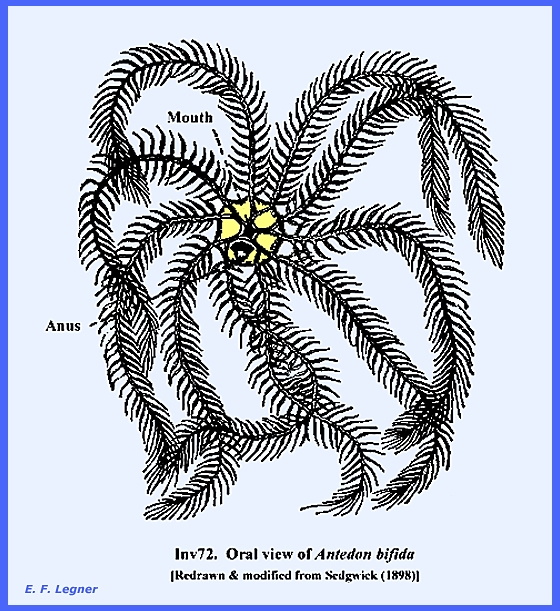
& Crinoidea -- Examples ------------------------------------ The Class Crinoidea includes
the sea
lilies
and stone
lilies. They are a remnant of a very large group
of Echinodermata that are mostly represented by fossils. Most of their life is spent in attachment
by a stalk consisting of a group of ossicles. They have pinnately branched tentacles and skeletal ossicles
make up support of the branched arms.
The calyx, or disc of other
Echinodermata, is the site of most internal organs. Tube feet are not locomotory but serve as sensory
structures. The madreporite is and
water combines with the coelomic fluid in the water vascular system via a
series of holes. In some ways these
animals are considered to be very primitive whereas in others they are
advanced.
Habits.--
Some Crinoidea remain sessile throughout their life but in others movement is
accomplished by alternate beating of the arms. The sessile stage develops more extensively. Feeding.--
A mucous scheme
is present. All of the arms are covered with mucous
and a groove runs down each arm.
There is a constant stream of mucous, which is carried toward the
mouth. The mouth and anus are located
on the same side, with the mouth being in the center and the anus off to one
side. Reproduction.--
The sexes are separate and fertilization is external. Bilateral larvae are formed. ------------------------------------ Additional
Echinodermata: Plate 43 =
Phylum: Echonodermata -- Example Classes:
Echinoidea, Blastoidea, Ophiuroidea ============== |