\File: <mollusca.htm> <Index to Invertebrates> <Bibliography> <Glossary> Site Description
<Navigate to Home>
|
Invertebrate
Zoology Kingdom: Animalia, Phylum: Mollusca (Contact)
CLICK on underlined file names and
included illustrations to enlarge: Mollusca
are a large well-defined group that is fundamentally bilaterally symmetrical
even though the distortion may be great.
There is no segmentation and name means "soft-bodied." Outstanding body features are the shell or
calcareous exoskeleton, the mantle,
which is a fold of the body wall that lines and secretes the shell, and the foot,
which is a muscular organ usually concerned with locomotion. A true coelom exists although it may be
reduced in size. The animals are
primarily marine, but many, like some clams and snails, are found in
freshwater and terrestrial. ------------------------------------ The Class Pelecypoda, meaning "hatchet
foot," includes the bivalves,
clams,
oysters and
mussels. They are bilaterally symmetrical and
laterally compressed. There are right
and left bivalve shells, which are hinged along the mid-dorsal line, and the
ventral side opens. The mantle lines
both valves of the shell. There is no
head and the foot is laterally compressed.
There are two pairs of lamellate gills. Characteristics of the freshwater clam Genus
Anodonta as
follows: Habitat.--
Anodonta
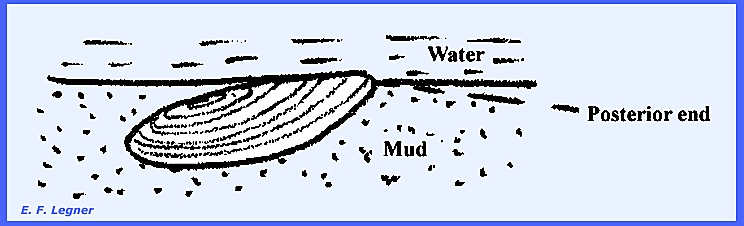
lies on the bottom or is partially buried in mud of freshwater streams and
lakes
Body
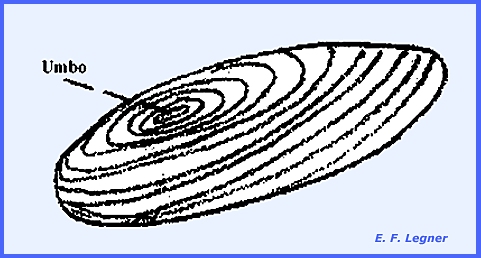
Plan.-- There is a shell the exterior of which
is covered with conspicuous concentric growth rings or lines. In older specimens these growth lines become
eroded.
The interior of the shell bears
ridges and projections called "hinge teeth",
which align the shells during closing.
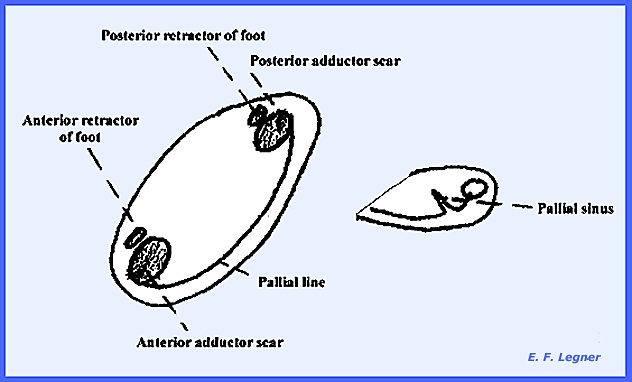
The hinge is elastic. Muscle
scars are the anterior and posterior adductor scars and anterior and
posterior retractors of the foot. A
mantle scar is derived from the pallial line,
which is the point of attachment of the mantle. The pallial sinus is
an indentation in the mantle of saltwater species and is a siphon scar.
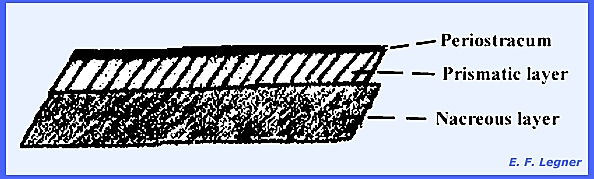
The mantle
consists of a pair of flaps, which enclose everything within: (1) a
proteinaceous periostracum, (2) a prismatic
or crystalline layer,
(3) a nacreous layer or "Mother
of Pearl." The latter two being calcareous.
A hinge ligament is a thickened
area of the periostracum. There are
poorly developed siphons in freshwater clams, which are located in an area
where the mantle does not reach.
Tubes may be formed in marine Mollusca where they project out of the
bivalve. This is formed of a fusion
of the mantle and may be longer than the shell itself.
The mouth is a tiny opening just
behind the anterior adductor muscle.
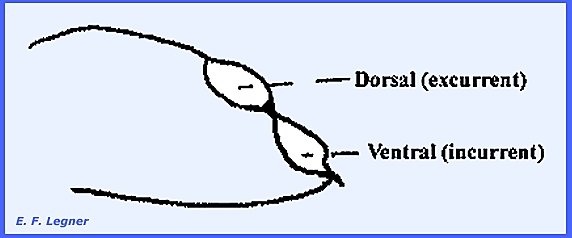
The anus opens into a dorsal excurrent siphon. Labial palps are triangular
flaps on each side of the mouth. A
foot is present but there is no sharp line between the foot and the visceral
mass. Body
Wall.-- The entire body is covered by a single
layer of epidermis, which is extensively ciliated. Ciliation is especially strong in siphons, gills and labial
palps. The dermis is mixed up muscle
and connective tissue that fills in all available space. It is not solid but filled with channels
for circulation of the blood. A pericardial
cavity
is all that is left of
the true coelom. Food
& Digestion.-- This is accomplished
entirely ciliary activity, and only microscopic organisms are ingested. The food enters via a current of water,
which comes in through the incurrent siphon.
The food is strained out of the water at the surface of the
gills. Here it is entangled in a
mucous sheath, which moves forward to the labial palps. It ends up at the mouth. Passage of food into the mouth and through
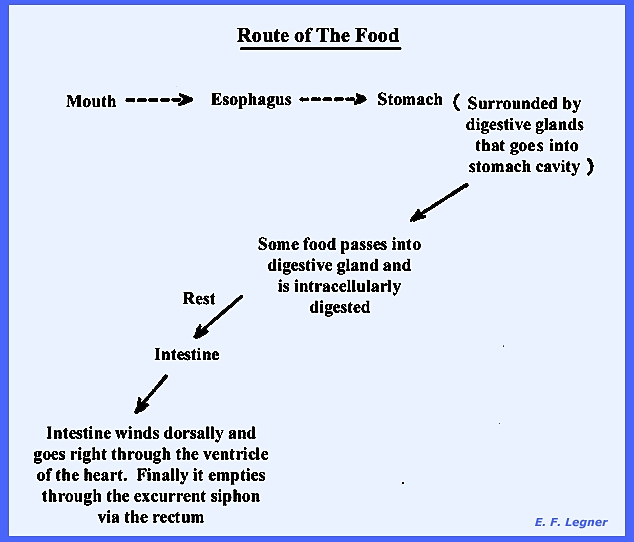
the digestive tract is also by means of the cilia. The route the food takes is shown
in the following diagram:
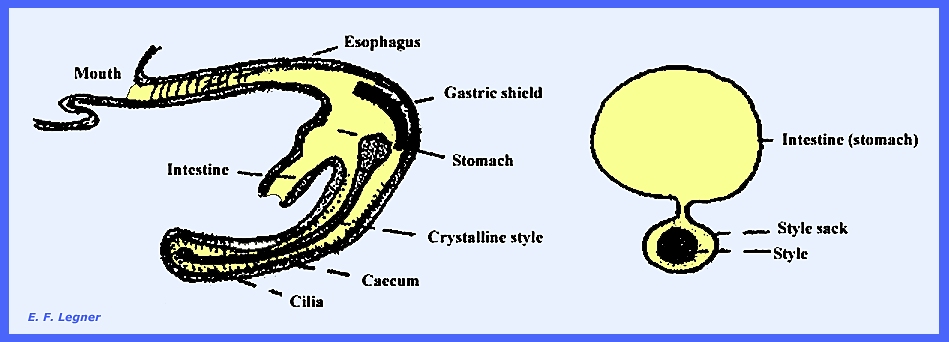
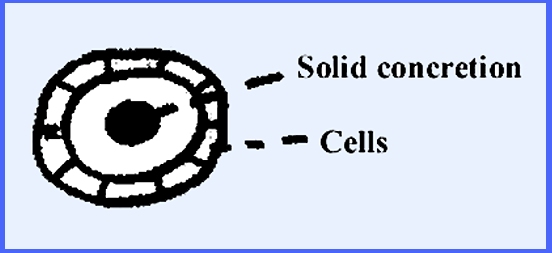
A crystalline
style
of gelatinous
consistency is present, which is constantly being rotated and pushed forward
up into the stomach. It abrades
against a horny pad in the stomach known as the gastric
shield. The style contains the enzyme amylase.
Circulation.--
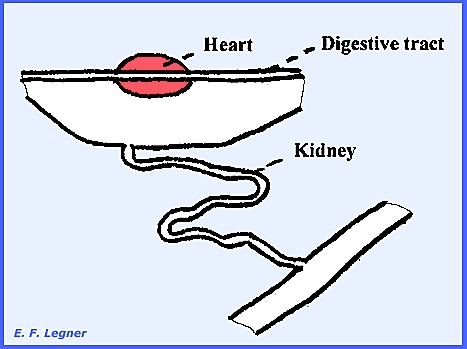
The heart has one ventricle and there are two auricles on either side. There are an anterior and a posterior
aorta. The vena
cava is
a short vessel that leads to the kidney.
Here the blood is collected and goes to the gills. Then it ends up at the auricles of the
heart again. The aortas divide and
end in blood sinuses or spaces left between the muscle and connective
tissue. This is strictly a percolation or
open circulatory system and
there are no capillaries. The blood
is colorless in most species. There
are a few examples of where haemoglobin is dissolved in the plasma and
hemocyanin may also occur. Respiration.--
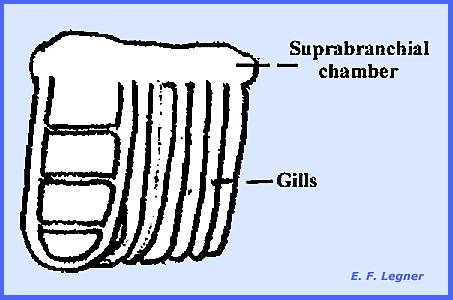
The gills consist of U-shaped tubes.
Blood circulates through the tubes and between them. Water circulates on the outside of the
tubes. Water flows through the gills and
moves up to the suprabranchial
chamber. Also food sticks to the surface of gills
whence it is moved by cilia to the mouth.
Excretion.--
One pair of kidneys lies immediately
ventral to the pericardial cavity.
These are essentially a nephridium since they lead from the coelom to
the outside.
Motion
& Locomotion.-- These animals plow
through the substrate by muscular movements of the foot, and some species are
especially active. The retractor
muscle pulls the body after the foot.
Blood enters and leaves the foot in a swelling and reduction process. Sense
Organs.-- In the roof of the
incurrent siphon there is an osphradium or
water
tester. One pair of statocysts located in the
interior of the foot is built on the same plan as those of the Cnidaria.
Numerous sensory cells occur all over the body, and the siphons
and edges of the mantle are especially sensitive. Nervous
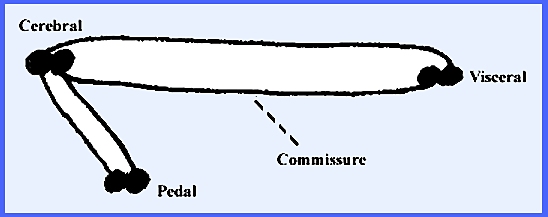
System.-- There are one pair
of cerebral ganglia, posterior or visceral ganglia
and pedal ganglia
in the foot.
Reproduction.--
Considering Anodonta spp,
freshwater clams, the sexes are separate.
Two gonads are diffuse, and ducts from them open into the suprabranchial
chamber. Sperm leave the body through the excurrent
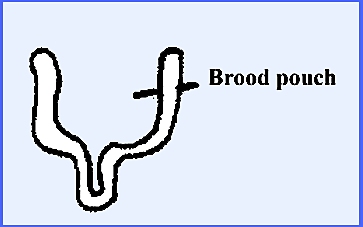
siphon. Eggs are carried into the suprabranchial
chamber but they become lodged in the gills in a brood
pouch.
Sperm enter the body of the female
and pass to the brood pouch where they fertilize eggs. Early development of the egg occurs in the
brood pouch producing the glochidium. Glochidia leave the body of the female via
the excurrent
siphon and become attached to
gills of fish where they complete their development. This involves a slow metamorphosis to the
adult. At maturity the glochidia
hatch out of cysts on the fish gills and fall to the bottom of the body of
water as small adults. Characteristics of
the marine clam Genera Vanus, Teredo and Pecten as follows: There is much variation in the
foot, siphon life cycle and muscles.
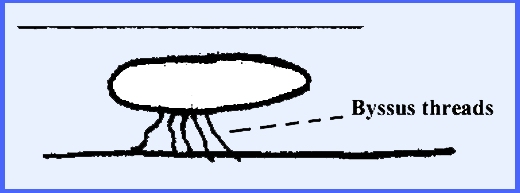
Some species have only an adductor muscle. Some like the oyster become sessile and secrete a shelly layer
to the substrate. Some secrete byssus
threads
to the substrate (e.g. black
mussel).
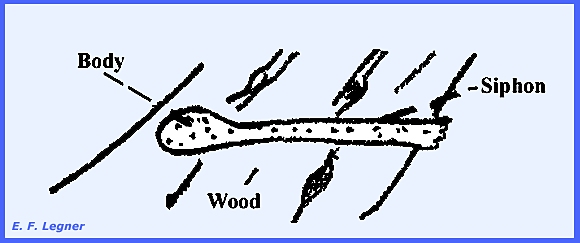
Shipworms of
the genus Teredo bore into wood and are able to digest
cellulose.
Scallops of
the genus Pecten are swimming
clams
where movement is
accomplished by clapping the valves together. Jets of water on the end opposite to the shell aperture push
the clam ahead. Blue eyes are present
on flanges of the mantle. Reproduction.--
This compares with freshwater forms.
The sexes are mostly separate.
Protandry
or "first
males" exists. All oysters are males at first and later
they become females. Sexes
may alternate from season to
season. Some freshwater clams such as
Sphaerium
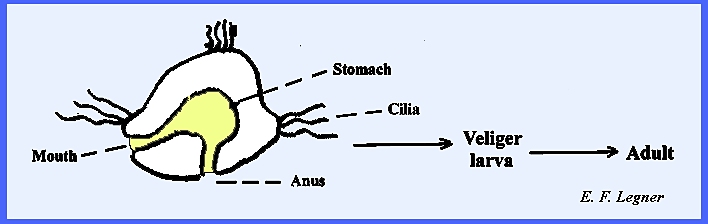
and Pisidium are also hermaphroditic and viviparous. Eggs and sperm are dumped into the
open sea. Fertilization forms the trochophore
larva. The Veliger larva possesses
a shell and more elaborate ciliature.
Economic
Importance of Pelecypoda.-- Oysters, clams and
scallops are a major source of human food.
The shells of freshwater clams particularly have been used for
buttons. Pearls are secretions of the
mantle around an irritant of calcium carbonate and are usually found in some
oyster species. ------------------------------------ Please see
following plates for Example Structures of the Pelecypoda: Plate
47 = Phylum: Mollusca: Pelecypoda: Venus
sp. Plate
48 = Phylum: Mollusca: Pelecypoda: Ostea,
Pecten, Ensis, Mytilus, Maja, Teredo spp. Plate 108 = Phylum: Mollusca, Class: Pelecypoda
-- Sculpturing on shell surfaces Plate 111 = Phylum: Mollusca, Class: Pelecypoda
-- Shells of various genera ------------------------------------ The Class Gastropoda, meaning, "stomach-foot",
includes the snails
and slugs. The shell is univalve and almost always
coiled. They have a flat, sole-like,
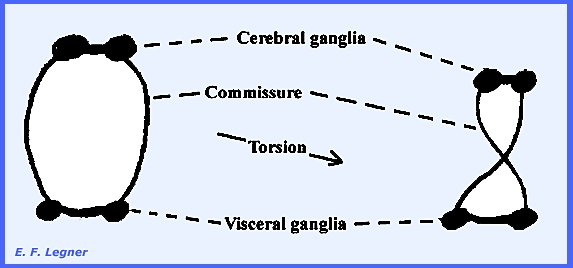
creeping foot and a well-developed head with sense organs. The mantle lines the shell. There is a twisting of the internal organs
called torsion. The majority of species are marine, but
many freshwater and terrestrial snails exist. There is a tremendous variation in
size, shape and sculpturing of the shell and also in reduction of the
shell. The mantle in addition to
secreting the shell also is especially modified to form a siphon on the left
side of the animal. A respiratory
chamber is formed, and the mantle is capable of being inflated in some
tropical snails, which results in a high polish on the outside of the shell. The foot is also subject to
modification. This is a wing-like
structure developed for swimming. The
operculum on the foot is for closing the shell like a door (e.g., Busycon sp.) The internal anatomy is largely
variable in the degree of torsion, where all organs in the visceral mass are
involved. The evolutionary trend is
toward the loss of paired structures, as there is only one gonad, kidney,
etc. resulting from the loss of one of the pair through atrophy. Larval stages are present in
marine snails. The trochophore larval
stage is always passed through in the egg and these hatch as veliger larvae
only, which have already undergone torsion.
The entire larval stages may be passed in the egg. Economic
Importance.-- Abalone,
snails, etc. have been important food sources for humans. Some species such as the oyster drill,
slugs and terrestrial snails are pests.
Over the centuries the dye Royal Purple was
produced from Mediterranean snails. The Subclass Prosobrachia are
all marine animals with seprate sexes.
They have twisted nerve cords and a gill located anterior to the
heart. Torsion of the shell is very
prominent. And a veliger larva occurs
during development. The Subgroup Opisthobranchia are
all marine and have many bizarre forms.
They are hermaphroditic and have straight nerve cords. The gill is located behind the heart, and
there is a veliger larva. The Subgroup Pulmonata have
both freshwater and terrestrial species.
They are hermaphroditic and the ganglia are clumped around the
esophagus. Thre is no gill but a lung
chamber instead. Development is
direct. Example Genus is Helix. ------------------------------------ An example animal is Helix pomatia, the vineyard snail: Habitat.--
The species is found in vineyards and gardens. Body Plan.-- It has a
coiled shell lined by the mantle that holds most of the viscera. The foot has a flat sole and the head
bears two pairs of tentacles. The
eyes are located on the tips of long tentacles. The mouth is ventral to the first pair of tentacles. The anus is situated on the right hand
side of the body and thee is one opening into the mantle cavity. Body
Wall.-- As in the clam there is an epidermis and
mixed muscle and connective tissue. Food & Digestion.--
Snails are active feeders in contrast to the passiveness of clams. A buccal mass is
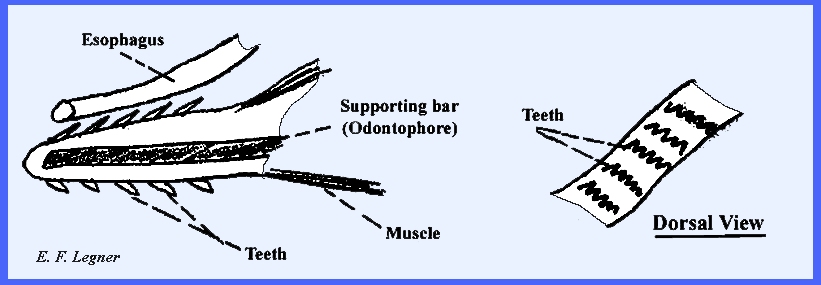
housed inside the proboscis, which can be protruded through the mouth. The radula is
a horny, rasping ribbon of chitin. A
cartilaginous bar, odontophore, is a
supporting structure. Muscles, and
esophagus and a stomach are also present.
Salivary glands are located on the
sides of the stomach. A coiled
intestine opens ultimately at the edge of the mantle on the right hand side. The loop results from torsion. A digestive gland, or liver,
opens into the stomach by several openings.
The food is primarily vegetarian.
Digestion is extra- and intracellular. Movement of the food is by ciliary action and muscular
contractions, but not strictly ciliary as in clams. Circulation.--
The heart has a single ventricle and auricle located on the left hand side of
the mantle cavity. There is an
anterior and a posterior aorta.
Arteries ultimately open out in sinuses between muscle and connective
tissue and movement of the blood is by percolation. The blood is collected from the sinuses and directed into the
vena cava after which it passes through the lung. The lung
is a mantle cavity,
which has become highly vascularized.
From here the blood returns to the ventricle of the heart. Blood is colorless, and has both
hemoglobin and hemocyanin in most species Respiration.--
There are no gills in Helix and
oxygenation is in the lung chamber.
The pneumatopore
is an opening into the
lung and is the only opening into the mantle cavity. Muscles that open and close it allowing
air to enter control it. Some
freshwater snails with lungs conserve air obtained from the water surface, or
they may simply fill the lungs with water that contains oxygen. Excretion.--
There is one kidney near the heart, which is the same as that found in
clams. The route is pericardium to
mantle cavity to outside the body. Locomotion
& Musculature.-- Snails are slow
movers. They creep along on a flat
foot. The columellar
muscle
fastens the animal to
the shell, while the retractor muscle serves
to pull the snail back into the shell.
There are separate muscles for the tentacles, radula, stomach, etc. Sense
Organs.-- The tentacles have
a well-developed eye at their tip.
There is no osphradium. One
pair of statocysts is in the foot and all the rest of the body surface is
highly sensitive. Nervous
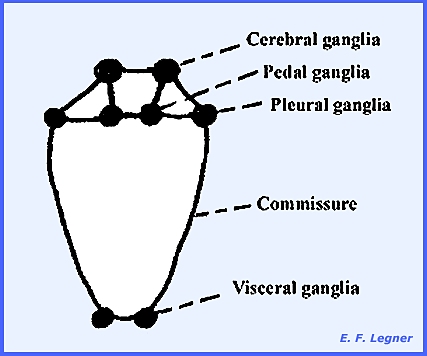
System.-- Modified from that
of the clam the nervous system shows torsion, but in Helix the nerve cords are not completely twisted. A pair of cerebral ganglia is on the sides
of the esophagus, and pedal ganglia are in the foot. There are also visceral
ganglia and pleural
ganglia. All the main ganglia are arranged in a
ring around the esophagus.
In Helix
the anterior location of the nerve cords avoid the torsion field.
Reproduction.--
Helix
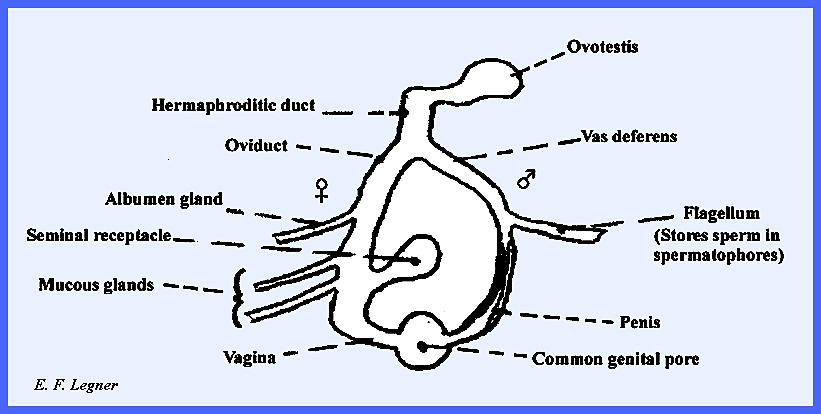
is hermaphroditic. The gonad consists
of a combination of ovary and testes, called the ovotestis,
and there is a joint carrier of eggs and sperm called the hermaphroditic
duct. This duct splits into two sections; one
for the male and the other for the female parts. Later the system will rejoin at the common
genital pore. The female portion consists of an
oviduct, an albumen gland, two mucous
glands, a seminal
receptacle, a vagina and
the common genital pore. The male
portion consists of a vas deferens,
a flagellum, a penis
and the common genital
pore.
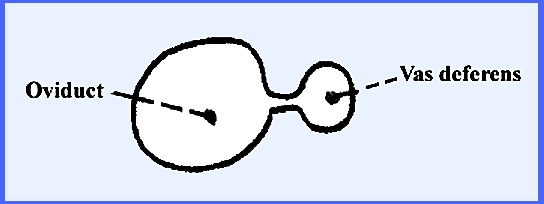
The two systems are actually connected at their proximal
ends (at the oviduct and vas deferens).
Copulation does
occur where an individual assumes one sex at a time. Cross-fertilization usually occurs, but self-fertilization
may also take place. The eggs are
laid with a considerable mass of albumen and they are enclosed in a
calcareous shell. They are deposited
in clusters in the ground or elsewhere.
Development in Helix is
direct and there is no larval stage. Ecology.--
Aestivation is
possible, which enables Helix to combat a combination of heat and
dryness. A mucous membrane is
secreted across the mouth of the shell and the snail can remain inactive for
months. Moisture is the stimulus for
emergence. Hibernation for
up to six months through the cold of winter is also possible in some snails. ------------------------------------ Please see
following plates for Example Structures of the Gastropoda: Plate 110 = Phylum: Mollusca,
Class: Gastropoda -- Shells of various genera ------------------------------------ The Class Cephalopoda, meaning,
"head foot", includes the squids,
cuttlefish,
octopus and
Nautilus. However, a well-developed shell is present
only in Nautilus. In the squid and cuttlefish the shell is
reduced and is located internally. In
the octopus it is completely absent. Tentacles
vary in number from eight in the octopus to 10 in the squid and more than 20
in Nautilus. The giant squid is the largest known
invertebrate that can reach 17 to 20 meters in length with its tentacles
extended. Cuttlefish do not occur in
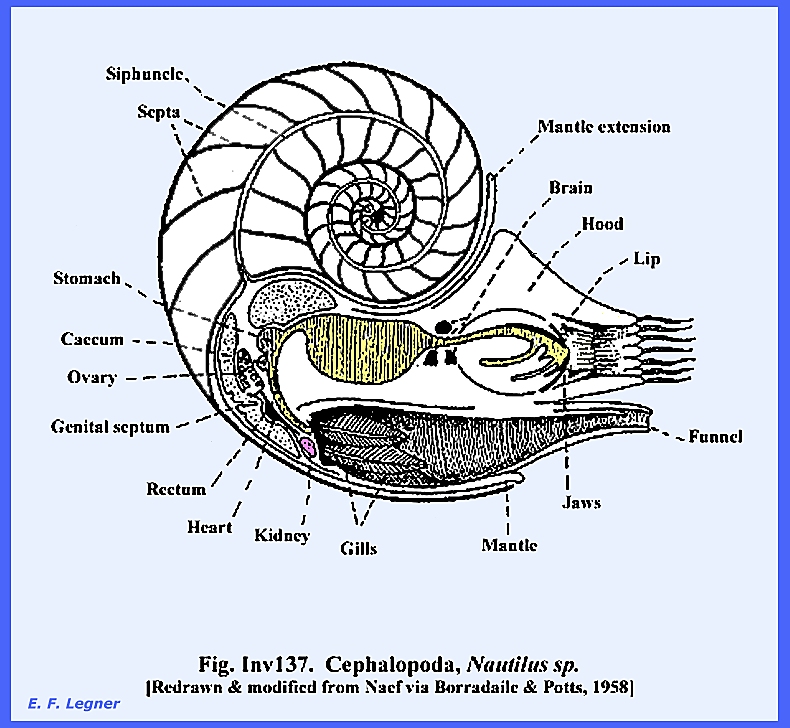
North America. See Inv137 for
example of Nautilus.
There is considerable intelligence
among many members of the Cephalopoda.
Their brain size is especially great in proportion to their total
biomass. Extensive experiments with
cuttlefish have shown them to be quick learners. They also display an array of defensive behavior, which allows
them to change pattern, color and surface texture in accordance with their
environment or other phenomena. Some
Southern Hemispheric species are able to produce a flashing light display of
many colors and luminosity. ------------------------------------ An example animal is Sepia, the cuttlefish. It produces a brown "sepia
dye" in an ink
gland. It is bilaterally symmetrical but
distorted. The foot is displaced
forward and modified into tentacles around the mouth. A jet of water from the mantle cavity can
be ejected through the funnel, which is also
derived from the foot. The funnel has
been erroneously referred to as a siphon.
The mantle encloses the whole body except the head. The shell is reduced or absent except in
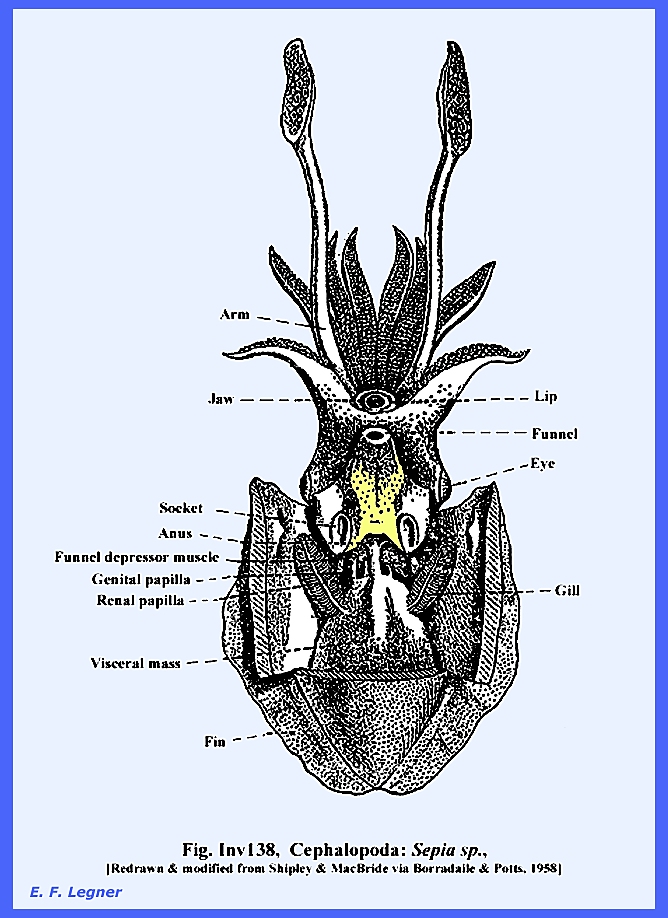
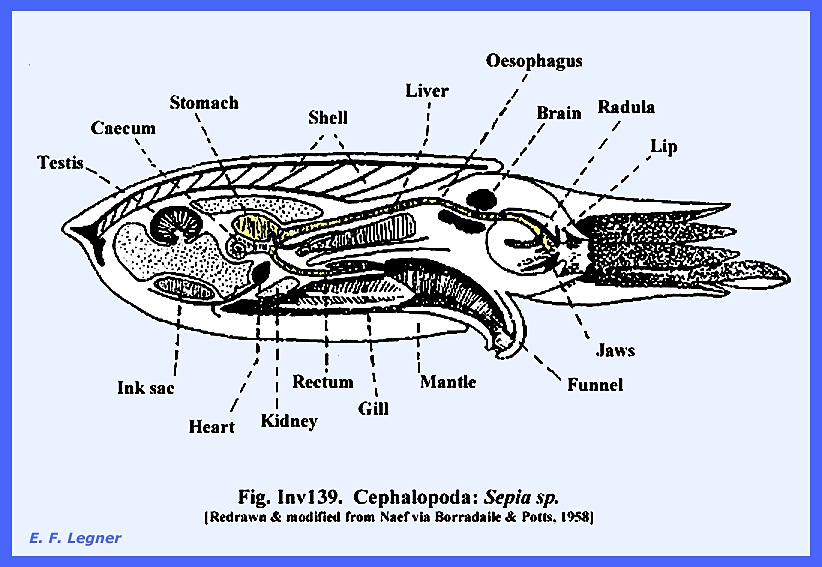
Nautilus, and there is an internal cartilaginous skeleton. The nervous system is highly
developed. See Figures Inv138 & Inv139 for
examples.
------------------------------------
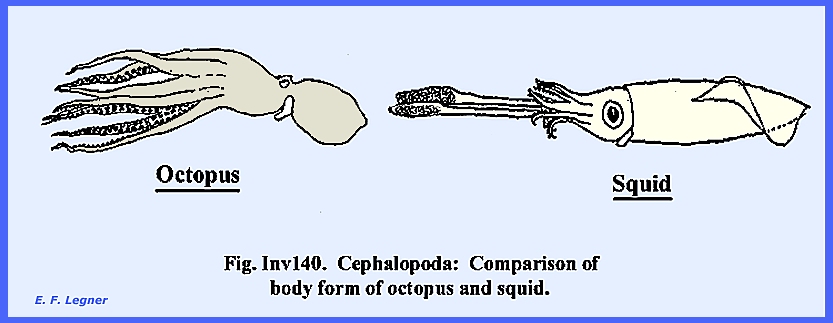
Another example animal is Loligo, the East coast squid. See Inv140 for comparison with octopus.
Habitat.--
Occurs in deep water in winter and shallow water in summer. Body
Plan.-- Similar to Sepia except longer and more streamlined. The ventral end is functionally anterior,
while the dorsal end is functionally posterior. The shell is reduced in size and internal. This is referred to as the "pen"
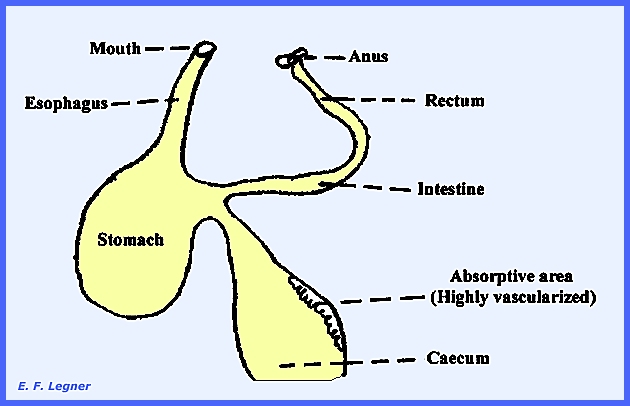
and it is chitinous. Food
& Digestion.-- Fish are the
primary food, which is caught by means of arms and tentacles and held by
suckers. The food is brought to the
mouth. Horny jaws or the "Beak"
tear food into smaller pieces. The
radula grinds up the food into still smaller pieces. Then the esophagus carries food to the
stomach.
Food is mixed with juices from the
liver and pancreas glands in the
stomach. Food as absorbed by an absorptive
surface
on the caecum. Salivary glands occur
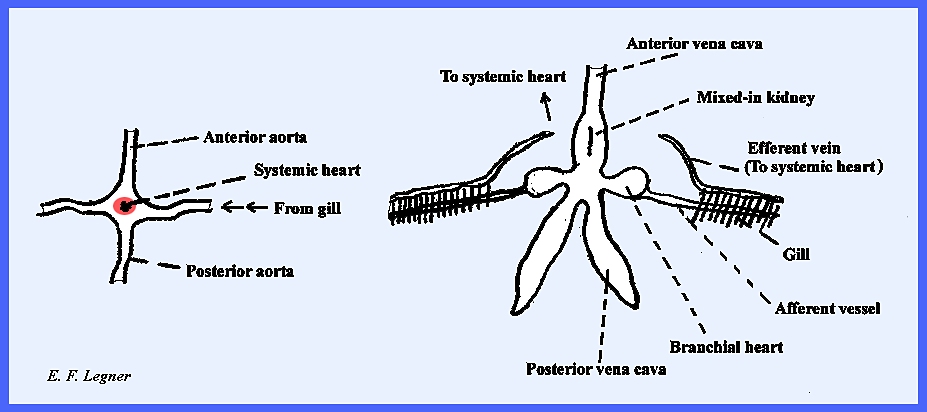
in the head, neck and body and all open into the buccal mass. Circulation.--
Sinuses and capillaries are emptying regions
for the blood arteries (not only the sinuses as in clams and snails). The pericardial cavity is a true
coelom. The blood contains hemocyanin
as well as the metallic element copper. Its color is pale blue when oxygenated and
colorless when reduced. The parts consist of an anterior
and a posterior aorta, veins from gills, a systemic heart, anterior venae
cavae, posterior venae cavae, branchial hearts,
a kidney mixed with anterior vena cava, afferent and efferent vessels to and
from the gills, respectively, etc.
Respiration.--
Two gills serve for respiration. Excretion.--
Two kidneys with nephridiopores,
which open into the mantle cavity directly. Support
& Protection.-- The pen serves to
support the animal, and there are cartilages throughout the body but best
developed in the head. There is a
heavy muscular mantle. These animals
have a remarkable ability to change color and patterns with that of their
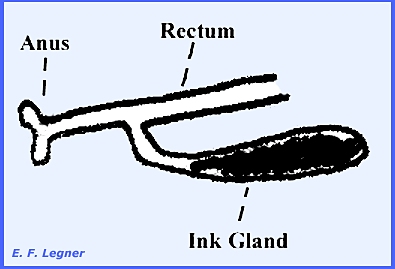
environment, and thus become less obvious to predators. The ink gland is a protective
structure that is derived from a diverticulum off of the posterior part of
the rectum. It is divided into a
glandular and a storage section. The
ink functions not as a coloring fluid, bur rather as an anesthetic to the
sense organs of predators. Some
species also are extremely poisonous if consumed.
Motion
& Locomotion.-- Rapid movement may
be attained by jet propulsion. A current of water is squirted out thru
the funnel, often referred to as the siphon.
The name "funnel" is preferred because it is not derived
from the mantle but from the foot. Flapping of the fins also allows
for a slow gliding motion. Sense
Organs.-- The eyes consist
of a sclerotic coat and rest in a socket.
A corollary coat is pigmented; there is a corona and an anterior
chamber, an iris, a lens, a posterior chamber and a retina. This differs from the vertebrate eye as the
nerves enter at the rear of the retina and there is no
blind spot. The anterior chamber contains salt water
and no aqueous humour. Olfactory slits are present, but
their function has been in doubt. Statocysts
and the general body surface are sensitive. Nervous
System.-- Concentrated in a
ring around the esophagus are the various ganglia all in a single mass. Star-shaped stellate ganglia are on each
side where the mantle is attached.
These control contraction of the mantle, which in turn regulates the
funnel and other structures actively. Reproduction.--
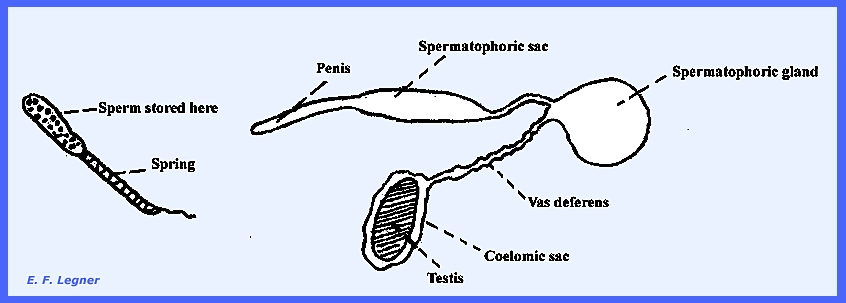
Males have a single testis, which lies in a sac that is a part of the
coelom. The vas deferens is connected
with the wall of the sac and not to the testes directly. There is a spermatophoric
gland, a spermatophoric
sac, and a penis. Sperm are stored in a spermatophore
(shown at left side of diagram below).
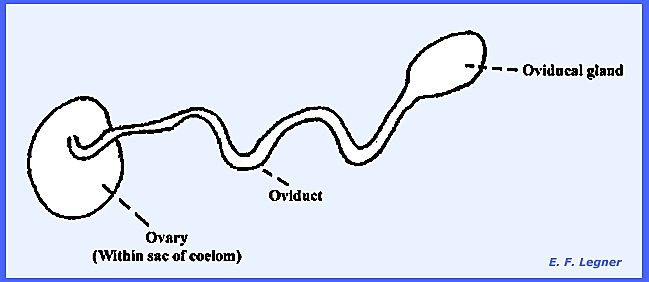
The female's ovary is located in a
sac of the coelom. There is an
oviduct, oviducal gland and nidamental
glands, the latter secreting
the egg cases.
During copulation the male reaches
down inside his mantle cavity with specialized tentacles to pick up a mass of
spermatophores, which he subsequently transfers to the mantle cavity of the
female. After fertilization a case is
secreted around the egg by the nidamental gland. Eggs may be brooded by female octopie. Development is direct, and there is no
larval stage. Economic
Importance.-- Cephalopods are
used for human food, fish bait in saltwater fishing, sepia dye and cuttlebone
for caged birds, especially canaries. ------------------------------------ Please see
following plates for Example Structures of the Cephalopoda: Plate 50 = Phylum: Mollusca: Cephalopoda: Loligo sp. -- General Morphology Plate 51 = Phylum: Mollusca: Cephalopoda: Loligo sp. -- Venous System Plate 52 = Phylum: Mollusca: Cephalopoda: Loligo sp. -- Arterial & Digestive
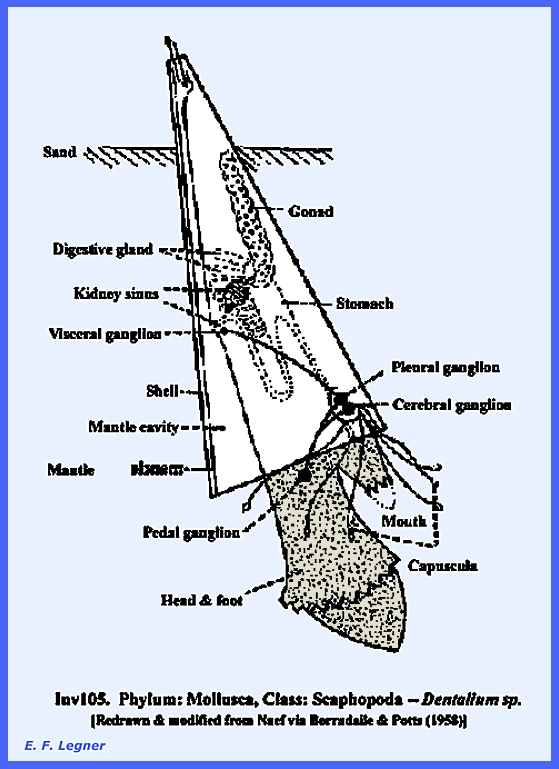
Systems ------------------------------------ The Class Scaphopoda has a body plan that is
bilaterally symmetrical and the shell is open at both ends. The head is without sense organs but may
bear exrtensible filaments called captacula. The foot is modified for digging.
The circulatory system is
simplified and there is no heart.
Respiration is by the mantle and there are no gills. Two kidneys that do not open into the perivisceral
coelom are involved in
excretion. The nervous system has separate
cerebral and pleural ganglia. For reproduction the gonad
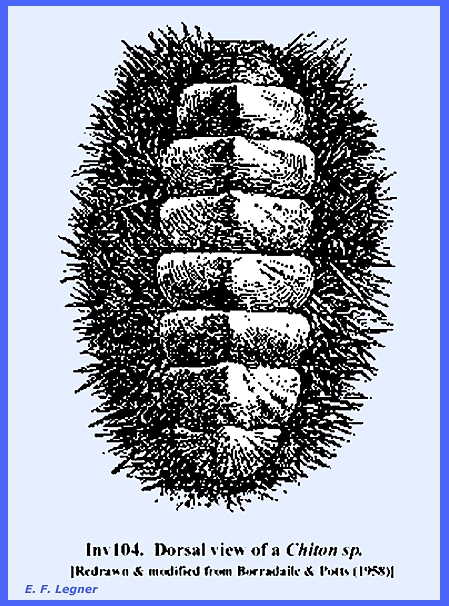
discharges into the right kidney, and there is a trochophore larva. ------------------------------------ The Class Amphineura
includes the chitons. Their body plan is bilaterally
symmetrical. The mouth and anus are
located at opposite ends. The head is
without tentacles or eyes. There are
a continuous series of shells dorsally located, and there is a flattened
foot.
Primitive gills serve for
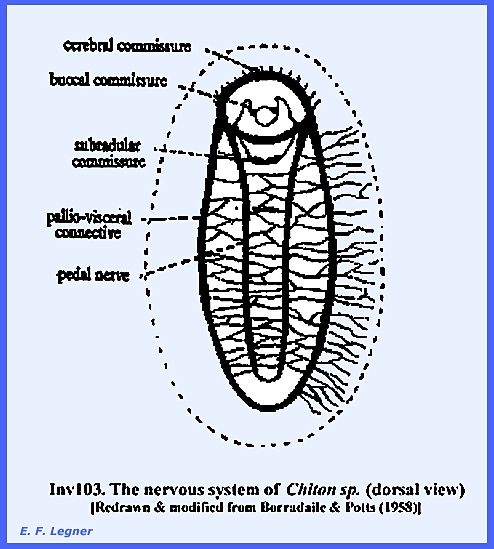
respiration. The nervous system also
is very primitive. For reproduction
some species have a trochophore larva.
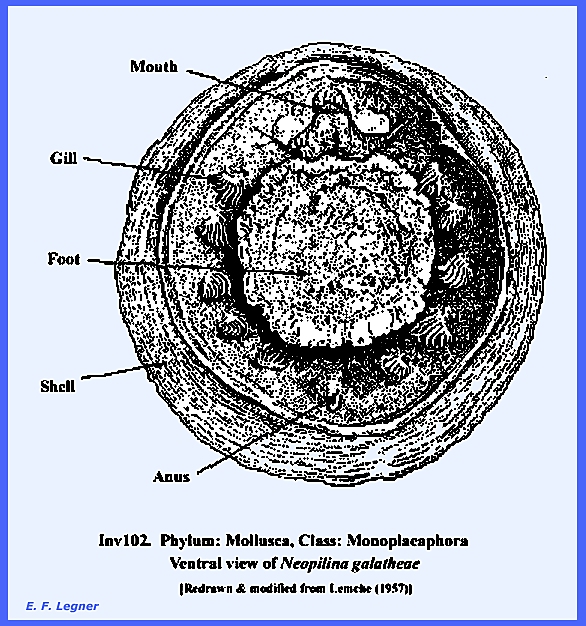
------------------------------------ Please see
following plates for Example Structures of the Amphineura: Plate 109 = Phylum: Mollusca, Class: Amphineura
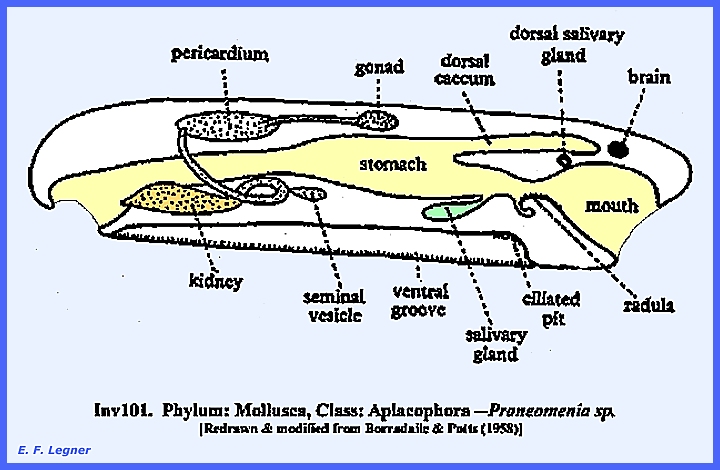
-- Ventral view of Neopilina galathecae ------------------------------------ Class Aplacophora
are worm-like animals
where the food is absent or represented by a median ridge in a groove on the
ventral side. The mantle is enlarged
and there are no shell plates by only spicules. A tiny cloacal chamber at the posterior end may represent the
mantle cavity. Gills may be either
present or absent. These are simplified Mollusca that
have many characteristics of worms but may be distinguished from the Annelida
by not having segmentation and possessing a Mollusca type of coelom. A radula is present in some species. Further information may be obtained from
Borradaile & Potts (1958).
------------------------------------ Class: Monoplacophora
are bilaterally symmetrical with internal metamerism. One solitary shell covers the pallium that
extends over the dorsum. The anus is
located in the medial posterior area.
They have well developed coelomic cavities The paired auricles deliver blood
to two symmetrical long ventricles located on either side of the
intestine. Nephridia emanate from
coelomic sacs and op0en on the surface in the palial furrow. The gonads are symmetrical and open
through the nephridia. The nervous
system is very primitive. Sexes are
separate. The animals occur at great depths
(3,500+ meters) in the ocean, one specimen having been found off the west
coast of Mexico. Further information
may be obtained from Borradaile & Potts (1958).
------------------------------------ Classes Caudofoveata,
Helcionelloida (extinct class) and Rostroconchia (extinct class) will not be
treated in this section at this time. ------------------------------------ Please see
following plates for Example Structures of the Mollusca: Plate 107 = Phylum: Mollusca -- Example stomach
with grooves for guiding food ============== |