File: <scotogam.htm> <Migrations Index> <Bronze Age Index> <Archeology
Index> <Home>
[Note: All Basque words are in Italics and Bold-faced Green]
|
SCOTLAND’S OGAM INSCRIPTIONS * A review derived from the following: Nyland, Edo. 2001. Linguistic Archaeology: AnIntroduction. Trafford Publ., Victoria, B.C., Canada. ISBN 1-55212-668-4. 541 p. ----Please CLICK on desired underlined categories [to
search for Subject
Matter, depress Ctrl/F ]:
An ancient language form that
originated in the sub-Saharan West African area of our most ancient
civilizations has been studied by Nyland (2001). He found that many words used to describe names
of places and things in Scotland were closely related to the ancient
language, which Nyland called Saharan,
and which later was predated by the Igbo Language of West Africa. Fortuitously, the Basque Language is
a close relative to the original Saharan. Following is a discussion of this relationship: In his book
"The
Symbol Stones of Scotland" (1984), Dr. Anthony Jackson, anthropologist at the University of Edinburgh,
illustrated and transliterated more than thirty Ogam inscriptions found in
Scotland and found that the best of efforts by linguists and others had not
resulted in even one translation. There had been few problems transliterating
them, but no one had been able to do anything with the
"meaningless" series of letters obtained. In October of 1993, Jackson followed
this work with an unpublished monograph called "Pictish Symbol
Stones?" in which he updated his earlier research.
Probably referring to efforts of Henri Guiter, Jackson wrote, "There is a popular theory that they
are Basque but this does not work either" (p.118). Jackson also
commented: "It is
curious that this small number of Ogam inscriptions has caused more headaches
than all the other problems of the Picts put together. As one leading
archaeologist put it: it is not really the fault of the Picts but the
interpreters of the Picts that are to blame! (p. 117). This remark was
so true by Nyland (2001), but Jackson
decided to give up entirely on translating the puzzling writings. He wrote: "All research along
linguistic lines has ground to a halt, unsurprisingly" (p.135) and:
"It is clear that the Ogam inscriptions are numerically based and not
linguistic" (p.153). In other
words he thought they were numerical magic, possibly a form of numerology,
inscribed on the ancient standing stones to overcome the pre-Christian magic:
"thus we seem to have a battle between rival magics" (p. 154). Edo
Nyland agreed with his suggestion that magic is involved, because the
inscriptions are so complicated in design that it is hard to believe that
they were intended to be read by the common people or even by most of the
clergy; they belonged to a very different level of theology. In 1968 a Basque scholar from France,
Henri Guiter, thought he could see Basque words in the transliterated
inscriptions and tried to make sense of some of them. He published two papers
in French, which received mixed reviews such as from Oliver
Padel who could not find the first paper, but
"if one is to judge by the information supplied in the second, this is
no great loss". Another person who criticized Guiter was Douglas
Gifford, Dept. of Spanish of St. Andrew’s University in Scotland. In a 1969
radio talk, he said that Guiter had twisted the evidence, but also suggested
that the Basque connection was worth a further look. Nyland then took this
‘further look’ and decided to include Guiter’s work in this article because
his approach was so very different from anyone else’s. The reader will see
that his translations appear to make little sense. The people who composed
the inscriptions were a great deal more sophisticated linguistically and
mathematically than our modern scholars have ever given them credit for.
Guiter’s effort had also been published in Spanish in a booklet called
"Garaldea" by Federico Krutwig and the Spanish translations of Guiter’s effort are shown
here. Dr. Gifford’s
suggestion that Basque could well be the language of the Ogam inscriptions
was supported by genetic and linguistic evidence in Ireland and Scotland.
Geneticist Dr. Cavalli-Sforza from Stanford University had published a world
map in Scientific American (Nov. 1991), showing the distribution of the
Rh-negative people. The populations with the highest proportion of their
members with Rh-negative blood were found among the Berbers
in Morocco, the Basques in Euskadi, and the dark featured peoples of Northern
Ireland and Scotland, all with over 25% of the people with this blood
peculiarity. He commented "... the resulting pattern roughly coincides
with anthropological reconstructions of ancient migrations." Of these
four groups, only the Basques still spoke their pre-Christian language. It
was therefore reasonable to suggest that the entire migration had spoken this
language. This possibility was crying out for proof. Fortunately a very large
number of early inscriptions on stone, silver, brass, bone etc. were
available; over 600 in Ireland and some 40 in Scotland. None of these
inscriptions had ever been translated with certainty. Transliteration from
the Ogam script had not been a problem, but only an apparently meaningless
series of letters, mostly consonants, had been obtained. However, as
considerable time and effort must have gone into making these
inscriptions. Edo Nyland assumed that
some system of decoding had to exist. [= Vowel Consonant Vowel ] From the moment
that Edo Nyland tackled the problem, it appeared likely that most of the
vowels had been removed for some good reason, based on a certain pattern.
After a great deal of experimentation, it was found that the basic pattern
had to have been VCVCVCV etc. This letter-pattern looked strikingly like that
of thousands of Basque words such as: "ohitura" (custom).
But, Basque being an agglutinated language, this word in itself was composed
of three other roots, ohi-itu-ura: ohi (habit) itungaitz (disagreeable) urratu (to break), meaning: "Break that disagreeable habit", creating a
VCV-VCV-VCV pattern. In addition, the vowels on either side of the hyphens
were always the same, completing the formula: VCV1-V1CV2-V2CV3-V3CV
etc. Nyland called this the "vowel-interlocking" or "VCV Formula".
Trial and error proved that this was indeed the formula used in every Ogam
inscription examined to date, without exception. For more examples, see "The Saharan Language". Searching for
linguistic evidence of Basque in the family and geographical names of these
countries, in Scotland many family names immediately stood out, e.g: MacKenzie, kentze is the act of
depriving, of taking away, to steal from, probably referring to territory.
The MacKenzie tribe was therefore known by their neighbours as the people who
had conquered or taken something that didn’t belong to them.
it easy".
THE SYSTEM OF
ENCODING AN OGAM INSCRIPTION Procedures for encoding
and decoding Ogam inscriptions were presented by Nyland (2001). 1). In the sentence to be inscribed, use only
those Basque words that start with vowel-consonant- vowel (VCV).
VCV1- V1CV2-V2CV3-etc.
system of prime numbers. (See Jackson
1993, pages 117 - 152).
1) Restore
the original letters: V becomes B, C and Q become K.
placing dots where
vowels were removed. In case of double vowels, an H has usually been removed. Keep in
mind that every consonant represents a word.
therefore starts
with CV.
<Translating Ogam >, and select the words that form
the appropriate sentence. In this section,
all three interpretations by Guiter, Jackson and Nyland
are brought together for each of the inscriptions . Let the reader be the judge. The order in which the
inscriptions are presented is taken from Jackson’s 1993 publication "Pictish
Symbol Stones?” The transliteration used is also taken from Jackson
because his interpretation is superior to any other efforts. Translating Ogam
is certainly no exact science, it is only the best possible approximation. It
may well be that some of the inscriptions were designed to be magical, yet
when they were finally translated, most made good sense from the standpoint
of evangelizing a "heathen" country. Two of the larger
inscriptions, Brodie B and Golspie, in spite of several hours of work, have
so far resisted the decoding process. Some like Altyre and Cille Barra
describe natural disasters that do not refer to evangelism. Aboyne B and
Altyre are grave markers. Strictly adhering to the vowel interlocking between
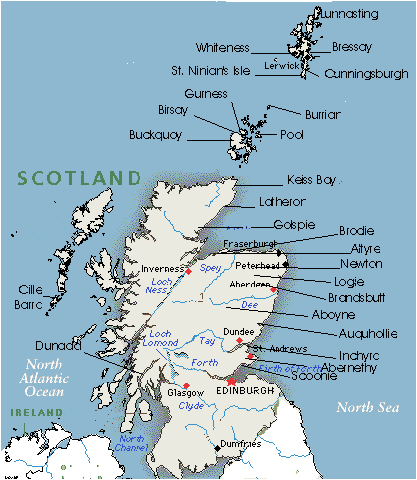
the VCV roots is the key to decoding the inscriptions. Map
showing the location of the following inscriptions.
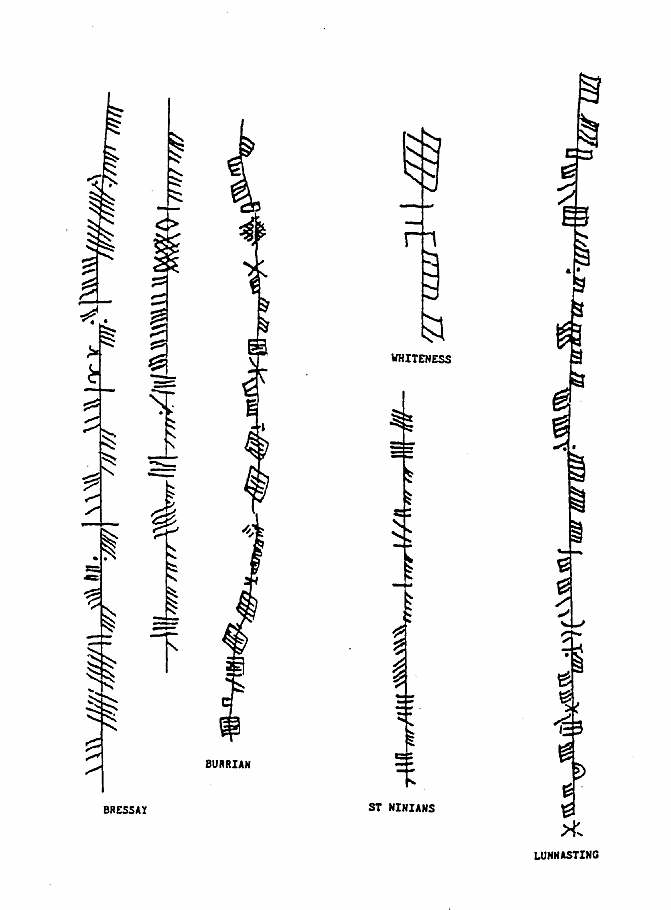
BRESSAY. A) CRROSCC- B) NAHHTVVDDADD -
C) DATTRR - Guiter: Basque reading: Berriz Enekoaren Kroska naiz Udak daragina.
Jackson: A) 28 7x4 75 5x5x3 Nyland:
B: NAHHTBBDDADDS
C: DATTRR
D: ANNBENNISES
The disciples, as well as the flock (Mark 14:50), in general
weakness were mocking during that moment of tribulation (Mark 15:17-20) E: MEOODDRROANN
BURRIAN. IDBMIRRHANNURRAC TEEVVCERROCCS Guiter:
Basque reading: Don kuorari añu(ti)ra dan kerroke.
Nyland: IDBMIRRHANNURRAKTEEBBKERROKKS
WHITENESS. VNDAR Guiter: No reading. Nyland: BNDAR.
LUNNASTING. A) ETTECUHETTS - B) AHEHHTTANNN - C)
HCCVVEVV - D) NEHHTONN Guiter: Basque reading: Etxekoez aiekoan nahigabe ba nengoen.
Jackson: A 36 6x6 140 7x5x2
Nyland: A: ETTEKUHETTS et. eta etariko
one of our group
B: AHEHHTTANNN ahe aihe aiher
full of anger
C: HKKBBEBB .h.
aha
ahal
I wish
D: NEHHTONN. ne ne nebarrebak
brothers and sisters
The place name Lunnasting itself is
interesting:
ST. NINIANS. BESMEQQNANAMMOVVVEZ Guiter: Basque
reading: Eneko ba nago bez.
Jackson: 54 6x9 172 43x4 Nyland: BESMEKKNANAMMOBBEZ .be be bedeinkagarri blessed one
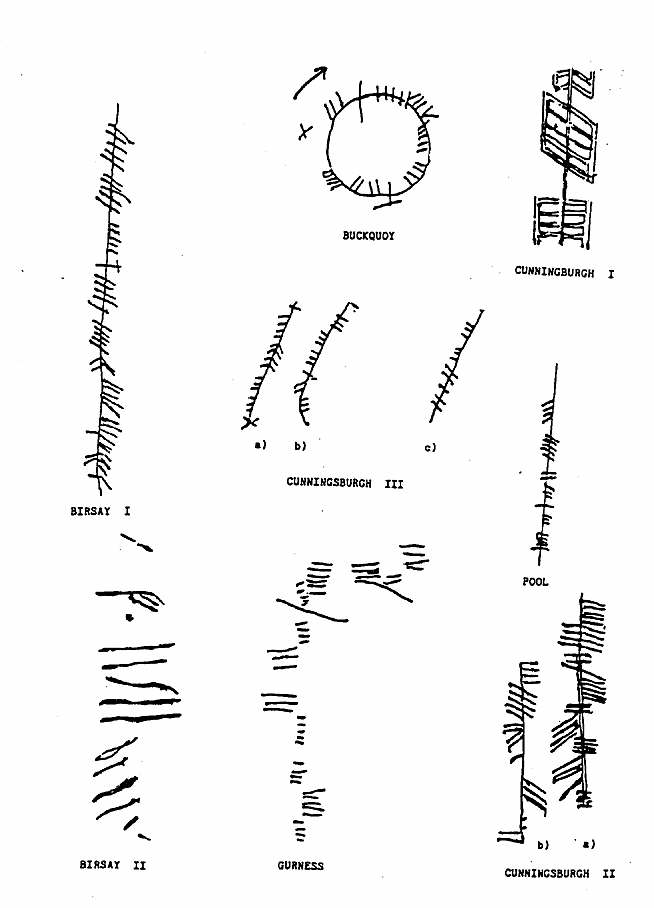
BIRSAY. 1) MBOLMVNORRALVRR - 2) BQIAB Guiter: Basque reading: None. Jackson: 43 prime 170 5x2x17 Nyland: Birsay 1) MBOLMVNORRALBRR m. ma maisu
teacher
despised cross. Birsay 2) BKIAB .b. be bedeinkagarri the blessed one
BUCKQUOY. ETMIQMSSALLC Guiter: Basque reading: None. Jackson: 36 6x6 135 5x3x3x3 Nyland: ETMIKMSSALLIK et. eti etika
ethics
CUNNINGSBURGH. 1) IRO - 2a) EHTECONMORS - 2b)
DOVHDDRS - 3a) ETTECA - 3b) VDATTVB 3c) RTT Guiter: Basque reading A few individual
words only. Jackson: (1): 12 3x440 5x2x4 Nyland: 1: IRO (on stone slab) iro iro irol
privy, outhouse
2a: EHTEKONMORS eh. ehu ehun
hundreds
2b: DOBHDDRS do do doatsutasun happiness
3a: ETTEKA et.
eti
etikoa
ethical
3b: BDATTBB .b.
abe
abegitasun
fondness of
3c: RTT This last
inscription has no identifiable vowel and therefore is not translatable with
the vowel-interlocking method. POOL. RVMVORC Guiter: Basque reading: None. Jackson: 23 prime 75 5x5x3 Nyland: Pool: RBMBORK .r. ara arraro
strange, odd
GURNESS. NEITTEMTOS M0CS Guiter: Basque reading: None. Jackson: 50 5x10 189 7x3x3x3 Nyland: NEITTEMTOSMOKS. .ne ene enekin with me
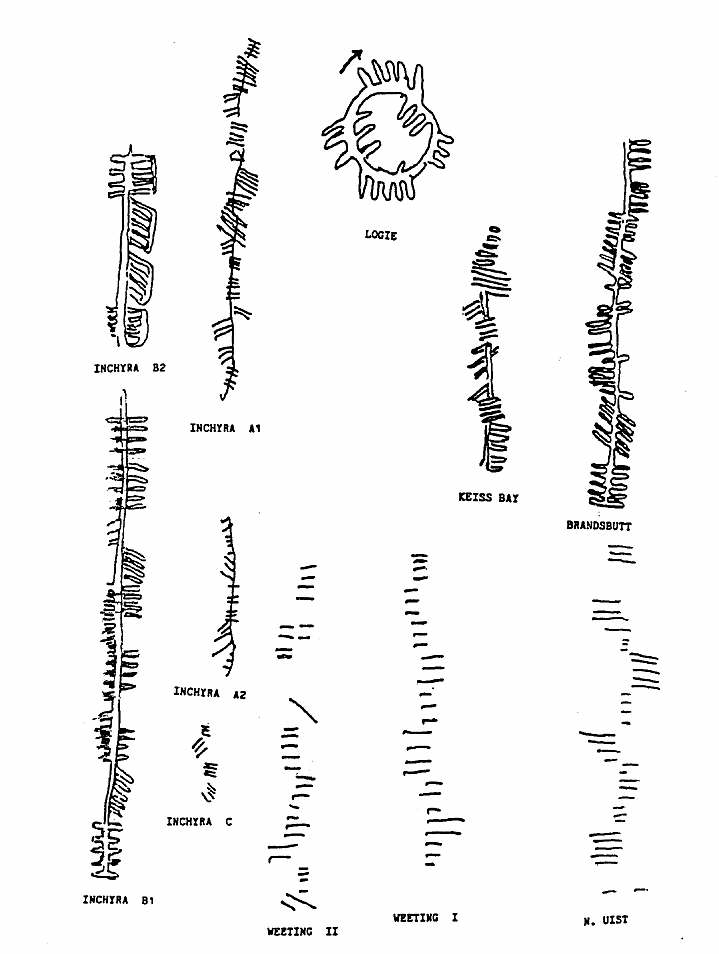
NORTH UIST. H QUNCENTC T Guiter: Basque
reading: Belaskuanuk..ta
Jackson: 37 prime 119 7x17 Nyland: HKUNKENTKT .h. ohi ohitu to get
used to
WEETING. 1) VLVEVVUTE - 2) GEDEVIM DOS Guiter: Basque reading: None. Jackson: 1) 28 7x4 84 7x3x2x2 Nyland: Weeting 1: Jackson: BLBEBBUTE,
Nyland: BLBEBBETE .b. aba abagadune occasion
Weeting 2: GEDEBIMDOS .ge age agerpen
revelation
BRANDSBUTT 8/45. IRATADDOARENS Guiter: Basque
reading: Iratakoaren.
Jackson: 40 5x8 123 3x41 Nyland: IRATADDOARENS (two possible
translations) ira ira irakatsi to preach a sermon
Nyland: IRATADDOARENS
INCHYRA - A1: OOTTLIETRENOIDDORS
Guiter: Basque
reading: Etorkoaren ...holoi...ina otsa utz
diet dinua?
Jackson: A1) 60 5x12 225 5x5x5x3 Nyland: A1: OOTTLIETRENOIDDORS o.o oho ohoregabe dishonored
A2: UHTUOAGED uh. uhe uherdura
confusion
B1: INEHHETESTIE. ine ine inertzia passive,
downtrodden
B2: INNE – in.
ine
inertzia
passive, downtrodden
C: SETU .se ase asetu
to be filled with
KEISS 41/7: NEHTETRI Guiter: Basque
reading: Nauke tagona.
Jackson: 30 5x6 95 5x19 Nyland: NEHTETRI ne
ne negarreztatu grieving
LOGIE
8/5: CALTQU
Guiter: Basque
reading: Kalkakoa
Jackson: 18 6x3 70 5x2x7 Nyland: KALTKU .ka
aka akabu
death
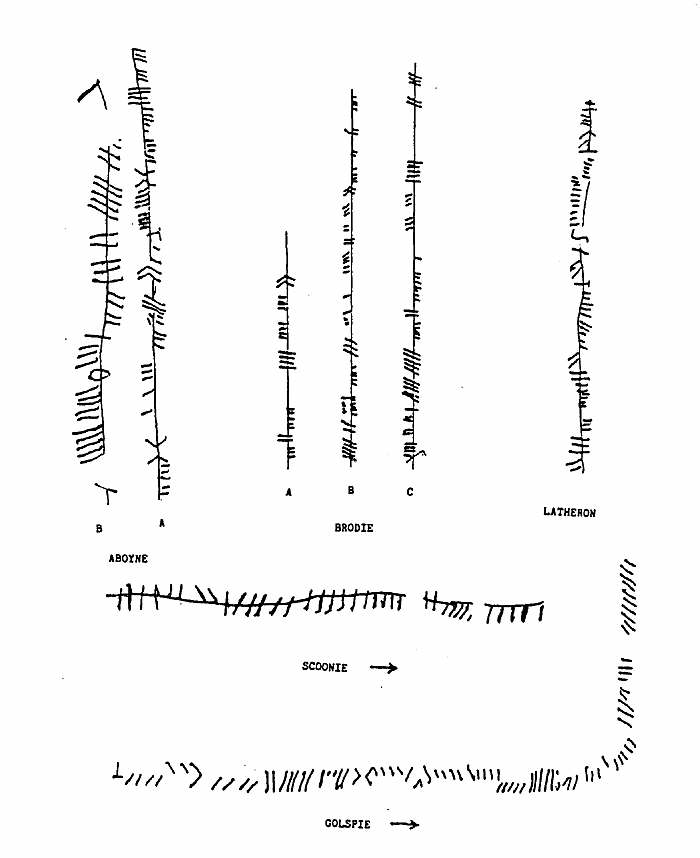
ABOYNE A: NEHHTVROBBACC – ENNEVV ABOYNE B: MAQQOTALLUORR Guiter: Basque
reading: Lemako da lurrpe. Dator doaken enea.
Jackson: A) 59 prime 149 prime Nyland: A) NEHHTBROBBAKK – ENNEBB .ne ene enetan
always
en. ene enetan
always
B: MAKKOTALLUORR. .ma ama ama
mother
BRODIE A 31/5: VONECCO BRODIE B 31/5: RAMINNGCHQODTOSLMBS BRODIE C 31/5: EDDARRNONR TTI Guiter: Basque reading: Idarreko noa doa mokorra erala behar aikaz bedi.Du sutu ocean iasoa lurreko karrak. Ba lo elhurra-be dago, haike,
aikako ibaia du.
Jackson: A) 24 8x3 58 29x2 Nyland: A: BONEKKO. .bo abo aboskatu to
express
B: RAMINNGKHKODTOSLMBS. This fairly long
inscription is a complicated puzzle, which has not yet yielded its secret,
probably because of the difficulties with reading the eroded inscription. C: EDDARRNONR TTI ed. eda edan
to drink
GOLSPIE 17/31: ALLHHALLORREDDMEOO – NUUVALHNRERR Guiter: Basque
reading: Aldalurrekoak hartza lotu zuan.
Jackson: 88 8x11 320 5x8x8 Nyland: This large
inscription looks authentic and should have given up its secrets, but I
didn’t succeed yet in decoding it. LATHERON 40E/41: DUVNODNNATMAOONAHATO Guiter: Basque
reading: Doana da Eneko t’ekaitsua
Jackson: 56 8x7 208 13x4x4 Nyland: DUBNODNNATMAOONAHATO .du edu eduki
to have
SCOONIE -/31: EDDARRNOSN Guiter: Basque
reading: udara zan onsa.
Jackson: 35 5x7 106 53x2 Nyland: EDDARRNOSN ed. ede eder egin to give
pleasure
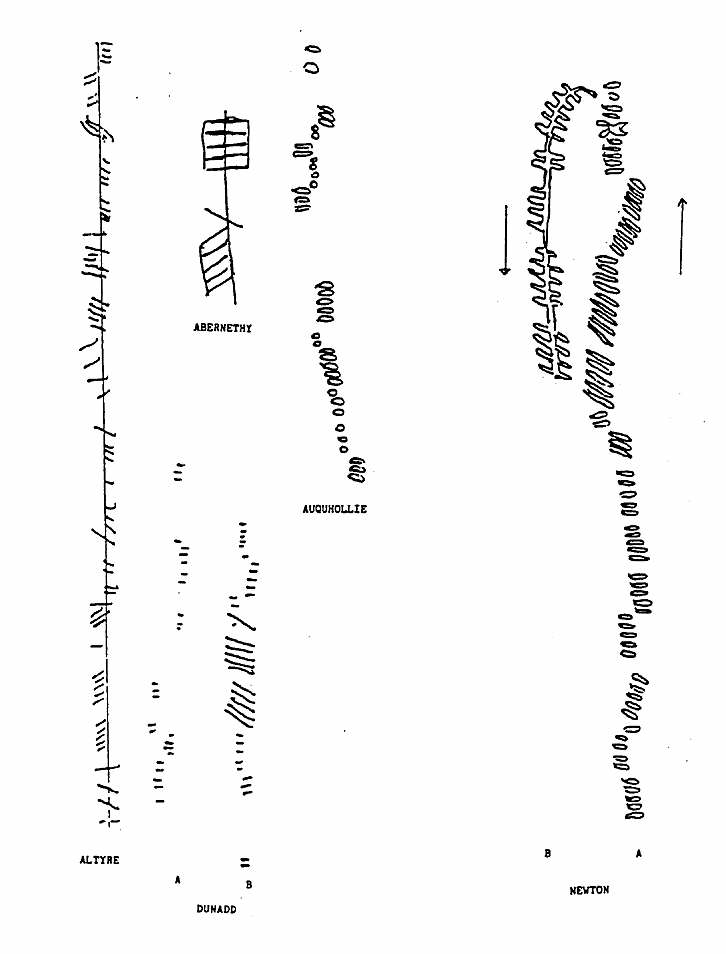
ALTYRE: AMMAQQHTALLMVBVMAA-HHRRASSUDDS Guiter: Basque reading: None. Jackson: 66 11x6 281 prime Nyland: AMMAKKHTALLMBBBMAAHHRRASSUDDS am. ama ama
mother
ABERNETHY: QMI. Guiter: Basque reading: None. Jackson: 11 prime 37 prime Nyland: KMI .k. ika
ikara fears
This is the first translation that appeared. KMI is very short,
doesn’t leave much to work with, and cannot be translated with certainty. AUQUHOLLIE: VUUNON - TEDOV – BB Guiter: Basque
reading: Hila du ileko obiak.
Jackson: 37 prime 138 6x23 Nyland: VUUNON. The
transliteration of this inscription is a problem. Only part makes
sense, the VCV "uno" does not exist and "BB" has no
vowel. (TEDOV) should read: TSOLV .te ate atedanbada knock on the
door
NEWTON: Jackson: A:
IDDARQNNNVORRENNIEUA B: IOSRE
Guiter: Basque
reading: Idarkoari hor Eneko dio zagor.
Jackson: A) 77 7x11 210 7x3x10 Nyland: A: IEARKNNNBDRRENNIEUA i.e ihe ihesleku find
shelter
NEWTON B: IOSRZ i.o iho ihortziri thunder
DUNADD A: AESD - T - V
- LVA – TV DUNADD B: L---VIRRAMDNA Guiter: Basque reading: None. Jackson: A) 29 prime 96 4x4x6 Nyland: A: AESD - T - B - TB. This inscription is too fractured to do
anything with it. B: L — BIRRAMDNAI L ? lagun?
friends?
CILLE BARRA STONE TIRTHURKIRTHUS;INRRISKURSSIARISTA:A This stone was
removed in 1865 from the Cille Barra cemetary (Isle of Barra) and taken to
the Museum of Antiquities in Edinburgh. It was always thought to be a
gravestone, which it obviously is not. The transliteration was copied from a
local tourist pamphlet. The twin islands Barra-Vatersay are the most
southerly populated islands in the Outer Hebrides of Scotland. The inscription
is not found in Jackson’s or Guiter’s writings. TIRTHURKIRTHUS .ti uti utikan! get away
from here!
INRRISKURSSIARISTA:A in. ino inor
everyone Everyone is dismayed,
petrified and overwhelmed to be eye-witness to this shocking flood from the
beginning; to dry up we escaped to this leaky shelter. It must be
pointed out that these are not Pictish Ogams; instead, they are Irish Ogams in Pictland
because they were written by early Irish evangelists who came to Scotland to
convert the Pictish "heathens" to the Irish form of Christianity.
All of the Irish and Scottish Ogam inscriptions that Edo Nyland has translated,
and he has done almost one hundred, are written in the Basque language,
without exception. Many, if not most, geographical and family names of
Ireland and Scotland can also be translated with the Basque dictionary using
the technique demonstrated above. Considering the evidence, it appears
certain that prior to the coming of Roman Catholicism in about 650 A.D., the
Basque language, or an earlier form of it, was spoken as the popular language
of the islands. This language was generally referred to by continental
evangelists as the "Iron
Language", also called Pictish in Scotland
and Cruithin in Ireland. It seems to indicate that the
Basque language hasn’t changed much over the past 1,500 years. Figure 1 Reprinted by permission from Anthony Jackson, ‘Pictish Symbol
Stones ?’ 1993
Figure 2 Reprinted by permission from Anthony Jackson, ‘Pictish Symbol
Stones ?’ 1993
Figure 3. Reprinted by permission from Anthony Jackson, ‘Pictish Symbol
Stones ?’ 1993
Figure 4 Reprinted by permission from Anthony Jackson, ‘Pictish Symbol
Stones ?’ 1993
Figure 5. Reprinted by permission from Anthony Jackson, ‘Pictish Symbol
Stones ?’ 1993
|