File:
<climate.htm> <Migrations Index> <Bronze Age Index> <Archeology Index> <Home>
TEMPERATURE CHANGES ON EARTH
DURING
THE
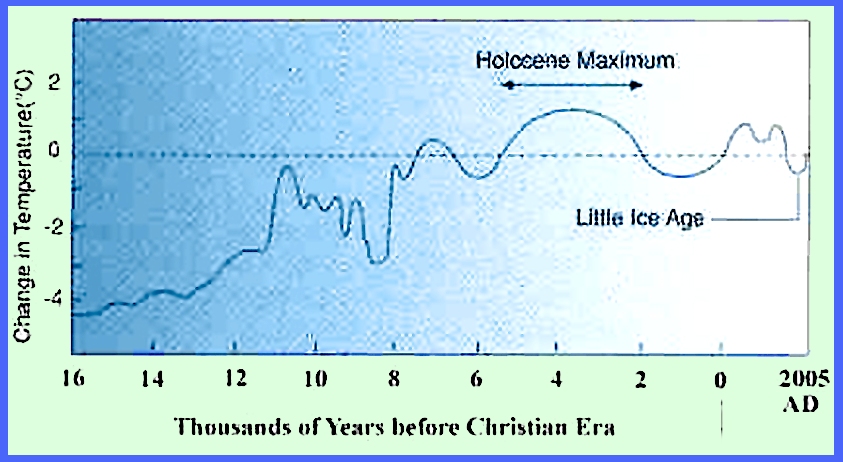
PAST 18,000 YEARS FROM 2005 AD
[Contacts] NOTE: Data obtained from Internet sources and
checked with various
authors for relative accuracy as of 2020 CLICK All
To Enlarge |
|
|
|
|
DATE APROXIMATIONS DISCUSSION REFERENCES
|
80,000 B.C. --------- 80-40,000 B.C. ---- 40,000 B.C. --------- 39,000 B.C. -------- 28,000 B.C. --------- 16,000 B.C. --------- 12,000 B.C. --------- 10,000 B.C. --------- 9,000
B.C. --------- 8,000 B.C. ---------
5,500 - 6,000 B.C.-- 6,000-3,500 B.C.---- 4,000 B.C. ----------- 1,700 B.C. ----------- 1,420
B.C. ----------- 1,290 –1,180 B.C. -- 1,100 B.C. --------
597 A.D. ---------- 600-700 A.D. -----
635 A.D. ---------- c 950-1250
A.D.
---- c 1360-1860
A.D.
---- 1870 – 2020 --- |
Modern humans appear in southern Africa (judged from jewelry
production) Several catastrophic climatic changes decimate human population Small group of modern humans cross Red
Sea to Yemen Artistic cave paintings appear at diverse locations Small carvings of human females appear from Europe through Asia The climate begins to warm Flooding over vast areas of the earth intensifies Development of reliable ocean navigation opened up the world around Mini Ice Age lasts a few
hundred years. Seafarers from Morocco
and northern Spain explore entire west coast of Europe. Caucasian race appears in Libya Ice Age mega fauna goes
extinct. Societies become
more centrally directed. Specialized trades expand, longevity increases. Ireland to Scandinavia colonized. Language becomes more organized and developed (See Linguistics) Migrations out of North Africa to points east and north (as desert
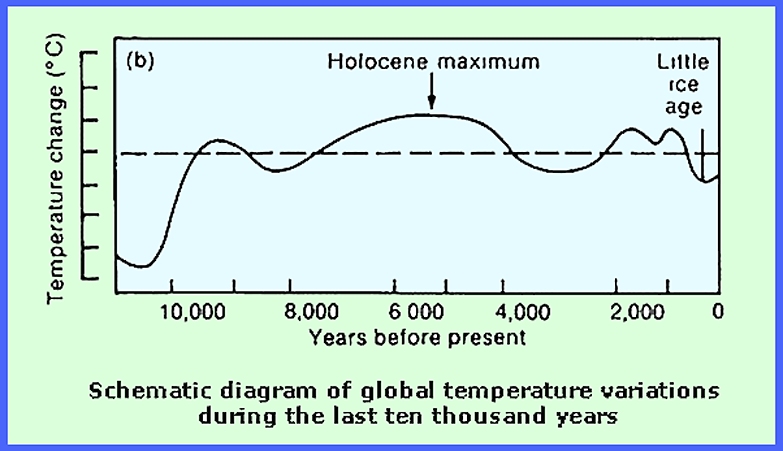
expands) The Holocene Maximum warm
period Peteroborough, Canada petroglyphs carved (See Bronze Age) Isle of Thera volcano erupts, devastating Crete & other areas Major attacks by Sea Peoples on Egypt (attempt
to reestablish Goddess religion) Hebrews leave Egypt Benedictine clerics expand Christian conversion activity in Europe Horsecreek Petroglyph carved in
West Virginia ? (See Horsecreek) Roman Catholic sponsored Invention of modern European languages
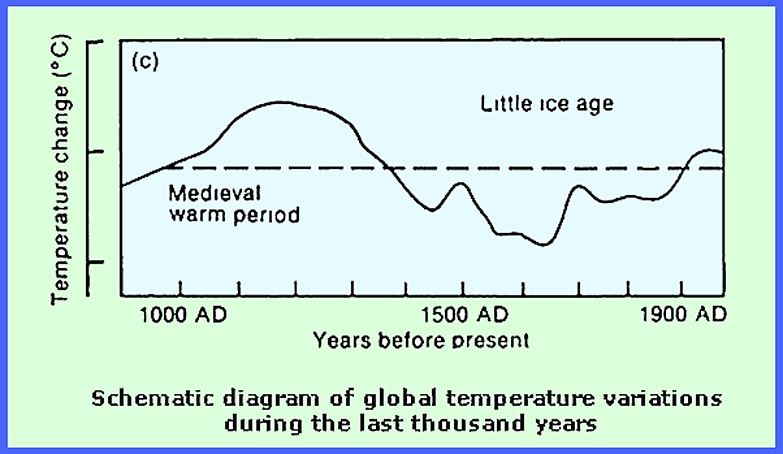
expanded Medieval Warm Period Little Ice Age Industrial Age , Global Warming |
|
The Earth has been ice-free (even
at the poles) for most of its history.
However, these iceless periods have been interrupted by several major
glaciations (called Glacial Epochs)
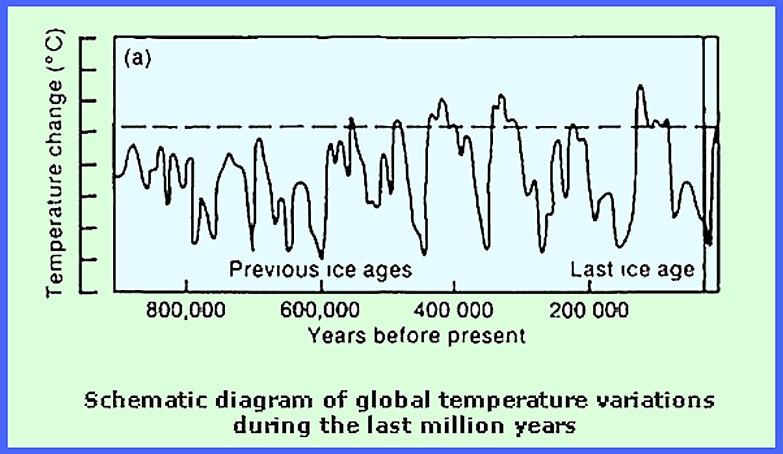
and we are in one now in the 21st Century. Each glacial epoch consists
of many advances and retreats of ice fields. These ice fields tend to
wax and wane in about 100,000, 41,000 and 21,000 year cycles. Each
advance of ice has been referred to as an "Ice Age" but it is
important to realize that these multiple events are just variations of the
same glacial epoch. The retreat of ice during a glacial epoch is called
an Inter-Glacial Period and this is our present climate system. The existing Plio-Pleistocene
Glacial Epoch began about 3.2 million years ago and is
probably linked to the tectonic construction of the Isthmus of Panama which
prevented the circulation of Atlantic and Pacific waters and eventually triggered
a slow sequence of events that finally led to cooling of the atmosphere and
the formation of new ice fields by about 2.5 million years ago. Thus far, the Earth has had around
15 to 20 individual major advances and subsequent retreats of the ice field
in our current Glacial Epoch. The last major
advance of glacial ice peaked about 18,000 years ago and since that time the
ice has generally been retreating although with some short-term interruptions
(See Graph above).
What we are presently experiencing in Greenland and other continents
is a rapid melting of surrounding sea ice by rising ocean temperatures and a
widening of the Gulf Stream. Greenland's continental glaciers are also
retreating due to an accumulation of atmospheric soot and a reduction of
fresh snow to cover it. Oceanic
islands are vulnerable to inundation by subsequent rising ocean levels and
destruction of protective coral reefs as a consequence of higher ocean temperatures. Abramov, O. & Mojzsis, S. J. Microbial habitability
of the Hadean Earth during the late heavy bombardment. Nature 459, 419–422
(2009). Allwood, A. C. et al. Stromatolite reef from the early
Archean era of Australia. Nature 441, 714–718 (2006). Anbar, A. D. et al. A whiff of oxygen before the Great
Oxidation Event? Science 317, 1903–1906 (2007). Beerling, D. et al. Methane and the CH4-related
greenhouse effect over the past 400 million years. American Journal of
Science 309, 97–113 (2009). Bekker, A. & Kaufman, A. J. Oxidative forcing of
global climate change; A biogeochemical record across the oldest
Paleoproterozoic ice age in North America. Earth and Planetary Science
Letters 258, 486–499 (2007). Bekker, A. et al. Dating the rise of atmospheric oxygen.
Nature 427, 117–120 (2004). Berner, R. A. GEOCARBSULF: A combined model for
Phanerozoic atmospheric O2 and CO2. Geochimica et Cosmochimica Acta 70,
5653–5664 (2006). Berner, R. A. Phanerozoic atmospheric oxygen: New
results using the GEOCARBSULF model. American Journal of Science 309, 603–606
(2009). Blake, R. E., Chang, S. J. & Lepland, A. Phosphate
oxygen isotope evidence for a temperate and biologically active Archean
ocean. Nature 464, 1029–1033. Brocks, J. J. et al. Archean molecular fossils and the
early rise of Eukaryotes. Science 285, 1033–1036 (1999). Byerly, G. R. et al. An Archean impact layer from the
Pilbara and Kaapvaal cratons. Science 297, 1325–1327 (2002). Canfield, D. E. & Teske, A. Late Proterozoic rise in
atmospheric oxygen concentration inferred from phylogenetic and
sulphur-isotope studies. Nature 382, 127–132 (1996). Canfield, D. E., Poulton, S. W. & Narbonne, G. M.
Late-Neoproterozoic deep-ocean oxygenation and the rise of animal life.
Science 315, 92–95 (2006). Catling, D. C., Zahnle, K. J. & McKay, C. P.
Biogenic methane, hydrogen escape, and the irreversible oxidation of early
Earth. Science 293, 839–843 (2001). Clayton, R. N., O’Neil, J. R. & Mayeda, T. K. Oxygen
isotope exchange between quartz and water. Journal of Geophysical Research
77, 3057–3067 (1972). Des Marais, D. J. et al. Carbon isotope evidence for the
stepwise oxidation of the Proterozoic environment. Nature 359, 605–609
(1992). Eugster, H. P. Sodium carbonate-bicarbonate minerals as
indicators of PCO2. Journal of Geophysical Research 71, 3369–3378 (1966). Evans, D. A. A fundamental Precambrian–Phanerozoic shift
in Earth’s glacial style? Tectonophysics 375, 353–385 (2003). Evans, D. A., Beukes, N. J. & Kirschvink, J. L.
Low-latitude glaciations in the Paleoproterozoic era. Nature 386, 262–266
(1997). Farquhar, J., Bao, H. & Thiemans, M. Atmospheric
influences of Earth’s earliest sulfur cycle. Science 289, 756–758 (2000). Goldblatt, C. & Zahnle, K. J. Clouds and the faint
young Sun paradox. Climate of the Past 7, 203–220 (2011). Goldblatt, C., Lenton, T. M. & Watson, A. J.
Bistability of atmospheric oxygen and the Great Oxidation. Nature 443,
683–686 (2006). Gough, D. O. Solar interior structure and luminosity
variations. Solar Physics 74, 21–34 (1981). Haqq-Misra, J. D. et al. Revised, hazy methane
greenhouse for the Archean Earth. Astrobiology 8, 1127–1137 (2008). Hessler, A. M. & Lowe, D. R. Weathering and sediment
generation in the Archean: An integrated study of the evolution of
siliciclastic sedimentary rocks of the 3.2 Ga Moodies Group, Barberton
Greenstone Belt, South Africa. Precambrian Research 151, 185–210 (2006). Hessler, A. M. et al. A lower limit for atmospheric
carbon dioxide levels 3.2 billion years ago. Nature 428, 736–738 (2004). Heubeck, C. An early ecosystem of Archean tidal
microbial mats (Moodies Group, South Africa, ca. 3.2 Ga). Geology 37, 931–934
(2009). Hofmann, H. J. Precambrian microflora, Belcher Islands,
Canada: Significance and systematics. Journal of Paleontology 50, 1040–1073
(1976). Hofmann, H. J. et al. Origin of 3.45 Ga coniform
stromatolites in Warrawoona Group, Western Australia. Geological Society of
America Bulletin 111, 1256–1262 (1999). Holland, H. D. The oxygenation of the atmosphere and
oceans. Philosophical Transactions of the Royal Society B: Biological
Sciences 361, 903–915 (2006). Hren, M. T., Tice, M. M. & Chamberlain, C. P. Oxygen
and hydrogen isotope evidence for a temperate climate 3.42 billion years ago.
Nature 205, 205–208 (2009). Jaffres, J. B. D., Shields, G. A. & Wallmann, K. The
oxygen isotope evolution of sea water; A critical review of a long standing
controversy and an improved geological water cycle model for the past 3.4
billion years. Earth-Science Reviews 83, 83–122 (2007). Kashefi, K. & Lovley, D. R. Extending the upper
temperature limit for life. Science 301, 934 (2003). Kasting, J. F. Theoretical constraints on oxygen and
carbon dioxide concentrations in the Precambrian atmosphere. Precambrian
Research 34, 205–229 (1987). Kasting, J. F. Earth’s early atmosphere. Science 259,
920–926 (1993). Kasting, J. F., Liu, S. C. & Donahue, T. M. Oxygen
levels in the prebiological atmosphere. Journal of Geophysical Research 84,
3097–3107 (1979). Kasting, J. F. et al. Paleoclimates, ocean depth, and the
oxygen isotopic composition of seawater. Earth and Planetary Science Letters
252, 82–93 (2006). Kharecha, P., Kasting, J. & Seifert, J. A. A coupled
atmosphere-ecosystem model of the early Archean Earth. Geobiology 3, 53–76
(2005). Knauth, L. P. & Lowe, D. R. High Archean climatic
temperatures inferred from oxygen isotope geochemistry of cherts in the 3.5
Ga Swaziland Supergroup, South Africa. Geological Society of America Bulletin
155, 566–580 (2003). Knoll, A. H. The early evolution of eukaryotic organisms:
A geological perspective. Science 256, 922–627 (1992). Knoll, A. H. et al. Eukaryotic organisms in Proterozoic
oceans. Philosophical Transactions of the Royal Society B: Biological
Sciences 361, 1023–1038 (2006). Kopp, R. E. et al. The Paleoproterozoic snowball Earth:
A climatic disaster triggered by the evolution of oxygenic photosynthesis.
Proceedings of the National Academy of Sciences of the United States of
America 102, 11131–11136 (2005). Kreidenweis, S. M. & Seinfeld, J. H. Nucleation of
sulfuric acid-water and methanesulfonic acid-water solution particles:
Implications for the atmospheric chemistry of organosulfur species.
Atmosphere Environment 22, 283–296 (1988). Lin, L-H. et al. Long-term sustainability of a
high-energy, low-diversity crustal biome. Science 314, 479–482 (2006). Locklair, R. E. & Lerman, A. A model of Phanerozoic
cycles of carbon and calcium in the global ocean: Evaluation and constraints
on ocean chemistry and input fluxes. Chemical Geology 217, 113–126 (2005). Lowe, D. R. Restricted shallow water sedimentation of
Early Archean stromatolitic and evaporitic strata of the Strelley Pool Chert,
Pilbara Block, Western Australia. Precambrian Research 19, 239–283 (1983). Lowe, D. R. & Tice, M. M. Geologic evidence for
Archean atmosphere and climatic evolution: Fluctuating levels of CO2, CH4,
and O2 with an overriding tectonic control. Geology 32, 493–496 (2004). Mather, T. A., Pyle, D. M. & Allen, A. G. Volcanic
source for fixed nitrogen in the early Earth’s atmosphere. Geology 32, 905–908
(2004). Maas, R. et al. The Earth’s oldest known crust: A
geochronological and geochemical study of 3900–4200 Ma detrital zircons from
Mt. Narryer and Jack Hills, Western Australia. Geochimica et Cosmochimica
Acta 56, 1281–1300 (1992). Marmo, J. S. & Ojakangas, R. W. Lower Proterozoic
glaciogenic deposits, eastern Finland. Geological Society of America Bulletin
98, 1055–1062 (1984). Melezhik, V. A. Multiple causes of Earth’s earliest
global glaciations. Terra Nova 18, 130–137 (2006). Mojzsis, S. J., Harrison, T. M. & Pidgeon, R. T.
Oxygen-isotope evidence from ancient zircons for liquid water at the Earth’s
surface 4,300 Myr ago. Nature 409, 178–181 (2001). Narbonne, G. M. & Gehling, J. G. Life after snowball:
The oldest complex Ediacaran fossils. Geology 31, 27–30 (2003). Noffke, N. et al. A new window into Early Archean life:
Microbial mats in Earth’s oldest siliciclastic tidal deposits (3.2 Ga Moodies
Group, South Africa). Geology 34, 253–256 (2006). Pavlov, A. A. & Kasting, J. F. Mass-independent
fractionation of sulfur isotopes in Archean sediments: Strong evidence for an
anoxic Archean atmosphere. Astrobiology 2, 27–41 (2002). Pavlov, A. A. et al. Greenhouse warming by CH4 in the
atmosphere of early Earth. Journal of Geophysical Research 105, 11981–11990
(2000). Pavlov, A. A. et al. Methane-rich Proterozoic
atmosphere? Geology 31, 87–90 (2003). Peck, W. H. et al. Oxygen isotope ratios and rare earth
elements in 3.3 to 4.4 Ga zircons: Ion microprobe evidence for high delta
O-18 continental crust and oceans in the Early Archean. Geochimica et
Cosmochimica Acta 65, 4215–4229 (2001). Rashby, S. E. et al. Biosynthesis of
2-methylbacteriohopanepolyols by an anoxygenic phototroph. Proceedings of the
National Academy of Sciences of the United States of America 104, 15099–15014
(2007). Rasmussen, B. & Buick, R. Redox state of the Archean
atmosphere: Evidence from detrital heavy minerals in ca. 3250–2750 Ma
sandstones from the Pilbara Craton, Australia. Geology 27, 115–118 (1999). Rasmussen, B. et al. Reassessing the first appearance of
eukaryotes and cyanobacteria. Nature 455, 1101–1105 (2008). Rondanelli, R. & Lindzen, R. S. Can thin cirrus
clouds in the tropics provide a solution to the faint young Sun paradox?
Journal of Geophysical Research 115, 689–690 (2010). Rosing, M. T. 13C-depleted carbon microparticles in
>3700-Ma sea-floor sedimentary rocks from west Greenland. Science 283,
674–676 (1999). Rosing, M. T. et al. No climate paradox under the faint
Sun. Nature 464, 744–747 (2010). Rossow, W. B., Henderson-Sellers, A. & Weinreich, S.
K. Cloud feedback: A stabilizing effect for the early Earth? Science 217,
1247–1247 (1982). Sagan, C. & Mullen, G. Earth and Mars – Evolution of
atmospheres and surface temperatures. Science 177, 52–56 (1972). Sheldon, N. D. Precambrian paleosols and atmospheric CO2
levels. Precambrian Research 147, 148–155 (2006). Sleep, N. H. & Hessler, A. M. Weathering of quartz
as an Archean climatic indicator. Earth and Planetary Science Letters 241,
594–602 (2006). Summons, R. E. et al. 2-methyl-hopanoids as biomarkers
for cyanobacterial oxygenic photosynthesis. Nature 400, 554–557 (1999). Tice, M. M. & Lowe, D. R. Hydrogen-based carbon
fixation in the earliest known photosynthetic organisms. Geology 34, 37–40
(2006). Trainer, M. G. et al. Organic haze on Titan and the
early Earth. Proceedings of the National Academy of Sciences of the United
States of America 103, 18035–18042 (2006). Valley, J. W. et al. A cool early Earth. Geology 30, 351–354
(2002). Wilde, S. A. et al. Evidence from detrital zircons for
the existence of continental crust and oceans on the Earth 4.4 Gyr ago.
Nature 409, 175–178 (2001). Zachos, J. et al. Trends, rhythms, and aberrations in
global climate 65 Ma to present. Science 292, 686–693 (2001). Zahnle, K. J.
Photochemistry of methane and formation of hydrocyanic acid (HCN) in the
Earth’s early atmosphere. Journal of Geophysical Research 91, 2819–2834
(1986). |