File: <bronze1.htm> <Migrations Index> <Bronze
Age Index> <Archeology Index> Subjects <Return to American Archeology> <Home>
Educational
Material: Quote Cited References
(high speed connections use <bronze.htm>.] [Additional Websites and #2 ]
|
EUROPEAN
BRONZE AGE VISITORS IN AMERICA1/ Summary of
Discoveries of Dr. Barry & René Fell [Contacts] NOTE: “Old Norse” and “Old Gaelic” as used by Fell may be equivalent to a
northern dialect of the Saharan language as discussed by Nyland. ----Please CLICK on underlined
categories for detail [ to search for Subject
Matter, depress Ctrl/F ]: Complete Summary:
All Sections Introduction
As of January
2020 there have been few implements found in the Americas that date from the
Bronze Age (Please see Discussion). Nevertheless,
there is considerable evidence of a voyage or voyages of a Bronze Age Scandinavian king, Woden-lithi,
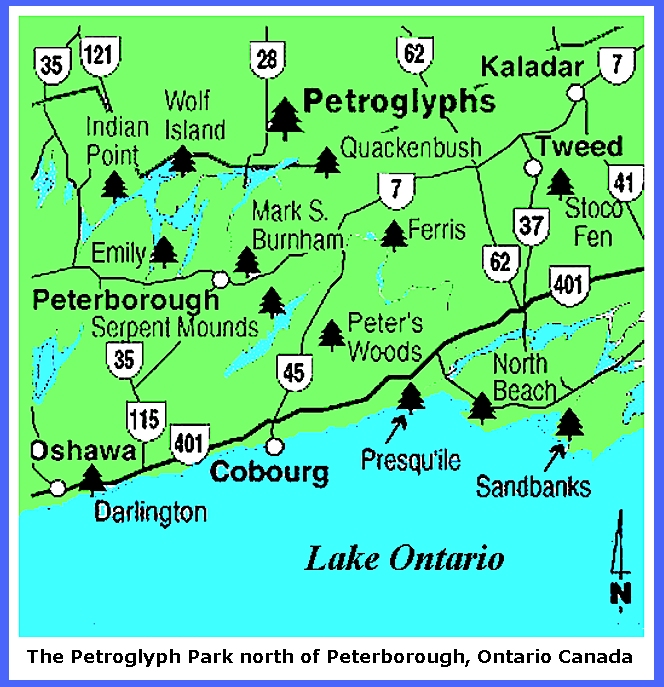
to North America around 1700 B.C. from texts found inscribed in the rocks at Peterborough, Ontario, Canada (Figs. 18 & 19 & MAP), and other North American sites. (Figs. 18 & 19 & MAP), and other sites. These
texts, written in Teutonic and Norse tongues, used alphabets that have survived
to the present in remote parts of the world.
However, in Europe Roman script became the predominant alphabet around
the time of Christ as part of the general occupation. They support the belief that Europeans
during the Bronze Age were literate, educated people. Harvard Professor Barry
Fell (1982) has attempted to translate the inscriptions to about
October 2000. Expected widespread
criticism of such new ideas flooded the archeological world (see Comments). Yet by the year 2005 there has emerged a
revolution in American prehistory that may finally remove antiquated biases
and enable concerted efforts at learning and dispelling myths about
colonization in America (please refer to Nyland’s
accounts). The evidence points to the
certainty that European colonists and traders have been visiting or settling
in the Americas for thousands of years, have introduced their scripts,
artifacts, and skills, and have exported abroad American products such as
copper and furs. The voyages occurred
just as the Iron Age was beginning, so that the explorers might have brought
with them implements of iron instead of bronze (see Picture), and most could
have eventually rusted away. Edo Nyland has examined the
Peterborough petroglyphs and especially what Barry Fell considered Ogam, but
he failed to see Ogam writing in it. Nyland noted that Fell took some
isolated characters that look like Ogam, then assigned English letters to it,
but none are connected into a sentence. If one looks at the Ogam inscriptions
that Nyland works with, you see that they form a series of connected
characters, a lineup of them, but that's not what Fell found.. Furthermore, Fell was using Gaelic to translate but
Gaelic did not exist until about 700 AD. The early Gnostics used Basque
exclusively. Nyland wishes that he could be more positive about Fell's work.
As far as he can see his true strength is in transliteration, not
translation. According to
Fell, Woden-lithi's main purpose for visiting America was apparently to
barter textiles with the Algonquian Indians in
return for metallic copper ingots (Fell 1982). He left a detailed record of his visit at
Peterborough where he established a permanent-trading colony. To critics who argued that there was no
writing among the Scandinavians until about the time of Christ, Fell (1982)
pointed to two alphabets as shown in Fig. 1. One alphabet,
"ogam consaine" was employed by the
ancient peoples of Ireland and Scotland (often erroneously referred to as
Celts—see Celts) and
recorded and explained in detail by Irish monks during the Middle Ages. A detailed description of this writing was
given in Barry Fell's books America BC and Saga America. The other
alphabet, called "Tifinag", is the special way of writing of the Tuaregs, a race of Berbers living in the
Atlas Mountains of North Africa. Both
ogam consain and Tifinag use only consonants in nearly all words, leaving the
vowels to be inferred, as do writers of Hebrew, Arabic and other ancient
scripts. Sometimes, where doubt may
exist as to the word intended, a vowel sign is added, or a pictograph, to
help recognize the word (Fell 1982).
[ Ogam Script details] It is
apparent from evidence provided in the following text that Bronze Age Irish and Norsemen colonists in America showed strong feelings about their pagan
gods and the power that they had over daily events. Therefore, the numerous inscriptions found
in America on rocks, implements and bone regularly connected these gods with
whatever the people were trying to show, whether it be gathering wool from
wild sheep or recounting their travels.
With his wide knowledge about Bronze Age mythology and religions in
Europe, Professor Fell noted close similarities in the American inscriptions. He interpreted these as cultural
extensions from Europe, following colonization by explorers crossing the
Atlantic in ancient times. (Pleases
refer to Figs. 20, 21, 22, 23 & 24 for more
illustrations to this section). As of
2005 we have come to recognize this ancient language as Saharan
from which all other Indo-European languages were derived. The
following text reconsiders the detailed account by Professor Barry Fell in
Bronze Age America, 1982,.with new knowledge accumulated since its
publication. Particularly, his
erroneous references to Celts have been changed to coincide with knowledge
acquired by 2004. Although Fell’s
reference to Celts often includes peoples of both Ireland and Scotland, I
have generally used the word Ancient Irish for both (Please see Celts). [ Continue with <bronze2.htm> ] |