|
File: <phori1.ima.htm> [For educational purposes only] Terminology Glossary <Principal Natural
Enemy Groups > <Citations> |
Immature Stages of Phoridae
Clausen (1940) gave a cursory description of the immature stages
of the Phoridae so that the parasitic and predaceous forms might be
distinguished from other Diptera that may attack the same hosts. The eggs of very few species were known by 1940, all being of
simple form and several times longer than wide, the anterior end wider than
the posterior and both smoothly rounded, with the chorion white and smooth. The first‑instar larva lacks the anterior spiracles. The mature larva of Hypocera incrassata
is rather elongated in form and, like many other parasite species, differs
from those that develop as scavengers in the absence or great reduction of
the numerous sensory spines and fleshy processes upon the cuticle of the body
segments. This distinction, however,
does not apply in all cases. The body
segments of Hypocera are
fairly distinct, though somewhat obscured by supplementary folds. The buccopharyngeal armature is of three
parts, with the mandibular sclerite in the form of a single stout structure. The anterior and posterior spiracles are
almost identical, are slightly elevated, and have four oval openings. The larva of S. cocciphila
is more robust in form and bears a transverse row of small setae dorsally
and laterally on each body segment.
In Melaloncha romnai, the body segments bear
a fine pubescence and a varying number of long, slender fleshy processes
dorsally and laterally. The posterior
spiracles are simple and circular in form.
In most species of the family, these have four openings, whereas the
anterior spiracles have only two. For
a detailed study of the morphology of phorid larvae, the reader is referred
to Keilin (19lla), who described the larvae of several scavengerous species. Please CLICK on picture to view details:
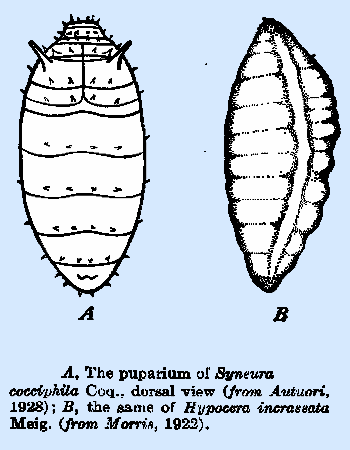
The puparia of this family are readily recognizable because of
their distinctive form (Fig. 174).
Instead of being circular in transverse section, the lateral margins
are flattened dorsoventrally. The
greatest thickness occurs in the third or fourth abdominal segments, and the
preceding thoracic and abdominal segments taper sharply. The dorsum is much less convex than the
ventral side of the body, and this, with the distinct lateral margins, gives
the puparium a boat‑like appearance.
In some species such as M.
ronnai, the puparium in
lateral view is somewhat S‑shaped, owing to the depression of the
dorsum of the abdomen, the concavity of the anterior ventral area, and the
marked convexity of the ventral surface of the abdomen. The prothoracic cornicles of the pupa
project from the anterior margin of the second thoracic segment; they may be
sma11, or they may equal several segments in length. In some species, emergence from the puparium is effected by
forcing off the operculum, consisting of the dorsal portion of the first and
second and most of the third thoracic segments, in a single piece; in other
species the operculum splits into two parts along the median line. References: Please refer to <biology.ref.htm>, [Additional references may
be found at: MELVYL Library ] |