|
File: <mymar1.ima.htm> [For educational purposes only] Terminology Glossary <Principal Natural
Enemy Groups > <Citations> |
Immature Stages of Mymaridae
Immature stages of Mymaridae were discussed in detail by Clausen
(1940), as follows: There is little variation in egg form within the family. The main body of the egg is ellipsoidal,
ovoid, or spindle‑shaped, with a slender tapering peduncle at the
anterior end ranging in length from one‑tenth that of the egg body in Anaphoidea nitens and Caraphractus
to equal its length in Polynema
striaticorne (Fig. 44A).
The ovarian egg is practically identical with the oviposited egg. These eggs are exceedingly minute, ranging
from O.06 mm. in length in Anagrus
atomus to 0.25 mm. in P. striaticorne. Please CLICK on pictures to
view details:
A great deal of confusion exists regarding the larval forms of
the Mymaridae. This is primarily due
to the exceedingly minute size of the early stages combined with the lack, in
the instars following the first, of heavily sclerotized or indurated
structures of fixed form. Often
several species have been involved in the descriptions of the instars of what
was supposedly a single species. This
was the case in the account given by Ayers (1884) of Teleas sp., a scelionid parasite in the eggs of Oecanthus in the United
States. His figures 2, 3, 8, 12, and
13, of plate 24, are undoubtedly of Polynema
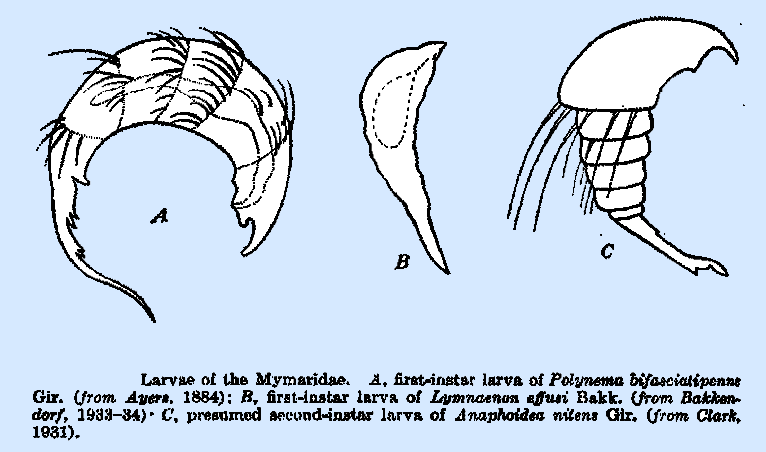
(Fig. 46A), which is stated by E. W. Wheeler (1923) to be P. bifasciatipenna Gir.
The Polynema sp. figured by Ganin is stated by Bakkendorf
to be Anagrus, probably A. incarnatus
Hal., though Henriksen believed it to be A.
subfuscus Foerst. There are two general types of first‑instar larvae. The first of these is oblong or flask‑shaped,
of the sacciform type, and occurs in the several species of Anagrus that have been studied
and in Prestwichia aquatica. The body is merely a bag, without
segmentation, and lacks any distinguishing characters. Bakkendorf (1934) figures a somewhat
intermediate form between this and the next, in what are considered to be
first‑instar larvae of Allaptus
minimus Hal. and Lymnaenon effusi Bakk. (Fig. 46B).
These are rather spindle‑shaped, with indications of segmentation,
and have the caudal segment attenuated and tapering to a point. There is no distinct tail structure, nor
are there spines or setae. The second and more common form of the first‑instar larva
is designated as mymariform and occurs in the described species of Polynema, Araphes, Ooctonus,
and Anaphoidea. The head is large, drawn out into a curved
median conical process, with a second smaller process beneath it,
representing the mouth. The thorax
and abdomen consist of six to eight segments, often indistinguishable, with
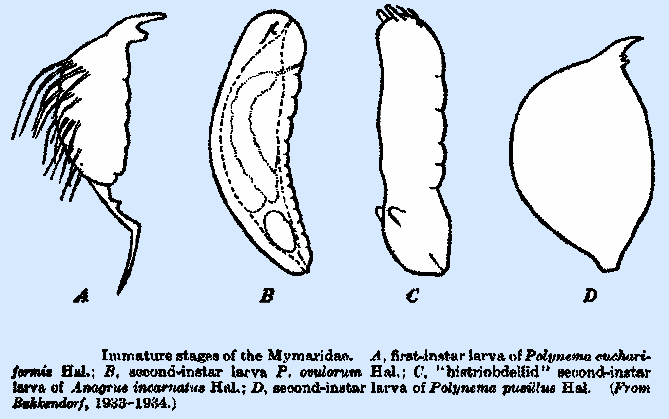
transverse rings of long hairs, which are most numerous upon the dorsum. The dorsal spines of P. euchariformis
(Fig. 45A) and Anaphoidea nitens are exceptionally long
and heavy. The caudal end of the body
bears a long, curved or abruptly bent process, often equal to the body in
length, which, in some species, is compressed laterally into blade‑like
form and bears a single large tooth or one or more smaller paired teeth on
the ventral margin. Clark (1931)
described two distinct mymariform instars in A. nitens;
the first of these has the tail slender and bent at right angles twice, first
ventrally and then dorsally, whereas in the second form it is constricted and
toothed at several points (Fig. 46C).
Clausen (1940) believed this to be highly improbable, and the two
forms doubtless represent either two species or different ages of the first
instar of the same species. In size
the first instar larvae of the Mymaridae are small and range from 0.1 to 0.3
mm. in total length at the time of hatching. The number of larval instars following the first is very
uncertain. Several authors asserted
that there are only the first and the mature forms, though in most species
there are said to be three. Balduf
described four in Polynema striaticorne. The second‑instar larva of Anagrus is of distinctive form and has been designated as
"histriobdellid" by Ganin, who first observed and described
it. This larva (Fig. 45C) is
cylindrical in form and is divided by constrictions into six segments, of which
the first and last are largest. The
head bears a pair of large, conical or cylindrical fleshy processes
lateroventrally, which are said to be the antennae, and the extruded
mandibles, which are long, slender, and curved, lie parallel to each other. The last segment bears a pair of large ear‑like
organs, of unknown function, lateroventrally. This type of larva has thus far been associated only with the
sacciform first‑instar larva and is not known in any species having
mymariform larvae. The second‑instar larvae of Prestwichia, Anaphoidea,
and Polynema (Fig. 45B, D)
have few digtinguishing characters except for the relatively large extruded
mandibles, which are somewhat fleshy.
The body is bag‑like, without segmentation, and lacks
appendages, spines, or setae. The mature larvae of Anagrus
and Paranagrus are similar
to the histriobdellid form except that the ear‑like processes of the
last segment are lacking and the mandibles and antennal processes are much
reduced in size. Those of Polynema (Fig. 44C), Prestwichia, Anaphes, and Anaphoidia are indistinctly
segmented, and, aside from the large extruded mandibles, have no recognizable
characters. The larva of Erythmelus goochi Enock appears to be intermediate in form between Anagrus and the above genera. In no species is there any indication of an internal tracheal
system or spiracles in any of the larval instars. References: Please refer to <biology.ref.htm>,
[Additional references may be
found at: MELVYL Library ] |