|
File: <misco1.ima.htm> [For educational purposes only] Terminology Glossary <Principal Natural
Enemy Groups > <Citations> |
Immature Stages
of Miscogasterinae
Immature stages of Pteromalidae (Miscogasterinae) were discussed
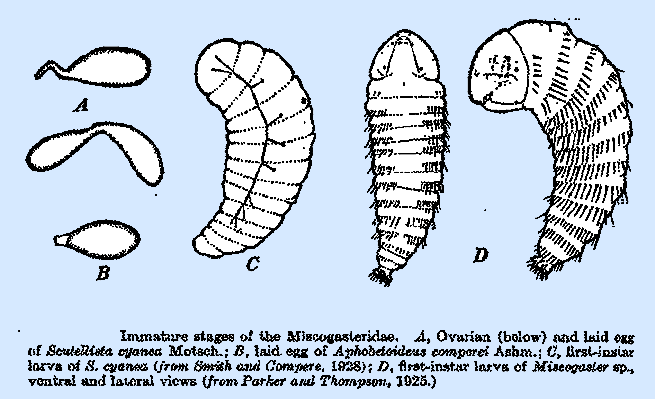
in detail by Clausen (1940), as follows: The ovarian eggs of the Miscogasteridae are of the two‑bodied
type, but at deposition the anterior body disappears and only a stalk or
peduncle remains. In Scutellista (Fig. 91A), Miscogaster, and Anysis, this stalk or peduncle
is ca. 1/2 the length of the egg body; but in Aphobetoideus (Fig. 91B) it is broad and stub‑like
and in Tomocera nipple‑like
and minute. The egg of Dinarmus dacicida Masi is ovate in form and lacks either a stalk or
a peduncle. The first instar larvae are hymenopteriform, with a variable
number and arrangement of segmental spines. That of S. cyanea (Fig. 91C) bears no
spines whatever, while Miscogaster
sp. (Fig. 91D) has a complete ring of 30-40 heavy spines about each
segment. In T. californica,
there are only two pairs on each segment, whereas in Systasis dasyneurae
three rows encircle each segment.
Spiracles are found on the second and third thoracic and the second
and third abdominal segments in Scutellista
cyanea, on the second
thoracic and first three abdominal segments in Anysis saissetiae,
and on the second thoracic and first and fifth abdominal segments in T. californica. No
spiracles are described or figured for Miscogaster
sp., which is further distinguished from others of the family by the bilobed
form of the last abdominal segment, each lobe terminating in a heavy spine. Please CLICK on picture to view
details:
The intermediate‑instar larvae have not been described for
any species, nor has the number of stages been determined as of 1940 (Clausen
1940). The mature larva has been described only for S. cyanea. The cuticular spines are minute or lacking
and the respiratory system now possesses nine pairs of spiracles, situated on
the last two thoracic and the first seven abdominal segments. References:
Please refer to <biology.ref.htm>,
[Additional
references may be found at: MELVYL Library ] |