|
File: <histe1.ima.htm> [For educational purposes only] Terminology Glossary <Principal Natural
Enemy Groups > <Citations> |
Immature Stages
of Histeridae
Adults and larvae of Histeridae are usually found in association
with decaying animal or vegetable matter, which has led to an early
assumption that they were principally scavengers. But it is becoming generally recognized that many species are
predaceous on various insects (Geden 1984, 1990; Geden & Axtell 1988a;
Geden & Stoffolano 1987; Geden et al. 1987a, 1988; Legner 1971a, Legner
& Olton 1970). Coleoptera and
Diptera larvae constitute the bulk of their prey. A few species live in the open and attack immature stages of
Chrysomelidae and Lepidoptera. The
larvae of species of a considerable number of genera are limited in their
host preferences to the immature stages of wood inhabiting Coleoptera,
principally of the Scolytidae and other soft bodied insects found in or
beneath bark (Balduf 1935). Struble
(1930) recorded adults of Plegaderus
nitidus Horn as being
predaceous on eggs of Dendroctonus,
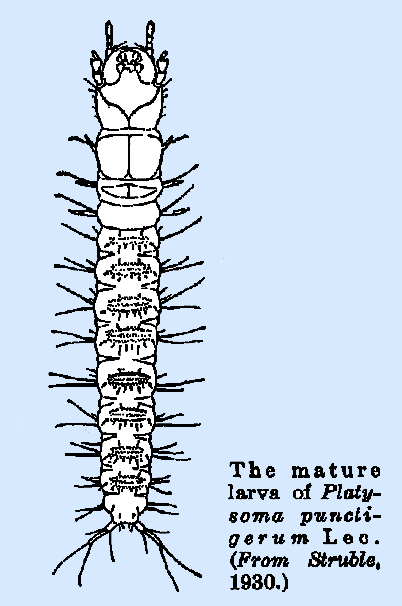
and those of Platysoma punctigerum Lec. feed on a
variety of insects found under bark.
The latter species places its eggs along the sides of the bark beetle
egg galleries. These hatch in 10-14
days, and larval development is complete in 4-6 weeks, followed by a pupal
stage of 10-14 days. There are two
generations per year, the overwintering brood of adults ovipositing in May
and the second brood emerging from July onwards. The larvae are active searchers and feed on many insects in
addition to Dendroctonus
larvae (Clausen 1940/1962). Please CLICK on picture to view details:
Plaesius javanus Er., in both larval and
adult stages, is predaceous on larvae and pupae of the banana borer, Cosmopolites sordida Germ., in Java. It was introduced into Fiji for control of
this pest, and satisfactory results were secured in those areas where bananas
are grown under uncultivated conditions.
Attempts were made to introduce it into Australia, Hawaii, Uganda,
Formosa and some West Indian islands, but success was achieved only in
Australia (Clausen 1940/1962). The
life cycle of this predator is long, taking almost one year, and the adult
beetles are very long lived even in the absence of food. Hister
bimaculatus L. was
introduced into Hawaii from Germany in 1909 for horn fly control. References: Please refer to <biology.ref.htm>,
[Additional references may be
found at: MELVYL Library ] |