|
File: <eulop1.ima.htm> [For educational purposes only] Terminology Glossary <Principal Natural
Enemy Groups > <Citations> |
Immature Stages
of Eulophidae
Immature stages of Eulophidae were discussed in detail by Clausen
(1940), as follows: The eggs of the great majority of Eulophidae are simple; they are
oblong or ovatc to elongate, are often slightly arched, and have both poles
smoothly rounded. The chorion is
usually delicate and unsculptured, though in Microplectron fuscipennis
it shows, under high magnification, minute, conical projections. In a number of species, the micropyle is
distinguishable as a small thickened area at the anterior end. The eggs of several genera of Elachertinae differ from those of
the majority of the members of the family.
Those of Euplectrus
and Elachertus have been
stated by several authors to have a pedicel at the middle of the mid‑ventral
curve; this serves as an anchor in the skin of the host in the same manner as
with the pedicellate eggs of other groups.
Observations regarding its form and origin are incomplete. In the figure given by Silvestri for Euplectrus bicolor (Fig. 63A), the pedicel appears to be a definite
adaptive modification possibly comparable to that of the tryphonine Ichneumonidae,
and Tothill stated that it is "continuous with the egg shell" in Elachertus sp. It may prove, however, to be similar in
origin to those of Euxanthellusand
the male eggs of some Coccophagus,
in which a fold of the unmodified chorion is knotted or twisted at the time
of deposition and is inserted into the puncture in the host skin. An examination of the ovarian egg would
probably clarify this point Please CLICK on picture to view details:
The pronounced darkening of the chorion of the egg during
incubation, which occurs in Euplectrus
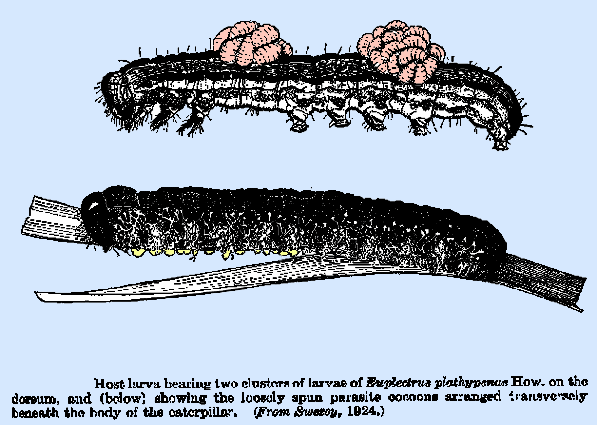
plathypenae (Fig. 63B) and E. comrstocki,
has not been observed in other species of the family. Records of the number of larval instars of the different species
show little consistency. Only three
have been detected in Eulophus
viridulus and Melittobia acasta, four in Pleurotropis
parvulus, Tetrastichus ovivorax, and Euplectrus bicolor, and five in Microplectron
fuscipennis. The first‑instar larvae are hymenopteriform and somewhat
cylindrical, with 13 distinct body segments, and they have no characters to distinguish them readily from larvae of related
families. Occasional species bear
fleshy protuberances or tubercles on the body. In Diaulinus sp. (Solenotus sp.) figured by Parker (1924), the sensory setae
are borne upon distinct tubercles.
The larvae of Dimmockia
javana possess distinct
intersegmental protuberances, which function as pseudopodia, on the mid
ventral line from the second to the ninth body segments. Each segment bears a transverse row of
minute setae on the dorsum and sides near the posterior margin. The last abdominal segment is bifurcate in
Tetrastichus sp. (Berry,
1938); this species has been confused with T. xanthomelaenae
from the same host, but the latter does not possess this character. Melittobia
acasta has a row of minute
spines at the anterior margin of each segment, and T. taylori
has a double row in the same position.
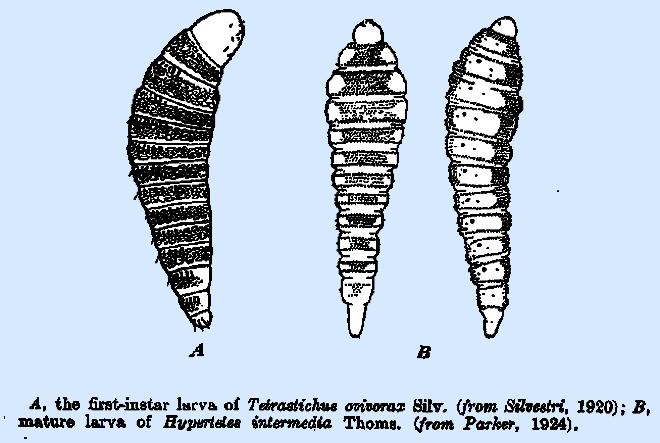
In T. avivorax (Fig. 64A), this row
of spines occurs only dorsally on each segment except the first and in the Tetrastichus sp. mentioned
above they encircle the segments.
According to Silvestri (1910c), the row of spines occurs at the
posterior margin of the segments in T
xanthomelaenae. P. parvulus
apparently lacks the sensory setae and cuticular spines. The integument of a number of species bears a distinct
sculpturing. That of T. ovivorax has a pebbled appearance, whereas in T. xanthomelaenae it is imbricated. Hyperteles intermedia Thoms. (Parker and
Thompson, 1928) has irregular areas of minute tubercles on all body segments
except the last two. There are three
pairs of sensory tubercles on each thoracic segment and four pairs on each
abdominal segment except the last, which has only one. The majority of species that have been studied have an open
tracheal system, with spiracles on the mesothorax and the first three
abdominal segments. Euplectrus bicolor is said to have five pairs, the additional one
being on the metathorax. Several
species of endophagous habit lack the open tracheal system, among them being P. parvulus, Tetrastichus
taylori, Anellaria conomeli, and Thripoctnus
bruni. The distinguishing characters of the first instar, particularly
the cuticular spines and ornamentation, usually do not persist after the
first molt, and the intermediate larval instars of the different species are
consequently quite similar. In Diaulinus, however, the
tubercles and setae are retained to the final instar, and this is true, also,
of the two pairs of "papillae" on the last abdominal segment of Eulophus viridulus. In most
species, the full complement of nine pairs of spiracles, situated on the last
two thoracic and the first seven abdominal segments, appears in the second
instar. They are stated to be on the
mesothorax and the first eight abdominal segments of Melittooia acasta.
The mature larvae are usually of simple form, with very few
integumentary spines or setae, and are usually without surface
sculpturing. Tetrastichus eriophyes
bears transverse striations, whereas T.
ovivorax has the minute
tubercles, mentioned for the first instar, ventrally. The larva of H. intermedia
(Fig. 64B) bears numerous small integumentary tubercles in transverse rows both
ventrally and dorsally on all body segments except the last. In Thripoctenus
brui, the mature larva
differs considerably from that of other genera in being cylindrical and about
three times longer than wide, with both ends broadly rounded and no visible
segmentation; it bears a transverse ring of about 12 short but stout spines
at the middle of the body. The
mandibles of Tetrastichus ovivorax bidentate, in contrast
to the simple form of other species of the family. The larvae of the gregarious species, such as Euplectrus (Fig. 63C) upon free
living hosts, are pear‑shaped and are very broad in the mid‑abdominal
region; the last four or five segments are much narrowed. Nine pairs of spiracles are usually present, these being on the
last two thoracic and the following seven abdominal segments. Pleurotropis
benefica, P. parvulus, and Chrysocharis
laricinellae Ratz. larvae only seven, those on the third
thoracic and on the first abdominal segments being missing. In P.
parvulus the number is said
to be variable, usually smaller than the full complement mentioned, and it
may differ on the two sides of the same individual. Thripoctenus brui and Anellaria conomeli
lack the spiracles even in the mature larva, and Silvestri did not mention or
figure them in Tetrastichus ovivorax. The pupae of a considerable number of species, particularly of
the Eulophinae, have an exceptionally heavy integument which m&y be jet
black or dark‑brown in color.
In a species of Elachertus
found attacking Altona by
Tothill, the pupa bears a pair of fleshy processes at the lateroventral
margins of the seventh and eighth abdominal segments, each of which bears a
spiracle at its tip. References:
Please refer to <biology.ref.htm>,
[Additional
references may be found at: MELVYL Library ] |