|
File: <chryd1.ima.htm> [For educational purposes only] Terminology Glossary <Principal Natural
Enemy Groups > <Citations> |
Immature Stages
of Chrysididae
Immature stages of Chrysididae were discussed in
detail by Clausen (1940), as follows: The eggs of only a few species of
Chrysididae were described as of 1940 (Clausen 1940). That of C shanghaiensis
is 2.1 to 2.5 mm. in length, ca. 1/5th as wide, cylindrical, and slightly
curved. There is a minute
protuberance at the anterior end, and the chorion is finely roughened. In other species, the anterior end is
slightly wider, and no protuberance at that end was mentioned in the
descriptions. Five larval instars have been
detected in the few species upon which close observations of larval
development have been made. The
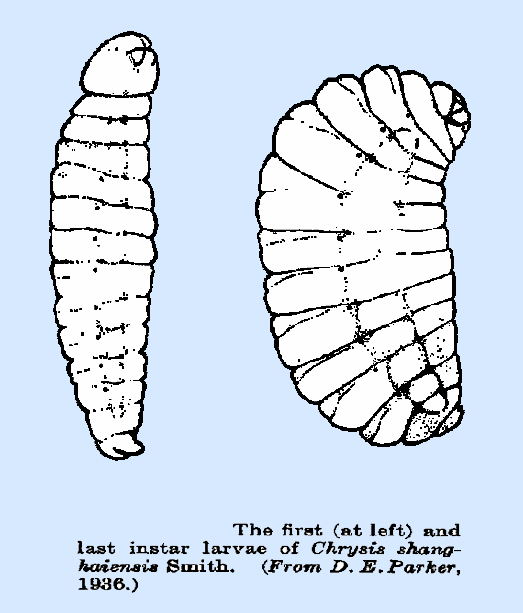
first-instar larva of C. shanghaiensis (Fig. 134), which
is quite typical of the family, has 13 distinct body segments, with a
relatively large, quadrangular head and simple mandibles. The caudal segment of the body is
bifurcate. Integumentary spines and
setae are lacking. The nine pairs of spiracles
are situated on the 2nd thoracic and 1st 8 abdominal segments. In C.
pacifica and C. dichroa, each body segment bears a ring of rather heavy
spines. The caudal segment of Pseudochrysis neglecta, as described by
Maneval, is more highly developed than in other species; and each lobe bears
three rings of setae, and the tip is heavily sclerotized. Ventrally and dorsally at the base of each
lobe is a fleshy spine or protuberance.
The two lobes are curved inward and can be employed, forceps-like, for
locomotion and combat. The intermediate-instar larvae are
similar in form and may be distinguished from the first by the more robust
body, the absence of great reduction of the bifurcate caudal process after
the first molt, the greater number of spiracles, and the dentate
mandibles. In C. shanghaiensis,
the 10th pair of spiracles, on the metathorax, appears on the 2nd instar
larva, and their number and arrangement then persist unchanged until
maturity. The mandibles are
tridentate in the 2nd to 5th instars.
These characters of the mature larva appear to be uniform for the
family. Please CLICK on picture to view details:
References: Please refer to <biology.ref.htm>, [Additional references may
be found at: MELVYL Library ] |