File:
<mallophaga.htm> < (Entomology), (Invertebrates),
(General Index)> <Invertebrate
Bibliography> <Glossary> <Site Description> < Home>
|
Entomology: MALLOPHAGA 1 Kingdom: Animalia, Phylum: Arthropoda Subphylum: Hexapoda: Class: Insecta: Order: Mallophaga (Contact) Please CLICK on underlined
categories to view and on included illustrations to enlarge: Depress Ctrl/F to search for subject matter:
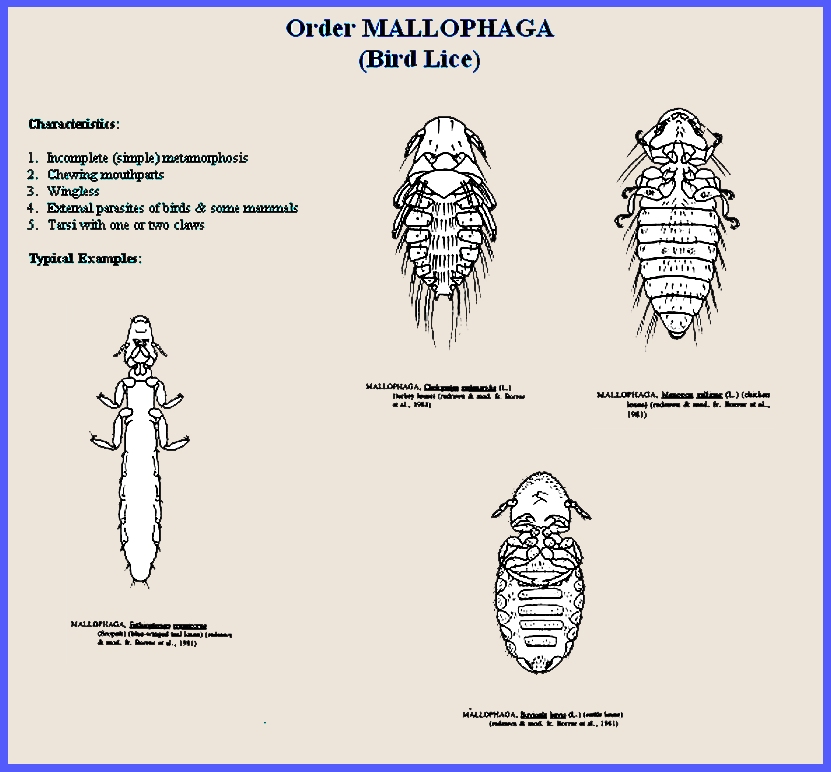
All species are apterous, although
it is believed that they lost wings in evolution, which is evidenced from thoracic
sclerites. There is a gradual metamorphosis.
The various families of biting lice are confined to definite groups of
birds, indicating that evolution of the parasites has proceeded along with
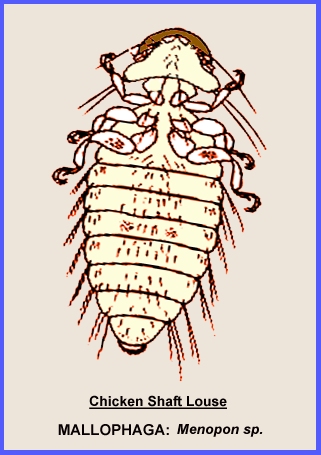
that of their bird hosts. The common hen-louse, Menoponpallidum
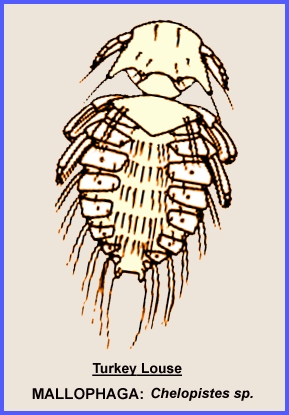
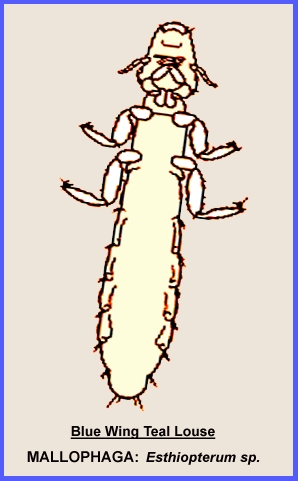
is an example. The head is
semicircular in form and articulates with a prothorax that is freely movable
on the rest of the body. A tagma is
formed by the fusion of the meso- and metathorax with the abdomen. The mouth is situated ventrally on the
head and surrounded by biting mandibles and less prominent 1st and 2nd
maxillae. All stages occur on the host and
reproduction is continuous. Although
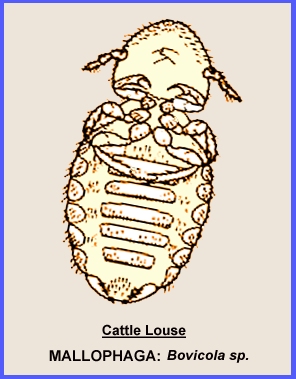
birds are the primary hosts Mallophaga are also found on mammals
occasionally. Birds that have become
infested often exhibit the habit of "dusting", which cuts down on
the number of lice. High infestations
will cause a loss of weight and lowering of egg production in fowl, whereas
small birds are often killed. Humans
and mammals may be attacked but only rarely; there is a report in 1999 from
Vero Beach, Florida. But generally
they have no medical importance for humans. as do the Sucking lice (Phthiraptera). When Mallophaga occur on birds they possess two claws,
while on mammals only one claw is present. Eggs are laid separately on
feathers or hairs and the life cycle is completed in about a month, the young
instars resembling the adult in form and habit. They are spread very rapidly through bodily contact. They crawl on the ground during the day
and return to their host at night. Mallophaga used to be controlled by
dusting their poultry hosts with insecticides. Restrictions on such practices for public health reasons have
made it exceedingly difficult to control these insects. When poultry are raised for the production
of eggs and meat it is best to corral them in open fenced yards on the
ground. In this way the birds are
able to dust themselves with soil and thereby reduce louse infestations
significantly. Such operations are
not always economically practical, however, because of the additional space
required and the difficulty of harvesting their eggs.
============== |