File: <insecticides.htm> < (Entomology), (Invertebrates), (General Index)> <Invertebrate Bibliography> <Glossary> <Site Description> <
Home>
|
An Introduction To
Entomology 1 REVIEW
OF PESTICIDES Kingdom: Animalia, Phylum: Arthropoda Subphylum: Hexapoda: Class: Insecta: Entomology Insecticides (Contact) Please CLICK on underlined
categories to view and on included illustrations to enlarge:
Depress Ctrl/F to
search for subject matter: |
|
Introduction The chemical industry that led to
the development of modern insecticides began around the year 1940. However, prior to this an array of
substances was deployed to combat insects.
Botanicals derived from plants employed nicotine primarily. Metallic compounds centered mainly on lead
arsenic. Various oils were used to
smother insects on plants and in aquatic habitats. Lime sulfur and sulfurs were used and hydrogen cyanide was used
extensively in eradication. There
were also many stomach and contact poisons and fumigants used. Modern chemical insect and mite
control in agriculture has strived to restrict applications to periods of
greatest target pest vulnerability early in the crop season and before
extensive pest reproduction can occur.
Various techniques are deployed to determine when pests become active,
such as acquiring data from light-traps, using pheromone traps and by making
periodic field observations. Placement of a pesticide in a area where insects
and mite will come in contact with it is of the utmost importance and
frequently requires considerable field research for determination. An example is the control of Australian
bush fly in Micronesia using poisoned baits (see Kwajalein). To minimize the exposure of
humans to chemical pesticides in the field applicators are required to
provide protective clothing to workers and to restrict access to fields that
have been treated until harmful residues have become degraded. Entomology also has traditionally
included the study and control of phytophagous mites, which cause extensive
damage to food plants (See Arachnida).
Details of the various substances used for control are discussed as follows: These include some of the oldest
of the insecticides. They consist of
complex volatile chemicals and their effect is primarily by contact. There were materials used that were highly
poisonous to humans and others that were not so poisonous. Nicotine.
-- This had been used since the mid 18th Century, during which time a great
number of human
suicides were associated with it.
Nicotine was formulated primarily as either nicotine sulfate or as a nicotine
alkaloid (e.g., Black Leaf 40). Nicotine was widely used in home
gardens for soft-bodied insects, especially aphids. It was considered desirable because it did not harm predatory
insects. Because of its high cost
there was only limited use of nicotine for commercial insect control. Also, its effectiveness was greatly
curtailed during cold weather. Pyrethrum.
-- Several species of chrysanthemum produced this material. It originated in Persia from around
1828. Later Japan developed
commercial production for the worldwide market followed by East Africa. Pyrethrum is not poisonous to humans. It is difficult to store as it becomes
inactivated in the presence of light.
The high cost of production limited its use for commercial insect
control. Rotenone.
-- This botanical, which has been used as an insecticide since 1848, is
obtained primarily from the roots of over 68 species of leguminous plants in
the genus Derris, of the Far East, and the genera Cubé and
Timbo
of South America. It is poisonous
only to cold blood animals and thus may be safely handled by humans. It has been used as a fish poison by indigenous people
in the Far East and South America.
Although it is very effective against cattle grubs and the Mexican
bean beetle, its high cost has limited its widespread usage. ------------------------------------------- Most metallic insecticides, which
have been in use since 1860, contained arsenic. They are strictly stomach poisons and therefore effective
against chewing insects only. They
are also highly poisonous to humans and honeybees. Standard Lead Arsenate
(PbHAsO4).
-- This product had been used as a dust since 1820, being especially
effective against codling moth on apples and pears. It had the undesirable effect of burning plant tissues and was
not recommended for stone fruits. Basic Lead Arsenate [ Pb(PbO+1)(AsO4)3 ].
-- This material was specially formulated to be effective on stone fruits as
it did not burn their foliage. It was
used primarily for peach twig borer control. Calcium arsenate
-- This material became
important as an insecticide in the mid 1920's. It was used quite extensively on field crops until 1942. Cryolite
(Na3AlF6).
-- Cryolite is obtained from mineral deposits in Greenland, but was not used
extensively with the advent of DDT. ------------------------------------------- The first usage of oils dates to the
mid 1800's with kerosene. By the
1900's it was found that one could mix the kerosene with water for better
distribution on plants. This mixture
is still commonly used in some areas. Oils are useful against mites,
scale insects and the eggs of insects particularly when this is the
overwintering stage. There are two main types of
oils: dormant and summer. Dormant oils are
used when leaves have dropped off the trees, while summer
oils can
be used on foliage. For this purpose
they must be more refined and contain little unsaturated and aromatic
hydrocarbons to prevent burning of plant tissue. Unrefined oils may leave sulfonated residues on the tissue that
cause burning. ------------------------------------------- These have been used as a control
for mites and as an insect control before the application of fungicides. ------------------------------------------- These compounds were developed in
the mid 1930's for the control of weeds, insects and plant diseases. When used in conjunction with oils they
also afford better of mite control. ------------------------------------------- Chlorinated hydrocarbons act as
contact and stomach poisons and have low to medium toxicity to animals and
humans. However, they can accumulate
in the fat tissue of animals and can produce acute or chronic reactions to
their toxicity. For decades in the
mid 1900's a small residue was tolerated by regulatory agencies in North
America (e.g., the Miller Amendment). But by the late 20th Century many of them
were banned from general use as data began to show adverse effects on birds
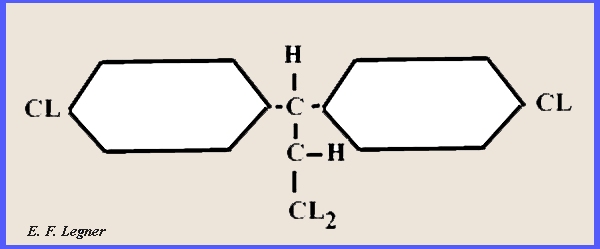
and on human health. D.D.T. --
This material was synthesized in Germany in 1874, but it was not until 1936
that it was rediscovered in Switzerland.
From 1942 to 1946 there was wide scale usage of D.D.T. in agriculture
worldwide. Its discovery has been
considered as a turning point in the insecticide industry. It was most effective on caterpillars,
beetles and adult mosquitoes, but not very good against mites, most aphids
and scale insects and the true bugs.
It is compatible with most other chemicals used in agriculture, but is
not suitable if used with highly alkaline mixtures such as lime sulfur. D.D.T. has a very low toxicity to
humans and its residual action is quite high as it continues to act one month
after application. Insects began to
develop resistance to D.D.T. after about 10 years of widespread usage. By the mid 20th Century it was found to
have a devastating effect on bird populations by causing a thinning of bird
eggshells. Nevertheless, it is still
widely used in Africa and South America to combat insects associated with
dwellings. The incidence of malaria
and Chagas Disease has decreased in those areas where it is still applied as
a control of mosquitoes and biting bugs, respectively..
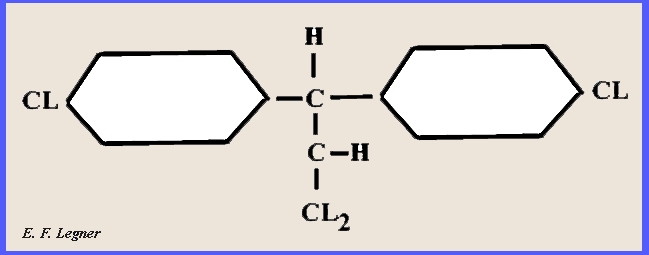
---------------------------------- D.D.D.
or T.D.E. -- This is a derivative of
D.D.T., and although less effective in pest control it does not accumulate in
fat tissue. It has considerably lower
toxicity in water. However, some
insects have been found to be controlled more effectively with this compound.
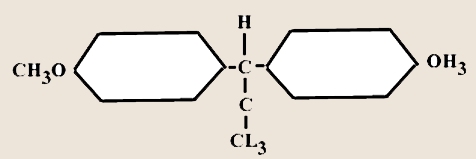
---------------------------------- Methoxychlor.
-- This compound gives faster action than D.D.T., but there is a much shorter
residual action. This is the least
toxic to humans of all the chlorinated hydrocarbons, and there is no
accumulation of residues in fat tissue.
It has been used for livestock insect control.
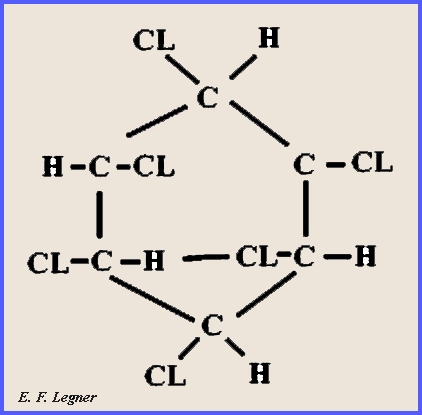
---------------------------------- B.H.C.
(Benzenehexachloride).
-- The gamma isomer of
this compound is most important for insecticidal action. It has a wider and faster range of action
than D.D.T. and is very effective against aphids and Hemiptera. It loses toxicity in alkaline
mixtures. A great disadvantage is that
it imparts off-flavors to products, which is caused by isomers other than the
gamma isomer.
---------------------------------- To greatly reduce the flavor
problem another related product, Lindane,
was developed, which consists entirely of only the gamma isomer. Toxaphene.
-- This is a mixture of several compounds, which once formulated controls
almost the same kinds of insects as D.D.T.
It has the advantage of being much less poisonous to honeybees. It is also more effective against certain
insects, such as grasshoppers, cutworms and armyworms. The
Chlordane Group. -- Chlordane
is actually a mixture of chemicals that began to be used in the mid 20th
Century. Derivatives of chlordane were developed as Aldrin,
Dieldrin and
Heptachlor,
and Endrin,
each with different residual activity and toxicity to humans and
animals. All are sensitive to
alkalinity and quite poisonous to Hymenoptera and Orthoptera. Their effectiveness in reducing some
insect populations in vegetable crops was quite good (see Earwig control). These chemicals ceased to be used in North America during the
latter half of the 20th Century as it was found that residues remained in
plant tissue for long periods of time, and thus posed a danger to human
health. ------------------------------------------- All of these compounds are highly
toxic to humans and warm-blooded animals except Malathion. They attack the nervous system of insects
and play havoc with humans as well. If one has been exposed to them the
compound atropine
can be administered as an
antidote. They are effective against
almost all insects and mites through three types of actions as contact
poisons, fumigants and stomach poisons.
Most of them have a short residual life and safe access by workers to
agricultural fields that have been treated is usually only a few days. However, it is especially important for
applicators not to let these chemicals in contact with skin, to wear
protective clothing and to reduce prolonged exposure. Nevertheless, there continues to be great
concern about side effects on humans who have been exposed to them (See 2010 News Release). TEPP
(or HETP). -- This product
was originally manufactured as a war gas and thus has a highly acute
toxicity. There is little residual
life and in agriculture it can be used immediately before harvest. It is highly volatile and functions
primarily as a fumigant. It breaks
down rapidly with water and is most effective if applied in warm and dry
weather. Parathion.
-- This was the most widely used of all the organic phosphates. The residual action is about a week and it
is very effective against a large number of insects and mites. It has a slow action on mammals and causes
chronic health symptoms. Malathion.
-- This compound has a residual life of about 10 days and is relatively
nontoxic to humans and animals. It
has been used almost as much as Parathion especially near dwellings. It is very effective against aphids. ------------------------------------------- Various pathogens such as viruses,
bacteria, fungi, nematodes and protozoa, have been used to control pest
insects. Detailed accounts of these can be found at <BC-50>.
Bacillus thuringiensis is one pathogen that has been in
widespread use for many decades and in 2010 is the source of genes that
produce toxins which can be introduced into food an fiber plants to kill
insects. However, topical
applications rarely gave acceptable control and by the year 2020 genetically engineered
crops generally required topical applications for satisfactory pest control. ------------------------------------------- These materials were developed so
that plants could absorb them into their tissues and thereby provide insect
and mite control. They generally
belong to the organic phosphate group of compounds. Systox
(Demeton). --
This product killed only piercing-sucking insects, and predators were not
appreciably harmed. However, it was
highly toxic to humans when contacted directly. Residues remained in plant tissue and the harm caused to public
health was not immediately apparent.
Systox was used mainly in field crops, apples and pears. There was little contact action reported, but
insects built up rapid resistance to it.
This was undoubtedly a result of the prolonged exposure to the product
that treated plants afforded in their tissues to pest populations. Miticides were developed that
specifically did not kill predatory mites.
They all had long residual actions.
Several materials that were commonly used are as follows: Aramite.
-- This material had 2-3 weeks of residual life and was toxic only under high
dosages. It killed only the active
forms of mites. It also was one of
the first pesticides known to cause cancer in humans. Ovotran
(Ovex).
-- Only the eggs of mites were killed.
It was essentially nontoxic to humans and had a one-month residual
action. There was also a high degree
of compatibility with other compounds. Other Materials.
-- These include the trade names of Sulphenone,
Dimite, Gemite
923 and FW 293. ------------------------------------------- Various formulations are used to
apply insecticides. Each has advantages
for different kinds of home or agricultural situation and climates. Considerations involve which pests are
targeted, the chemical's safety to humans, its phytotoxicity and the nature
of the crop treated. In order to keep
ahead of resistance in an insect or mite population, pesticide industry must
periodically change the structure of their chemical products. Dusts.
-- Clay powder may be added to such compounds as D.D.T at the rate of 90-95%
powder in order to give the insecticide volume and to keep the chemical
dispersed. These may then be applied
to plant foliage in calm weather.
This of course adds to the cost of the material. Wettable Powders.
-- Sometimes an insecticide is mixed with clay and a wetting agent at the rate
of only 50 %. Water may then be added
just before application. Various
stickers and emulsifiers may also be added to improve adhesion to plant
foliage. Attractants.
-- An insecticide might be added to an attractant, such as a pheromone or simply
a sugary substance to attract insects.
Many households use the latter to attract and kill ants, which spread
the insecticide throughout their nests. ------------------------------------------- Insects and mites develop
resistance to almost every pesticide that is used against them. For this reason the pesticide industry
must continuously modify the formulae of their products in an effort to
counteract the resistance. Detailed
accounts of resistance to pesticides among pests as well as their predators
and parasites may be found at <resist.htm>. Crops that have been genetically
engineered to produce bacterial toxins are especially vulnerable to showing
resistance due to their continuous presence in the environment. ------------------------------------------- Plant breeders have traditionally sought
varieties of plants that have resistance to plant pests. In many cases this resistance was created
by selection under experimental conditions.
Examples are the grafting of resistant rootstocks to desirable
varieties, producing fruits with hardened skins, as in tomatoes, and many
fruits and the development of grains resistant to various diseases. However, beginning in the latter decade of
the 20th Century researchers have been introducing the genes that produce
bacterial toxins directly into the food plant. In this way the plant itself becomes the insecticide. Bacillus
thuringiensis, as noted above, produces a crystal, which is toxic to
insects when ingested. When the gene
for the toxin in the bacterium is incorporated into the genome of the plant,
the plant itself produces the toxin and kills the insects when they chew into
it. Many nations, especially in
Europe, have prohibited the distribution of transgenic
food plants, as it is feared that
long-term ingestion might be harmful to the human population. They are also very defensive of desirable
flavors in food and are wary of the effect such toxins also might have on
their desirability. As of August 2010
there are no restrictions being placed on such transgenic plants in the
United States. ------------------------------------------- Harmful Effects of Pesticides on Humans There have been many cases of
pesticide poisonings among the human population over the long history of pest
control. Accidental exposure to lead arsenate,
chlorinated hydrocarbons and organophosphates are widespread and serious
health problems have been reported. A
2010 report from the University of California on health threats of
organophosphate pesticides emphasizes the seriousness of this problem. Pesticides Linked To Hyperactivity Prenatal and childhood exposure are associated with an increase in attention deficit problems. By Thomas H. Maugh II -- Los Angeles Times, Aug 2010
Forty organophosphate pesticides
are registered in the United States; with at least 73 million pounds used
each year in agricultural and residential settings. ADHD is thought to affect 3 percent to 7 percent of American
children, with boys affected more heavily than girls. Many experts believe
its incidence has increased sharply in recent decades, but critics attribute
the increased incidence to over-diagnosis. Some attribute the increase to the
greater use of pesticides. The newest study, reported
Thursday in the journal Environmental
Health Perspectives, examines the effects of both prenatal and childhood
exposure to the pesticides, which are widely used in the United States to
control insects on food crops. Epidemiologist Brenda Eskenazi of the
University of California, Berkeley, and her colleagues have been studying
more than 300 Mexican American children living in the heavily agricultural Salinas
Valley.
The researchers believe that most
of the children in the study were exposed to the malathion through food. 'It's known that food is a
significant source of pesticide exposure among the general population,"
Eskenazi said in a statement. "I would recommend thoroughly washing
fruits and vegetables before eating them, especially if you are
pregnant.'" ============= |