<Economic Plants
Index> <Main Botany Menu>
<Home>
Rubber and Other Latex Products
(Contacts)
Please
CLICK on Underlined Categories to view:
[To search for Subject Matter, depress Ctrl/F
]:
|
Rubber is acquired from the milky
fluid, or latex, of various erect or climbing woody plants of the tropics or
subtropics. Most of the rubber plants
belong to the Moraceae, Euphorbiaceae, or Apocynaceae. Although more than 50 species are
available as sources, only a few have been important commercially, with Hevea brasiliensis being the most
prominent. Originally only wild trees
were the source of rubber, but later cultivated Hevea trees, the
“plantation rubber” furnished about 98 percent of the supply (Hill 1952). Rubber is the most recent of the
major crops of the world. The
industry by 2003 was about 150 years old, but cultivation has been carried on
only about 100 years. The increase in
the production of plantation rubber was from 800 long tons in 1900 to 305,000
tons in 1920 and 1,395,000 tons in 1940.
This development of the rubber-growing industry has not been without
drawbacks. Overproduction had
seriously affected the industry financially by 1950, and many attempts have
been made to regulate its supply. The
British and Dutch, in particular, tried to restrict production and exert
other methods of control in Malaya, Java, Sumatra and other plantation rubber
centers within their spheres of influence.
The successful development of synthetic substitutes for rubber, after
many years of experimentation, further jeopardized the natural rubber
industry. Nevertheless, while these
substitutes are superior for some purposes, such as the conduction of oil, natural
rubber is still preferred for vehicle tires, which utilize about 3/4ths of
the rubber output. Latex occurs in special cells or in a
series of special vessels, which permeate the bark, leaves, and other soft
parts of the tree. Usually only the
latex from the lower part of the trunk is of importance commercially. Latex is a gummy white liquid full of
minute globules. It consists of a
mixture of water, hydrocarbons, resins, oils, proteins, acids, salts, sugar
and caoutchouc, the substance used as the source of rubber. The significance of latex to the plant is
obscure, but it is know to be of some value in the healing of wounds, and it
may serve for protection, nutrition, and the transport of materials or as a
fluid reservoir. The properties of rubber were known
by primitive cultures in Central America and Peru. Their word cauchuc has been changed to the present
caoutchouc (caucho in Spanish).
Columbus was the first to report the existence of rubber to Europeans,
but it was not introduced into Europe until 1735. Priestley first applied the name “rubber” in 1770, due to the
fact that caoutchouc could be used for removing pencil marks. Mackintosh in 1823 developed a process for
waterproofing cloth, but it was not until 1830 when Goodyear made the
discovery of the vulcanizing process, that rubber really became popular. From then on the rubber industry developed
rapidly, and today rubber has a vast and constantly increasing number of uses
and industrial applications. The
properties that make it so valuable include its plasticity and elasticity,
its resistance to abrasion and to electrical currents, and the fact that it
is impermeable to liquids and gasses. The Hevea or Para rubber tree (Hevea brasiliensis) is the normal source
of 95-98% of the rubber produced throughout the world. The tree is native to the hot damp forests
of the southern affluents of the Amazon River in South America. It was estimated in 2019 that that there
are over 50-million trees remaining in the vast area traversed by the Amazon
and the Orinoco. Within this region
the optimum conditions for its development are found. This includes a uniform climate with a
temperature range from 75-90 deg. Fahrenheit and a rainfall of 80-120
inches. The trees may reach an age of
at least 200 years and may attain a height of 60-140 ft. The leaves are 3-lobed, and the flowers
are small and inconspicuous. The
fruits have three seeds, which contain 23-32 % of fatty oil. This oil is sometimes extracted and used
as a drying oil. The resulting oil
cake is rich in proteins and is used as a stock feed. Although rubber trees are natives of
swampy floodlands, they grow best on deep, fertile, well-drained upland soils
at an elevation of 600-1500 ft. above sea level. The latex occurs in a series of vessels in the cortex. Several other species of Hevea are
tapped, including Hevea
benthamiana,
which has high-quality latex, but their production is insignificant compared
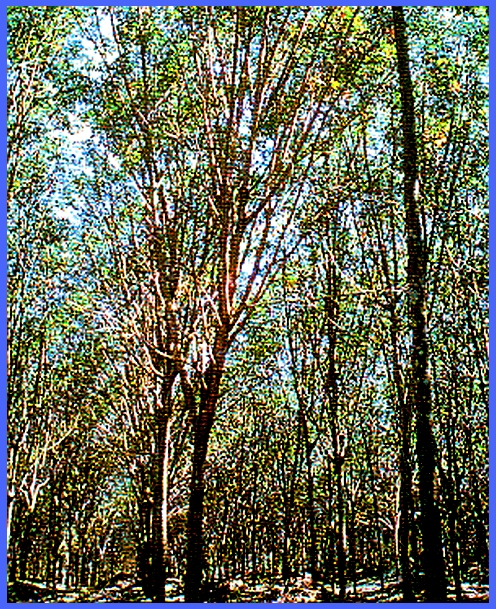
with H. brasiliensis. Rubber Plantation <bot713> Hevea brasiliensis
plantation {Brazil} [CLICK to enlarge)]
In the beginning of the industry only
wild rubber trees are available as a source of rubber. The maximum production was reached in 1910
with an output of 83,000 long tons.
After that with the development of plantation rubber, wild rubber
production steadily declined to as low as 8,500 tons in 1932. Since that time the output has fluctuated,
depending on price and demand. During
World War II wild rubber was again actively exploited. The methods employed in obtaining and
preparing the latex have changed little over the years. The collection of the latex is in the
hands of local residents, called “seringuieros” who are usually in the employ
of absentee owners (Hill 1952). Each
seringuiero is responsible for a single tapping circuit, which contains from
35-180 trees, about 2 or 3 to the acre.
When a new tree is located, it is tapped at a point about 3 ft. above
the ground by cutting several short downward 30-degree panelike incisions in
the bark with a special knife. The
cuts are deep enough to sever the latex vessels but do not extend far enough
to injure the cambium. Cups are
placed below the incisions to receive the latex, which flows for several
hours. The seringuiero makes the
round of his trees each day.
Successive tappings consist of entirely new incisions made slightly
below the previous ones. The latex is
collected from the cups and carried to the camp for coagulation. This is done by coating a pole with latex
and suspending it over a fire made of palm seeds or special woods. These yield a dense smoke containing
acetic acid, creosote, and tars which coagulates the latex, forming a layer
of crude rubber. The process is
repeated until balls weighing 125-200 lb. are obtained. In some areas paddles are dipped in the
latex and held in the smoke. The
balls are shipped to mills for processing. Plantation
Rubber in
the Eastern Hemisphere Henry Wickham transported 70,000 Hevea
seeds from the Amazon to England in 1876.
These were grown at Kew, and enough seedlings were obtained to start a
rubber industry in the eastern tropics, at first in British Malaya and Ceylon
and later in Java, Sumatra and other areas (Hill 1952). There had been earlier attempts at rubber
cultivation, but plantation rubber did not become permanently established
until the beginning of the 20th Century.
In 1910, when Amazon rubber production was at its peak, the East
produced only 11,000 tons. Four years
later it had outstripped its rival, and by the outbreak of World War II, it
was responsible for 98% of the world’s output of 1,500,00 tons, with nine
million acres under cultivation. The rapid development of plantation
rubber in the East may be attributed to a favorable climate, absence of
diseases, low labor costs, and the extensive research program launched by the
British. Every step in the production
of the crop was rigidly supervised, and the best methods of planting,
cultivation, tapping and coagulation were discovered. A selection and breeding program
facilitated an increase in yield. The
discovery of bud grafting allowed that buds of high-yielding plants be
grafted on ordinary seedlings. The
resulting clones differed greatly, and only those with the most desirable
traits were retained. Using such
approved clones began in 1925. By
1945 10% of the plantations had trees that were the result of grafting, and
they obtained a yield of 1500 lb per acre.
The 90%, which still had a random mixture of trees, had a yield of
only 450-500 lb/acre. Where
controlled crosses of high-yield clones were made, yields as much as 2000 lb.
per acre were possible. Not all
plantation rubber was produced on the large estates. The acreage devoted to rubber grown by
small growers was produced in small family gardens and was actually more than
that grown on estates. Plantation Rubber in the Western
Hemisphere Following the imposition of export
restrictions on eastern rubber in 1924, the United States favored the
establishment of plantations in other parts of the world. The Firestone Corporation selected Liberia,
but Ford Motor Co. and Goodyear turned to tropical America, the native area
of Hevea. The 2,500,00-acre
Fordlandia was started in Brazil in 1928, while Goodyear chose Panama and
Costa Rica. All the American efforts
failed after a promising beginning, due primarily to the ravages of leaf
blight, Dothidella ulei, to which plantation rubber in the Western
Hemisphere was very susceptible. It
was obvious that rubber could not succeed as a crop in the American tropics
without adequate disease control. A
research program did produce satisfactory results, however. An effective spray, of copper and sulfur
fungicides with various spreaders and stickers, was developed and could be
used on seedlings. Yield and
resistance experiments were conducted on thousands of wild trees, with the
most desirable being selected for propagation. Fortunately there was a successful importation of approved
eastern clones from a Goodyear plantation in the Philippines. When these were budded on resistant stock
from the jungles, desirable combinations of characters were obtained. Double budding also proved
satisfactory. This involves budding a
high-yielding eastern clone onto a native root as soon as the plant is large
enough. This is grown in a nursery
under spray control until it is 6-10 ft. tall. Then the top is budded with a disease-resistant strain. The resulting rubber tree has a native
root system, a high-yielding eastern clonal trunk, and a disease-resistant
crown. Long-term breeding programs
were continued well into the mid 1900’s, as well as extensive explorations in
the jungle, with the goal of obtaining strains that combined disease
resistance and high yield and which would reduce the expensive spraying and
double-budding practices. The cooperation of the United States
with governments in Latin America resulted in rubber being grown successfully
in many areas. Emphasis was placed on
small family plantings rather than on large plantations. The rubber trees were usually set out at
intervals of 12-24 ft. in tows 20 ft. apart.
Other crops were grown between the rows. Thus, from 1/3rd to 1/2 of the acreage was resting; the balance
was tapped on some alternating program.
At each successive tapping a thin shaving of bark was sliced off the
original panel until it almost reached the ground. One-third, 1/2 and full spirals were used. Following the collection of latex, a
small amount of ammonia or some other anticoagulant was often added to keep
it liquid until it reached the processing area, where it was concentrated and
made into sheet rubber. Cleaning the
latex and pouring it into large pans accomplished this. A coagulant, such as formic or acetic
acid, was added, and in several hours a mass of soft rubber resulted. Blocks of this were washed and run between
rollers to form thin sheets. These
were smoked and baled for shipment.
Other types of crude rubber were also prepared. “Worm rubber” consists of irregular
wormlike pieces cut from sheets with a pair of shears. “Crepe rubber” was made by passing washed
and bleached coagulated latex through a creping machine, which turned out
long, thin, perforated strips of rubber.
In the preparation of “sprayed rubber” latex was dropped on whirling
disks and little particles of rubber were thrown off. Any moisture quickly evaporated. This kind of rubber was exceedingly pure
and clean. Also, steadily increasing
amount of liquid latex was evaporated.
This required immediate processing in the field and was feasible only
for large plantations Panama or Castilla rubber is
from Castilla
elastica,
a tall tree native to southern Mexico and Central America. There are many names for this tree in the
indigenous languages of the region.
It was the chief source of rubber from 1794-1850. Other species of Castilla may also
be used, among which are C. ulei of
the Amazon, the source of caucho rubber. Castilla elastica is found in
deep loamy soil on high ground and may reach a height of 150 ft. It requires temperatures above 60 deg. F.
and requires shade when young. Often
the natives cut these trees down in order to obtain the large possible yield
of latex, which could ultimately lead to this species extinction. Trees are tapped when 8-10 years of
age, with adult trees yielding a maximum of 50 lb. of latex. This is coagulated with plant juices, alum
and by boiling or exposure to the air.
The crude rubber is shipped in flat cakes. Castilla rubber was once extensively cultivated in Central
America in plantations, but it could not compete successfully with Hevea
rubber. The plantations were
abandoned. The surviving trees were
the source of some of the emergency supply of Castilla rubber during World
War II (Hill 1952). Ceara or Manicoba rubber is obtained from Manihot glaziovii, a small tree native
to drier regions in Brazil. It grows
well in dry rocky ground so that it may be utilized in areas unsuitable for
other types of rubber. The tree grows
rapidly, reaching its maximum height of 30 ft. in a few years. Ceara rubber is also grown in Ceylon,
India and other tropical countries.
The trees are tapped when 4-5 years of age and yield a good grade of
rubber. The latex is coagulated by
exposure to air or smoke. The crude
rubber is exported as blocks or flat cakes. Assam or India rubber as it is often called,
is obtained from Ficus
elastica,
a native tree of northern India and Malaya.
The tree requires a hot climate and a high rainfall. It often begins life as an epiphyte. It grows to a great height, developing
huge buttresses or prop roots. The
roots as well as the stem are tapped.
The latex is allowed to drip onto bamboo mats, where it coagulates. A large amount coagulates on the trunk as
well. This crude rubber is scraped
off, cleaned and dried. The native
procedures for tapping the wild trees have been very wasteful, so the tree is
cultivated in some areas. The yield
is low and the trees do not mature until about 50 years of age. Assam rubber is of low grade and has been
of little or no commercial importance. Lagos silk rubber is from Futumia elastica, a large tree of
tropical West Africa. Discovered in
1894, it was immediately exploited to the point of near extermination. In 1898 over 6 million pounds were exported. The tree has been cultivated and an
attempt made to reestablish the industry.
However, plantations of Hevea rubber are the chief source of rubber in
West Africa. Other former sources of African
rubber were several woody climbers in the genus Landolphia. The most important were L. kirkii on the east coast and L. heudelotis and L. owariensis on the west
coast. The huge vines, sometimes 6
in. in diameter. Were pulled down and cut into small pieces. The latex that exuded was coagulated with
plant juices or the heat of the sun, sometimes even on the bodies of the
native collectors (Hill 1952). The
most wasteful methods were employed, for a large immediate yield was desired. There was very barbaric treatment of the
natives involved in this harvest.
Operations in the Belgian Congo during the reign of Leopold II remain
some of the most awful pages in history.
Although there is still a considerable amount of wild landolphia
rubber, there is apparently no future commercial value for it. Cultivation of this plant is not
practical. The guayule, Parthenium argentatum, a native of America,
has been utilized sine 1910 as a minor source of rubber. This low semi-shrubby plant grows in the
arid regions of Mexico and the southern United States. The early Amerindians who obtained the
caoutchouc by chewing the plants knew it.
Unlike the other sources of rubber, there is no latex present in the
guayule plant. There are small
granules of caoutchouc scattered all through the tissues. These are extracted mechanically or by
means of solvents. The entire plant
is pulled up and chopped up or ground with water. The particles of caoutehouc float to the surface and are
removed. They are then dried and
pressed into slabs. If solvents
remove the resinous materials the product is as good as the best Hevea
rubber. Guayule rubber is especially
good for mixing with synthetic rubber substitutes. Guayule has been adapted to plantation culture and it was
extensively investigated as part of the Emergency Rubber Program during World
War II. The yield has been increased;
the life cycle shortened, and improved cultural, harvesting, and processing
machinery developed. Production costs
are still high so that it does not compete with Hevea rubber except in
emergencies. The importance of
guayule for the future lies in the fact that it constitutes a living
stockpile of rubber on land which otherwise would be idle (Hill 1952). The dandelion of Russia, Taraxacum kok-saghys, is a close relative
of the common dandelion. In 1931
Russian botanists discovered it while searching for new economic plants. Rubber is present in considerable
quantities in latex tubes in the long taproots. The yield has been increased by selection and breeding, and the
plant was grown on some 2 million acres during the time of the Soviet
Union. Seeds were brought to the
United States in 1942 and planted experimentally in 42 states. Vigorous plants with greater root weight
and rubber content were segregated.
Hill (1952) believed that a yield of 400-500 lb. per acre could be
achieved through continued research.
The plant is well adapted to the northern United States and Canada,
where it can be harvested the year it is planted. Under the most favorable conditions it might be profitable to
grow this species as a minor source of rubber, and indeed was cultivated for
this purpose in Argentina. Other species of plants have been
considered as a possible source of rubber.
Among these are Intisy
(Euphorbia
intisy). This leafless shrub of arid regions of
Madagascar contains latex that has had considerable use locally. The rubber coagulates on the surface of
the plant in long elastic strands and is of high grade. Attempts have been made to cultivate
intisy in the United States because of its adaptation to desert conditions. Cryptostegia grandiflora and C. madagascariensis are ornamental woody
climbers from Madagascar. They are
now found in the tropics and subtropics of both hemispheres and were
seriously considered during World War II as a new source of rubber. Both species have been grown for many
years in India as a source of high-grade palay rubber. They are abundant in Mexico, occuring
there in a wide variety of soils and climates. They seem the hardiest and fastest growing of all rubber
plants, attaining harvest age within six months. They seem to offer considerable future promise, but attempts in
Haiti to grow them on a large scale failed due to difficulties of extracting
the rubber. Other rubber-bearing plants of local
importance include the Mangabeira
(Hancornia speciosa), a shrub or small
tree of Bolivia, Brazil and Paraguay; a species of Micrandra, which yields the caura
rubber of Venezuela; and various species of Sapium in northern South
America. Also a few native North
American plants have rubber-contining latex.
Among those, which have been given some attention, are the Desert milkweed (Asclepias
subulata);
the Indian
hemp (Apocynum scannabinum); several Goldenrods, in particular Solidago leavenworthii, which was
investigated by Thomas A. Edison; species of the Rabbit
brush (Chrysothamnus), the source of Chrysil rubber; and species of Cnidoscolus from which Chilte rubber is obtained. Other
Latex Products Gutta-percha is a nonelestic rubber
obtained from the grayish-white latex of several members of the
Sapolaceae. It has been known since
1842. The chief source is Palaguium gutta, a tree of Malayan
origin, which has been grown in Borneo, Sumatra, the Philippines and other
tropical countries. The latex is produced in sacs, which occur in the cortex,
phloem, pith and leaves. It is
obtained by making incisions from which the milky juice runs out very slowly,
or by felling the trees. The latter
is the usual method. The bark is
removed in strips one inch in with and one foot apart, and the latex is
collected in coconut shells or in palm of plantain leaves. The latex soon coagulates into grayish-yellow
masses of a hard substance, which is odorless and heavier than water. This crude product contains several resins
and other impurities and is purified by washing in hot water. The whole mass is boiled and then kneaded
into blocks, or it is chopped or sliced up and the pieces are washed,
strained and kneaded, and then rolled into thin sheets (Hill 1952). The value of gutta-percha depends on the
amount of a hydrocarbon, gutta that is present. Gutta-percha is hard at ordinary
temperatures. It deteriorates very
rapidly when exposed to air through oxidation and should be kept under
water. It softens at 77 degrees
Fahrenheit, can be kneaded at 122 deg. F., and melts at 248 deg. F. Because it is an exceedingly poor
conductor of electricity it has been used for insulation. For many years no other material could
replace gutta-percha and the similar balata in the construction of submarine
cables, which require a substance that is resistant to salt water, pliable
and with just the right amount of rigidity.
Other uses included splints, supports, pipes, golf balls,
speakingtubes, telephone receivers, waterproofing and adhesives. It has also been utilized for protecting
wounds and in dentistry. Balata is a nonelastic rubber that is obtained
from the latex of Manilkara
bidentata,
formerly known as Mimusops balata, and other species of the
genus. It is a native of Trinidad and
South America. This magnificent tree
grows to a height of over 100 ft.
When mature its purplish wood is very hard and durable and is much
used for ties and building purposes under the name of bully wood or
bulletwood. The fruit is also
edible. The latex is obtained by
tapping the trees three times each year.
It flows freely and readily coagulates in the air. A tree 3 ft. in circumference will yield
50-100 lbs. of dry balata. After
coagulation it is cleaned and molded into cakes. Balata contains about 50% gum.
It serves the same purpose in industry as gutta-percha. It is particularly well adapted for machine
beltings as it grips tightly and never stretches. It is also used as a substitute for chicle. Balata has been known since 1859, but
unlike gutta-percha, it has never been cultivated. Several inferior types of balata are
found in the Amazon region, chief of which is Abiurana or Coquilana obtained from Ecclinusa balata. Jelutong is obtained mainly
from Dyera costulata and related species from Malaya. These trees have a copious flow of latex,
greater than all the other latex species combined. From 1910-1015 this was exploited as a source of rubber. However, the latex is combined with many
gums, resins and other impurities, and it yielded a poor quality of
rubber. Jelutong has been used mainly
as a substitute for chicle. Sapodilla or naseberry
(Achras zapota) is a tall evergreen
tree native to the Yucatan Peninsula of Mexico. It is cultivated in tropical America and Florida for its edible
fruit. The bark contains latex,
20-25% of which consists of a gum, or chicle, similar to that of
gutta-percha. It is the basis of the
chewing-gum industry but is also used in making surgical tape and dental
supplies. The primitive method of obtaining
chicle involves tapping the trunk and then scraping the thickened exudates
from the bark. The crude or leaf
chicle consists of pink or reddish-brown pieces mixed with 25-40%
impurities. In southeastern Mexico
and British Honduras where the industry occurs most abundantly, the native
collectors or chicleros are more careful.
Zigzag gashes are cut in the trunk with a machete, up to a height of
30 ft. The latex runs to the base of
the tree where it is collected in rubberized bags, leaves or even hollows in
the earth. This accounts for the
grains of sand that are oftentimes found in chewing gum. The flow of latex lasts for several hours
and the yield may be as much as 55 liters.
In order to conserve the supply, plantations were established. However, these were not practicable
because the trees can be tapped only every 2-3 years. The hardened chicle is boiled; a
process that requires considerable skill, for the chicle must be poured off
when the moisture content reaches 33%.
It is then molded into blocks for shipment. Raw chicle contains resin, gutta, arabin, calcium, sugar and
various soluble salts. Purification
involves breaking the blocks into small pieces, washing in a strong alkali,
neutralizing with sodium acid phosphate, washing again and finally drying and
powdering. The final product is an amorphous
pale-pink powder, which is insoluble in water and forms a very sticky mass
when heated. Ageing partially
oxidizes the mixture that then turns brown and becomes very brittle. The final steps in the manufacture of
chewing gum involves cleaning, filtering, sterilizing and compounding with
various flavoring materials. Thirteen
pounds of the final product yields about 5000 pieces of chewing gum. A piece of gum usually contains about 15%
chicle, the remainder being chicle substitutes, sugar and flavoring
substances. Attempts to find
substitutes have not been very successful, but inferior latex from other sapodillas, balata and jelutong are all utilized to
some extent. Sorva or Leche caspi, obtained from Couma macrocarpa, a large tree of the
upper Amazon, was exploited during World War II. The tree, which has very abundant latex, is felled, ringed and
the latex is collected in cups made from palm leaflets. The latex is then coagulated by boiling
and is shipped in the form of large blocks.
The white wood of this species is also used for furniture, and the
fruits have a mucilaginous but edible pulp. By 1952 the United States was the
greatest chewing-gum market and used about the entire output of chicle. The supply was chiefly from Mexico, Guatemala
and British Honduras. |