FILE: <ch-87.htm> GENERAL INDEX [Navigate to MAIN MENU ]
|
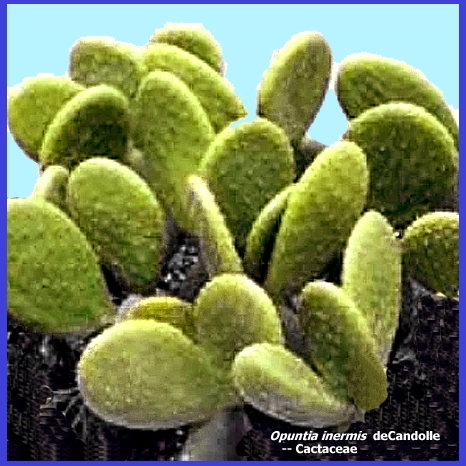
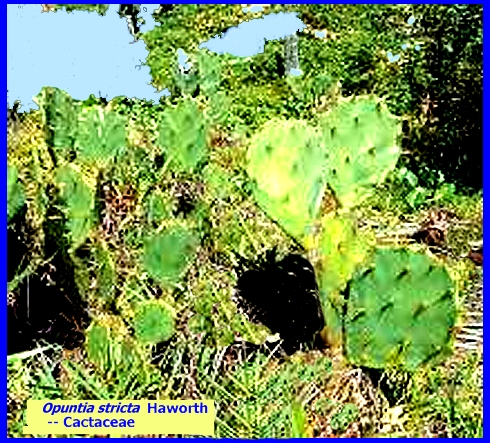
PRICKLY PEAR CACTUS Opuntia inermis deCandolle & Opuntia stricta Haworth -- Cactaceae (Contacts) ----- CLICK on Photo to enlarge &
search for Subject Matter with Ctrl/F. GO TO ALL: Bio-Control Cases The earliest record
of the biological control of a noxious plant involved the intentional
introduction of the cochineal insect, Dactylopius
ceylonicus (Green) to
northern India from Brazil in 1795 in the false assumption that it was D. coccus Costa, a species cultured commercially as a source
of carmine dye.
Instead of
reproducing well on the cultivated, spineless prickly pear cactus, Opuntia ficus-indica
(L.) Miller, D. ceylonicus readily transferred
to its natural host plant, O.
vulgaris Miller, that had
become widespread in India when it escaped cultivation in the absence of its
South American natural enemies. Once
the value of D. ceylonicus as a biological
control agent was recognized, it was introduced in 1836-1838 to southern
India, where it brought about the first successful, intentional use of an
insect to control a noxious plant.
Shortly before 1865, D.
ceylonicus also was
transferred from India to Sri Lanka which resulted in the successful control
of O. vulgaris throughout the island (Goeden 1978, Moran &
Zimmerman 1984). An attempt was made
to introduce D. ceylonicus to Australia from
Ceylon and India in 1903, without success (Goeden 1978, Moran & Zimmerman
1984). Then an intensive Australian
effort on the biological control of prickly pear cacti (Opuntia spp.) began in 1913-1914, when the two membered
Prickly-Pear Travelling Commission surveyed the insects and pathogens
associated with these plants in Java, Sri Lanka, India, East Africa, South
Africa, the Canary Islands, littoral Mediterranean countries, the United
States, Mexico and parts of Central America, the West Indies, South America
and Hawaii (Johnston & Tryon 1914).
This effort of worldwide exploration for natural enemies of a group of
noxious plants remains unequalled in scope of geographic coverage. Biological control
of the prickly pear cacti, Opuntia
inermis deCandolle and O. stricta Haworth in Australia ranks as one of the most
successful projects in biological control of noxious plants. The project followed the initial efforts
of the Prickly Pear Travelling Commission, which first recognized the
potential value of what was later to become the principal natural enemy, the
moth, Cactoblastis cactorum (Berg) (Lepidoptera:
Pyralidae) (Goeden & Andrés 1999).
The principal entomological effort in this biological control project
occurred during the 1920's when North and South America, particularly the
southern United States, Mexico and Argentina, were thoroughly explored for
potentially useful, cactus-feeding insects.
More than 150 species of cactus insects eventually were collected and
studied, many of which were new to science.
From 1921 to 1925, 48 species were imported into Australia, of which
19 were liberated and 11 became established (Goeden & Andrés 1999). A single
consignment of C. cactorum was imported from
Argentina in 1925. Large scale mass
culture and host plant specificity tests with useful and weedy plant species
were undertaken for the first time in a biological control project. Cactoblastis
cactorum became widely
established following the distribution of more than 2.7 billion mass reared
and field collected eggs between 1925 and 1933. Almost 90% of the original stands of O. inermis
and O. stricta were destroyed by 1934 through larval feeding by
this moth, supplemented by airborne, soft-rot bacteria for which the borers
provided entrance wounds into infested plants. Virtually complete control of the cacti was achieved in
Queensland and northern New South Wales involving 24 million ha of formerly
infested land that was restored to agricultural use (Dodd 1940, Goeden 1978,
Moran & Zimmerman 1984). The spectacular
success of Cactoblastis cactorum tended to eclipse the
benefits derived from other cactus insects used in biological control,
notably several species of cochineal insects (Moran & Zimmerman
1984). For example, Dactylopius ceylonicus was successfully
reintroduced to Australia during 1913-1915 and virtually eliminated O. vulgaris as a rangeland weed in Queensland. Both C.
cactorum and Dactylopius spp. were
transferred during the mid 1920's and 1930's to countries where prickly pear
cacti also were introduced pests:
Indonesia, Mauritius, New Caledonia, Reunion and South Africa (Rao et
al. 1971, Greathead 1971, Goeden 1978).
In South Africa and Mauritius these early successful transfer projects
led to the independent development of other successful research projects in
the biological control of noxious plants (Greathead et al. 1971, Goeden 1978,
Julien 1982, 1987). Details of
the Collections
DeBach (1974)
expounding on the prickly pear cactus in Australia, stated that it was a
massive, long term project comparable to the gypsy and brown tail moth
project and represents the first striking success in biological control of a
weed. Many entomologists and
assistants were employed and a lot of foreign exploration carried out in the
Americas ranging from the United States to Argentina. DeBach (1974) considered it ironic that
but for an unfortunate circumstance, the natural enemy Cactoblastis cactorum
berg, which caused the ultimate destruction of the prickly pear, could have
expressed itself at least 10 years earlier than it did and with a minimum of
cost. It would have been another
simple, nearly miraculous success like the cottony-cushion scale
project. Apparently Mr. Henry Tyron,
one of a pair of members of a Queensland Prickly Pear Travelling Commission,
was impressed by the potentialities of the Cactoblastis work he saw in Argentina and actually brought
a small number of larvae back to Australia in 1914; unfortunately he was not
able to rear these to maturity. No
further project activity occurred until 1920 and Cactoblastis was not imported until 1925. The enormity of the
prickly pear problem in Australia is difficult to visualize. Evidently various species were brought by
the early settlers as ornamentals and escaped. Two species, Opuntia
inermis and Opuntia stricta, assumed major catastrophic pest proportions but
several others were pests in more localized areas. These two became established in the 1800's when Australia was
being opened for grazing and the human population was sparse. After 1900 the cacti spread rapidly,
reaching a peak around 1925 when 60,000,000 acres were heavily infested,
30,000,000 of which were so dense that the land was completely useless. Hundreds of miles were impenetrable to
humans or animals. Otherwise it was
good grazing land with potential for dairying and general farming. Eighty percent of the infested land was in
Queensland and 20% in New South Wales.
The cost of chemical or mechanical control was more than the land was
worth. During the peak years the rate
of spread of the cacti was alarming; year by year more land became unoccupied
and more holdings and homesteads deserted (DeBach 1974). The project that
led to ultimate and complete success began with the appointment of the
Commonwealth Prickly Pear Board in 1920.
Their first approach was to send entomologists to America and to
establish insectaries and quarantine facilities in Australia. They decided early to concentrate on
cactus-feeding insects rather than disease organisms because disease did not
appear to be important in the field.
Several diseases occurred accidentally in Australia already, and there
was the question of diseases transferring to other plants. All told there were
150 species of insects discovered that were restricted to feeding on
cacti. About 50 species were sent to
Australia, totaling more than 500,000 individuals. All imported material was screened through a central quarantine
and culture laboratory at Brisbane and subjected to starvation tests on a
wide variety of other plants before being sent out to local breeding or
colonization stations. Final tabulation
showed that 12 species of prickly pear insects had become established and
were exerting some measure of control when the establishment and final
success by Cactoblastis put
an end to further trials. Larvae of Cactoblastis cactorum were collected, apparently
by Alan P. Dodd, at Concordia, Argentina in late January 1925, and taken to
Buenos Aires. DeBach (1974) notes
that they came from two different species of Opuntia than those they were destined to attack in
Australia. Moths emerged in February and
readily laid many eggs. Six Wardian
cages were filled with Opuntia
for food and 3,000 Cactoblastis
eggs were placed on the prickly pear in the cages. In March the shipment went by steamer via Cape Town to
Australia. Some 25 larvae were
removed for examination at Cape Town so the original shipment then included
2,750, and this gave rise to all Australian stocks. The unsupervised cages arrived in Brisbane 10 weeks and 14,000
miles later in May 1925 in excellent condition. They contained primarily half grown larvae. This was possible because cactus pads may
last several months. These larvae
were given food and they successfully pupated in August-September 1925,
producing 1,137 cocoons. There were
1,70 moths emerged which produced 100,605 eggs, a return of nearly 36X. eBach (1974)
considers that had this shipment not succeeded, it is doubtful whether or at
least when, another would have been made.
Dodd returned to North America following the shipment because
Argentina had a limited fauna of Opuntia
insects and he had no particular reason to believe that Cactoblastis might be more successful than other Opuntia feeding insects. According to Dodd, "certainly, its
remarkable achievement could not have been foretold." Therefore, if the one shipment had not
resulted in establishment, further investigations in Argentina may not have
been undertaken for some years. The first
colonizations of Cactoblastis
consisting of 2,263,150 eggs were made in various localities in Queensland
and New South Wales during February-March 1926. By March 1927, 10,196,150 eggs had been released in the
field. Redistribution of eggs
obtained from field material finally amounted to 389,225,520 by November
1929. Establishment and increase
occurred so rapidly that by 1930-2 the general collapse and destruction of
the original stands of prickly pear had occurred. Miles of dense growth collapsed in a few months under the
concentrated attack of enormous numbers of larvae. According to Dodd the most optimistic scientific opinion could
not have foreseen the extent and completeness of the destruction. The spectacle of miles of heavy prickly
pear growth collapsing en masse and disappearing in the
short time of a few years did not appear to fall within the bounds of
possibility. The other cactus natural
enemies were generally eliminated at the same time but this did not make a
difference. Following the die back of
the cactus plants, the Cactoblastis
population naturally collapsed and during 1932-3 a heavy regrowth of cactus
occurred from the roots. However, Cactoblastis responded to this
and destroyed the regrowth during 1933-5.
From then on until now the prickly pears have remained under almost
complete control and the former densely infested country reclaimed and
brought into production (Dodd 1940). For further details
on biological control effort and biologies of host and natural enemies,
please also see the following (Tryon 1910, 1911; Hunter et al. 1912, Warren
1914, White-Haney 1914, 1915, 1916; Johnston 1921, 1924; Hamlin 1924a, 1924b,
1925, 1932; Alexander 1925, Dodd 1927a, 1927b, 1929, 1960; Kunhi-Kannan 1928,
1930; Hutson 1926, Imms 1931, Jepson 1930, Ayyar 1931, Sweetman 1935, Pettey
1943, 1946, 1948, 1950, 1953; Bailey 1949, Sellers 1952, David &
Mathukrishnan 1953, Fullaway 1954, 1958; Williams 1954, Naude 1955, Pemberton
1957, Anonymous 1960, Simmonds 1960, Wilson 1960, Holloway 1964, Davis 1966,
Goeden et al. 1967, 1968, Greathead 1967). REFERENCES: [Additional references may be found at: MELVYL
Library ] Anonymous. 1960. Kenya.
I. REview of entomological
work of the Department of Agriculture.
In: 7th Commonwealth Ent. Conf., Rept., July
6-15, 1960, London. p. 298-303. Alexander, W. B.
1925. Natural enemies of
prickly pear and their introduction into Australia. Austral. Comm. Inst. Sci. Ind. Bull. 29. 80 p. Annecke, D. P., M. Karny & W. A. Burger. 1969.
Improved biological control of the prickly pear, Opuntia megacantha
Salm-Dyck, in South Africa through use of an insecticide. Phytophylactica 1: 9-13. Ayyar, T. V. R.
1931. The Coccidae of the
prickly-pear in south India and their economic importance. Agric. & Livestock in India 1: 229-37. Bailey, L. H. 1949. Manual of Cultivated Plants. Rev.ed.
MacMillan Co., New York. 1116 p. DeBach, P.
1974. Biological Control by Natural Enemies.
Cambridge University Press, London & New York. 323 p. David, A. L. & T. S. Muthukrishnan. 1953. The prickly pear
cochineal, observations on its natural hosts and enemies in south India. Indian J. Ent. 15: 219-24. Davis, C. J. 1966. Progress report: Biological control status of noxious weed pests in
Hawaii--1965-1966. Hawaii Dept.
Agric. Rept. 4 p. Dodd, A. P. 1927a. The biological control of the prickly
pear. Austral. Council Sci. &
Indus. Res. Bull. 34. 44 p. Dodd. A. P. 1927b. The biological control of the prickly
pear. Austral. Council Sci. &
Indus. Res. J. 1: 48-54. Dodd, A. P. 1929. The progress of biological control of
prickly pear in Australia.
Commonwealth Prickly Pear Bd., Brisbane. 44 p. Dodd, A. P. 1940. The biological campaign against prickly
pear. Commonw. Prickly Pear Board,
Brisbane, Australia. 177p. Dodd, A. P. 1960. Biological control investigation projects
in Queensland. 3rd Austral. Weed
Conf. Proc. 1, Paper 4. 27 p. Fullaway, D. T.
1954. Biological control of
cactus in Hawaii. J. Econ.
Ent. 47: 696-700. Fullaway, D. T.
1958. Biological control of Opuntia megacantha and Lantana
camara in Hawaii. 10th Internatl. Cong. Ent. Proc. 4: 549-52. Goeden, R. D., C. A. Fleschner & D. W.
Ricker. 1967.
Biological control of prickly pear cacti on Santa Cruz Island,
California. Hilgardia 38: 579-606. Goeden, R. D., C. A. Fleschner & D. W.
Ricker. 1968.
Insects control prickly pear cactus.
Calif. Agric. 22: 8-10. Goeden, R. D. 1978. Part II:
Biological control of weeds, p. 357-545. In: C. P. Clausen (ed.), Introduced Parasites
and Predators of Arthropod Pests and Weeds: A World Review. U. S. Dept. Agric. Handb. No. 480. Goeden, R. D. & L. A. Andrés. 1999. Biological control
of weeds in terrestrial and aquatic environments. In: Bellows, T. S. & T. W. Fisher (eds.), Handbook of Biological Control: Principles and Applications. Academic Press, San Diego, New York. 1046 p. Greathead, D. J.
1967. A list of the more
important weeds of East Africa.
Commonwealth Inst. Biol. Control Tech. Rept. 7 p. Greathead, D. J.
1971. A review of biological
control in the Ethiopian Region.
Commonw. Inst. Biol. Contr. Tech. Comm. No. 5: 1-172. Hamlin, J. C. 1924a. Biological control of prickly pear in
Australia, contributing efforts in North America. J. Econ. Ent. 17:
447-60. Hamlin, J. C. 1924b. A review of the genus Chelinidea (Hemiptera-Heteroptera) with biological
data. Ann. Ent. Soc. Amer. 17: 193-208. Hamlin, J. C. 1925. Biological notes on important Opuntia insects of the United
States. Pan-Pacific Ent. 2: 97-105. Hamlin, J. C. 1932. An inquiry into the stability and
restriction of feeding habits of certain cactus insects. Ann. Ent. Soc. Amer. 25:
89-120. Hunter, W. D., F. C. Pratt & J. D. Mitchell. 1912.
The principal cactus insects of the United States. U. S. Dept. Agric. Ent. Bull. 113. 71 p. Hutson, J. C. 1926. Prickly pear and cochineal insects. Trop. Agric. (Ceylon) 67: 1-3. Holloway, J. K.
1964. Projects in biological
control of weeds, p. 650-70. In: P. DeBach (ed.), Biological Control of Insect Pests and
Weeds. Reinhold Publ. Co., New
York. 844 p. Imms, A. D.
1931. Biological control. II.
Noxious weeds. Trop. Agric.
(Trinidad) 8: 124-27. Jepson, F. P. 1930. Present position in regard to the control
of prickly-pear (Opuntia dillenii Haw.) in Ceylon by the
introduced cochineal insect Dactylopius
tomentosus Lamk. Trop. Agric. (Ceylon) 75: 63-72. Johnston, T. H. 1921. Biological
control of the prickly-pear pest.
Queensland Agric. J. 16: 65-8. Johnston, T. H.
1924. The Australian
prickly-pear problem. Austral. Assoc.
Adv. Sci. Rept. 16: 347-401. Johnston, T. H. & H. Tryon.
1914. Report on the
prickly-pear travelling commission, 1st November, 1912-30th April, 1914. Parliamentary Paper, Comming, Brisbane,
Australia. 132 p. Julien, M. H. (ed.). 1982. Biological control
of weeds: a world catalogue of agents
and their target weeds, 1st ed.
Commonw. Agric. Bur., Slough, U.K.
108 p. Julien, M. H. (ed.). 1987. Biological control of
weeds: a world catalogue of agents
and their target weeds, 2nd ed.
Commonw. Agric. Bur. Int., Wallingford, U.K. 150p. Kunhi-Kannan, K. 1928. The introduction of a new insect into
Mysore. Mysore (India) Agric. J. 8: 141-45. Kunhi-Kannan, K. 1930. Control of cactus in Mysore by means of
insects. Mysore (India) Agric. J. 11: 94-8. Moran, V. C. & H. G. Zimmerman. 1984. The biological
control of cactus weeds: achievements
and prospects. Biocontr. News Info.
5: 297-320. Naude, T. J. 1955. Biological control of prickly pear. Farming in South Africa 30: 493-94.
523. Pemberton, C. E.
1957. Progress in the
biological control of undesirable plants in Hawaii. 9th Pacific Sci. Cong. Proc. 9: 124-26. Pettey, F. W. 1943. Prickly-pear eradication by insects and
felling of plants. Farming in South
Africa 18: 743-46. Pettey, F. W. 1946. Biological control of prickly pear. Farming in South Africa 21: 31-3. Pettey, F. W. 1948. The biological control of prickly pears in
South Africa. South Africa Dept.
Agric. Sci. Bull. 271. 161 p. Pettey, F. W. 1950. The cochineal (Dactylopius opuntiae)
and the problem of its control in spineless cactus plantations. I.
Its history, distribution, biology, and what it has accomplished in
the control of prickly pear in South Africa.
South Africa Dept. Agric. Bull. 296.
12 p. Pettey, F. W. 1953. The boring beetles of prickly pear in
South Africa and their importance in the control of Opuntia megacantha. South Africa Dept. Agric. Bull. 340. 36 p. Rao, V. P., M. A. Ghani, T. Sankaran & K. C. Mathur. 1971.
A review of the biological control of insects and other pests in
south-east Asia and the Pacific Region.
Commonw. Inst. Biol. Contr. Tech. Commun. No. 6: 1-149. Sellers, W. F. 1952. The collection of the cactus weevil, Cactophagous spinolae (Gylh.) in Mexico and
its dispatch to South Africa. Bull.
Ent. Res. 43: 43-50. Simmonds, F. J.
1960. Report on a tour of
Commonwealth countries in Africa March-June 1960. Commonwealth Agric. Bur. London. 98 p. Simmonds, F. J. & F. D. Bennett. 1966. Biological
control of Opuntia spp. by Cactoblastis cactorum in the Leeward Islands
(West Indies). Entomophaga 11: 183-89. Sweetman, H. L.
1935. Successful examples of
biological control of pest insects and plants. Bull. Ent. Res. 26:
373-77. Tryon, H. 1910. The "Wild Cochineal Insect",
with reference to its injurious action on prickly pear (Opuntia spp.) in India, etc., and its availability for the
subjugation of this plant in Queensland and elsewhere. Queensland Agric. J. 25: 188-97. Tryon, H. 1911. The insect enemies of the prickly
pear. Queensland Agric. J. (n.s.)
2: 402-05. van der Goot, P. 1940. The biological control of prickly pear in
the Palu Valley, North Celebes. Landbouw
(Buitenzorg, Java) 16: 1-17. [in Dutch with English summary]. Warren, E. 1914. The prickly pear pest. Union of South Africa Agric. J. 7: 387-91. White-Haney, J.
1914. Report of the officer in
charge of the prickly-pear experimental station, Dulacca, up to 30th June,
1913. Appendix IV. Queensland Dept. Public Lands Ann. Rept.
for 1912 & 1913. 63 p. White-Haney, J.
1915. Report of the officer in
charge of the prickly-pear experimental station, Dulacca, from 1st May, 1914,
to 30th April, 1915. Appendix
IV. Queensland Dept. Public Lands
Ann. Rept. 45 p. White-Haney, J.
1916. Report of the officer in
charge of the prickly-pear experimental station, Dulacca, from 1st May 1l15,
to 30th June 1916. Appendix IV. Queensland Dept. Public Lands Ann.
Rept. 45 p. Williams, J. R.
1954. Mauritius. Review of agricultural entomology during
the period 1948-1954. 6th
Commonwealth Ent. Conf. Rept.:
281-84. Wilson, F. 1960. A review of the biological control of
insects and weeds in Australia and Australian New Guinea. Commonwealth Inst. Biol. Control, TEch.
Commun. 1. 102 p. |