FILE:
<ch-84.htm> GENERAL INDEX [Navigate to MAIN MENU ]
|
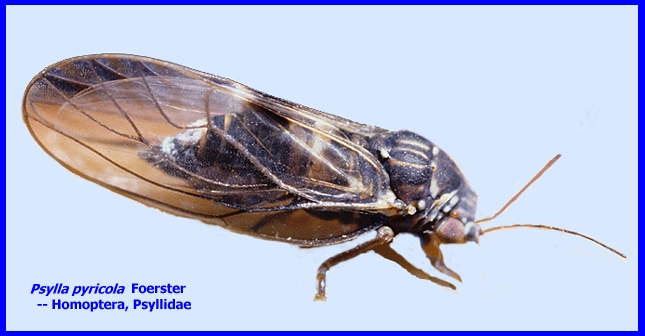
PEAR PSYLLA Psylla pyricola
Foerster -- Homoptera, Psyllidae (Contacts) ----- CLICK on Photo to enlarge &
search for Subject Matter with Ctrl/F. GO TO ALL: Bio-Control Cases
In Canada natural
enemies were imported beginning in 1962, when shipments of the predator Anthocoris nemoralis (F.) were obtained from Switzerland, followed by
A. menorum (L.), A.
pilosus (Jak.) and the encyrtid
parasitoid P. mitratus. Field releases at Summerland, British
Columbia in 1963 were in only small numbers (Clausen 1978). However, a low number release of A. nemoralis at Summerland resulted in establishment. The predator became very abundant at the
release site by 1966 and had dispersed to other orchards at least 1.5 miles
distant (McMullen & Jong 1967). Prionomitus mitratus was recovered from 1st
generation host nymphs in 1964, not only at the release site but at three
other points up to 45 miles distant, although in very small numbers. This parasitoid had previously been
recorded from native Psyllidae on the Pacific Coast, and McMullen (1966)
believed that it was already present in British Columbia before the release
of the imported stocks. The
cecidomyiid parasitoid Endopsylla
agilis Meij. was obtained
from Germany after 1966, but no other information is available. In the United
States stocks of P. mitratus and Trechnites psyllae (Ruschka) were imported from Switzerland during
1965, and releases in infested orchards in northern and central California
during 1965-68 totaled 13,894 and 5,134, respectively. However, again information is lacking
regarding recoveries; but Jensen (1957) reported the P. mitratus
as parasitic on several genera of Psyllidae in California. REFERENCES: [Additional
references may be found at: MELVYL Library ] Burts, E. C. & W. R. Fischer. 1967.
Mating behavior, egg production and egg fertility in the pear
psylla. J. Econ.
Ent. 60: 1297-1300. Clausen, C.
P. 1978. Psyllidae. In: C. P. Clausen (ed.), Introduced Parasites
and Predators of Arthropod Pests and Weeds: A World Review. U. S. Dept. Agric., Agric. Handbk. No.
480. 545 p. Croft, B. A. & W. Bode. 1983.
Tactics for deciduous tree fruit IPM.
Chapter 8, p. 219-70. In: B. A. Croft & S. C. Hoyt (eds.), Integrated Management of
Insect Pests of Pome and Stone Fruit Insect Pests. Wiley Intersci., New York.
456 p. Croft, B. A. & M. T. AliNiazee. 1999.
Biological control in deciduous tree fruit crops, IN: Bellows, T. S. & T. W. Fisher (eds.), Handbook of Biological Control: Principles and Applications. Academic Press, San Diego, New York. 1046 p. Jensen, D.
D. 1957. Parasites of the
Psyllidae. Hilgardia 27: 71-99. Madsen, H. F., P. H. Westigard & R. L.
Sisson. 1963. Observations on the natural control of the
pear psylla, Psylla pyricola Forster, in
California. Canad. Ent. 95: 837-44. Madsen, H. F. & T. T. Y. Wong. 1964.
Effects of predators on control of pear psylla. Calif. Agr. 18(2): 2-3. McMullen, R. D. 1966. New records of
chalcidoid parasites and hyperparasites of Psylla pyricola
Forster in British Columbia. Canad.
Ent. 98: 236-239. McMullen, R. D. & C. Jong. 1967a.
The influence of three insecticides on predation of the pear psylla, Psylla pyricola. Canad.
Ent. 99: 1292-97. McMullen, R. D. & C. Jong. 1967b.
New records and discussion of predators of the pear psylla, Psylla pyricola Forster, in British Columbia. J. Ent. Soc. Brit. Colum. 64: 35-40. Metcalf, C. L. & W. P. Flint. 1939.
Destructive and Useful Insects. Ed. 2. McGraw-Hill, New York & London. 981 p. Nickel, J.,
L., J. T. Shimizu & T. T. Y. Wong.
1965. Studies on natural control of pear psylla
in California. J. Econ.
Ent. 58: 970-76. Shimizu, J.
1970. The influence of natural
enemies on field-caged pear psylla.
Calif. Agr. (1970).Westigard, P. H. & H. F. Madsen. 1963.
Pear psylla in abandoned orchards.
Calif. Agr. 17(1): 6-8. |