FILE: <ch-82.htm> GENERAL INDEX [Navigate to MAIN MENU ]
|
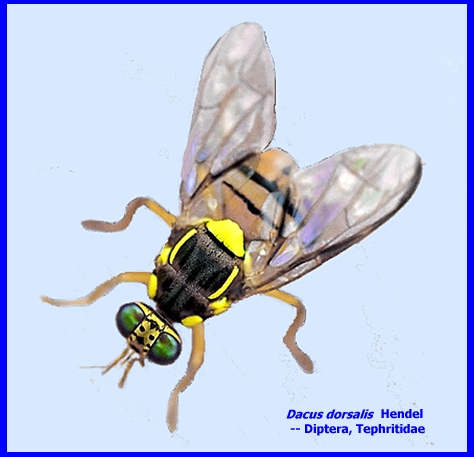
ORIENTAL FRUIT FLY Dacus dorsalis
Hendel -- Diptera, Tephritidae (Contacts) ----- CLICK on Photo to enlarge &
search for Subject Matter with Ctrl/F. GO TO ALL: Bio-Control Cases
The Hawaiian
Territorial Board of Agriculture and Forestry initiated explorations for
natural enemies in 1947-8 in the Philippines and Malaysia. Although it was impossible to ascertain
the identity of the parasitoids being imported, it is apparent that the
success obtained was due to the importations made at this time. Thus, in 1948-9 other interested
organizations joined into a cooperative effort, including the USDA, the
University of California, The Hawaiian Agricultural Experiment Station, the
Hawaiian Sugar Planters Experiment Station and the Pineapple Research
Institute. By 1951, fourteen
explorers collected parasitoids from many fruit fly species in most of the
tropical and subtropical areas of the world including especially the
Philippines, Malaysia, Taiwan, Thailand, Borneo, India, Sri Lanka, Australia,
New Caledonia, Fiji, South Africa, Kenya, Congo, Brazil and Mexico. Shipments were mostly of parasitized
puparia sent by airmail or air freight and usually reached Hawaii in seven
days or less from any given area.
There were more than 4,246,000 fly puparia of over 60 species sent to
Hawaii. About 1/3rd of these were Dacus dorsalis. About 80
species of parasitoids were obtained, of which at least 16 larval parasitoids
of the genus Opius, six
pupal parasitoids and one predator were cultured and released in the
field. Recovery was made of 11
species initially, but one species became dominant. DeBach (1974)
relates that the story is somewhat confused because various of the imported
species of Opius were very
similar in appearance and some were misidentified initially. Therefore, the original material received
from the Philippines in 1947 contained the three most important of all the
parasitoids eventually imported, but only one of these, Opius longicaudatus
(Ashmead) was correctly identified.
The other two, Opius vandenboschi Fullaway and Opius oophilus Fullaway were thought to be one species. Opius
persulcatus (Silvestri),
which actually was never present. The
same applied to the next group of shipments received from Malaysia in
1948. Parasitoids from these
shipments became readily established.
Opius longicaudatus increased rapidly
in the field after its initial release on Oahu in 1948 but suddenly lost its
dominant position during the latter half of 1948 to O. vandenboschi
which had been released initially about the same time. Later O.
vandenboschi was replaced by
O. oophilus which had first been recognized to be established
in 1949. In spite of the competition
between these three species, each replacement of one by another was
accompanied by a higher total parasitism and a greater reduction in the fruit
fly infestation (DeBach 1974). Both O. longicaudatus and O.
vandenboschi had virtually disappeared
by 1951 and this status has since continued.
The final result
has been a very substantial reduction in the Oriental fruit fly populations
in all of the Islands estimated to be on the order of 95% as compared to the
1947-9 peak abundance. At that time
practically 100% of most kinds of fruits were infested. The threat of movement to the mainland has
been greatly reduced. Still, some
preferred fruit such as guava and mangoes, which up to 1949 were 100%
infested, are sometimes infested to ca. 50%, but with many fewer larvae per
fruit. Yet on the average less than
10% of the mangoes are now infested, and many kinds of fruits that were once
heavily infested are not practically free of attack (DeBach 1974). DeBach (1974)
stated that this project illustrates the basic importance of accurate
knowledge of both taxonomy and biology to biological control. Opius
oophilus was mistaken for
some time as O. persulcatus. Had the latter been imported and
established early with some degree of success, it is possible that further
work, including the final discovery of the best parasitoid, O. oophilus, might have been dropped. Interestingly, O. oophilus
has also turned out to be the best parasitoid of the Mediterranean fruit fly
in Hawaii, having displaced O.
tryoni (Cameron), which
previously was well established and moderately effective. Had O.
oophilus been recognized as
a valid species and introduced from Malaysia in 1913-14 when importation of
parasitoids of the Mediterranean fruit fly was being conducted, greater
biological control would have occurred 40 years earlier. Opius oophilus
attacks eggs and O. longicaudatus and O. vandenboschi attack host larvae. The former lays its eggs in an egg of the host, then completes
development in the host larva. Had
this habit been known in 1935-6 when F. C. Hadden probably imported O. oophilus along with other Opius species from Malaysia and India for control of the
Mediterranean fruit fly, it probably could have been cultured and
established. But insectary propagation
did not occur, probably because its habit of ovipositing only in host eggs
was not then known and also only host larvae were provided during culture
attempts. If the biology had been
understood so that the parasitoid had become established on the Mediterranean
fruit fly at that time, it not only would have provided better biological
control of that fruit fly from 1936 to 1950 (when O. oophilus
finally was established), but it would have been present to attack the
Oriental fruit fly when it first reached Hawaii in 195 and might have made
the later massive and expensive project unnecessary (Bess & Haramoto
1958, Clausen et al. 1965, DeBach 1974).
For additional details of biological control effort and biologies of
host and natural enemies, please also refer to the following (Silvestri 1914,
Noble 1942, van den Bosch & Haramoto, 1951, 1953; van den Bosch et al.
1951, Clancy et al. 1952, Dresner 1953, Fullaway 1953, Hagen 1953, Peterson
1957, Christenson & Foote 1960, Bess & Haramoto 1961, Bess et al.
1961, 1963). REFERENCES: [Additional references may be found at: MELVYL
Library ] Bess, H. A. & F. H. Haramoto. 1958. Biological
control of the oriental fruit fly in Hawaii.
Proc. 10th Intern. Cong. Ent. (1956)4: 835-40. Bess, H. A. & F. H. Haramoto. 1961. Contributions to
the biology and ecology of the Oriental fruit fly, Dacus dorsalis
Hendel (Diptera: Tephritidae) in Hawaii.
Hawaii Agric. Expt. Sta. Tech. Bull. 44: 30 p. Bess, H. A., R. van den Bosch & F. H.
Haramoto. 1961.
Fruit fly parasites and their activities in Hawaii. Hawaii. Ent. Soc. Proc. 17: 367-68. Bess, H. A., F. H. Haramoto & A. D. Hinckley. 1963.
Population studies of the Oriental fruit fly, Dacus dorsalis
Hendel (Diptera: Tephritidae).
Ecology 44: 197-201. Christenson, L. D. & R. H. Foote. 1960. Biology of fruit
flies. Ann. Rev. Ent. 5: 171-92. Clancy, D. W., P. E. Marucci & H. Dresner. 1952.
Importation of natural enemies to control the Oriental fruit fly in
Hawaii. J. Econ.
Ent. 45: 85-90. Clausen, C. P., D. W. Clancy & Q. C. Chock. 1965.
Biological control of the oriental fly (Dacus dorsalis
Hendel) and other fruit flies in Hawaii.
U. S. Dept. Agric. Tech. Bull. 1322.
102 p. DeBach, P.
1974. Biological Control by Natural Enemies. Cambridge University Press, London &
New York. 323 p. Dresner, E.
1953. Observations on the biology and habits of
pupal parasites of the Oriental fruit fly.
Hawaii. Ent. Soc. Proc. 15:
299-310. Fullaway, D. T.
1953. The Oriental fruit fly (Dacus dorsalis Hendel) in Hawaii. 7th Pacific Sci. Cong. Proc. 4: 148-63. Hagen, K. S. 1953. A premating period in certain species of
the genus Opius
(Hymenoptera: Braconidae). Hawaii.
Ent. Soc. Proc. 15: 115-16. Newell, I. M. & F. H. Haramoto. 1968. Biotic factors
influencing populations of Dacus
dorsalis in Hawaii. Proc. Hawaiian Entomol. Soc. 20: 81-139. Noble, N. S. 1942. Melittobia
(Syntomosphyrum indicum) (Silv.) (Hymenoptera,
Chalcidoidea), a parasite of the Queensland fruit fly, Strumeta tryoni
(Frogg.). Linn. Soc. New South Wales,
Proc. 67: 269-76. Peterson, G. D., Jr.
1957. An annotated check list
of parasites and predators introduced into Guam during the years
1950-1955. Hawaii. Ent. Soc. Proc.
16: 199-202. Silvestri, F. 1914. Report of an expedition to Africa in
search of the natural enemies of fruit flies (Trypaneidae). Hawaii Bd. Agric. Forestry, Div. Ent.
Bull. 3. 176 p. van den Bosch, R & F. H. Haramoto. 1951. Opius oophilis Fullaway, an egg-larval parasite of the Oriental
fruit fly discovered in Hawaii.
Hawaiian Ent. Soc. Proc. 14:
251-55. van den Bosch, R, H. A. Bess & F. H.
Haramoto. 1951.
Status of Oriental fruit fly parasites in Hawaii. J. Econ. Ent. 44: 753-59. |