FILE: <ch-80.htm> GENERAL INDEX [Navigate
to MAIN MENU ]
|
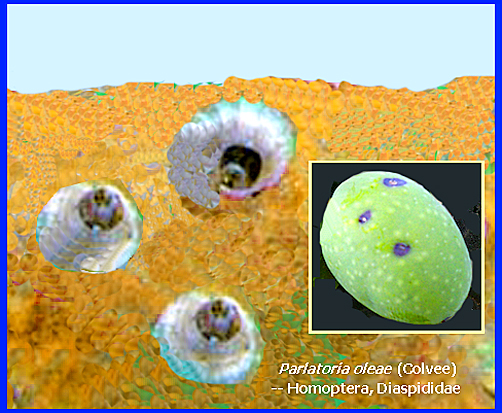
OLIVE SCALE Parlatoria oleae
(Colvee) -- Homoptera, Diaspididae (Contacts) ----- CLICK on Photo to enlarge &
search for Subject Matter with Ctrl/F. GO TO ALL: Bio-Control Cases
A biological
control effort was initiated in 1949 with the importation of a strain of Aphytis maculicornis (Masi) that was found attacking olive scale
in Egypt. The effort failed. In 1951, Dr. Harry Smith arranged for Dr.
A. M. Boyce to search for natural enemies throughout the presumed native home
of the olives scale from India through the Middle East, North Africa and the
Mediterranean. Dr. Boyce was abroad
about one year and made numerous consignments to California by air from
India, Pakistan, Afghanistan, Iran, Iraq, Syria, Lebanon, Israel, Cyprus,
Egypt, Greece and Spain. Even during
the relatively modern period he experienced many adventures, including
collecting in rebel areas under armed escorts. Collaborators made additional shipments from India and Pakistan
in 1952-3 (DeBach 1974). Several species of
parasitoids were obtained and colonized in California, including four strains
or sibling species of Aphytis
maculicornis. These were indistinguishable
morphologically but laboratory studies suggested that they had distinct
biological attributes, so they were reared and liberated separately in the
field. It then became obvious that
the Persian strain of A. maculicornis released in 1952
was the only natural enemy showing appreciable promise in the field. Over 20 million parasitoids were colonized
during 1952-60 at several hundred sites in 24 counties of California. Dramatic results soon became evident. The Persian Aphytis became readily established everywhere and
increased rapidly, commonly attaining parasitization rates of >90% and
generally reducing the average densities of olive scale populations by
98-99%. Plant damage was practically
eliminated, but even this dramatic reduction proved to be economically
unsatisfactory on olive in many cases because even one scale on a fruit may
cause it to be rejected, and not more than 5% cullage was acceptable. Since a heavily infested olive tree might
have over one million scales, a reduction of 99% would leave 10,000 scales,
which could mean that a large number of fruit might have one or more
scales. The parasitoid was prevented
from being more effective because its populations were greatly reduced each
summer by the hot dry weather.
Otherwise, it would probably produced complete biological control
everywhere as it did in a few favorable localities (DeBach 1974). In an effort to
establish additional effective natural enemies, Dr. Paul DeBach while
searching for parasitoids of the California red scale in West Pakistan early
in 1957 had gone with Dr. M. A. Ghani to a remote village in the Tribal
Territories where citrus had been reported.
It was to be a brief 3-day trip with one day at the village for
collecting because of continuing travel commitments (DeBach 1974). Upon arrival there, DeBach and Ghani found
that the altitude was too high and the climate too cool for citrus, so DeBach
spent the day looking for other scale insect parasitoids on deciduous fruit
trees and ornamentals. Olive scale
was found and parasitoid activity was noticeable, especially emergence holes
of internal parasitoids in dead scales.
DeBach knew that no internal parasitoids were established in
California, and therefore collected as much f this material as he could and
then returned to Rawalpindi the next day, where he packaged it and sent it to
the University of California at Berkeley by airmail. Dr. Boyce believes that he made the
original discovery of Coccophagoides
during his earlier collecting trip, but that successful culture in California
was not obtained (A. M. Boyce, pers. commun.). Two species of parasitoids emerged from
this single shipment and both were successfully cultured. Only one, however, Coccophagoides utilis
Doutt, became established. By early
1961 it showed great promise of improving the degree of biological control of
olive scale in the two groves in which it was first released in 1957-8. This led to mass culture and colonization
of over 4 million of the parasitoids during 1962-4 at over 170 sites in 25
counties. Widespread complete
biological control resulted. Coccophagoides acted as a
complementary mortality factor to Aphytis
maculicornis. Although it only added ca. 4-8% additional
host mortality to that which A.
maculicornis could have
produced by itself, this was sufficient to reduce the equilibrium level of
the scale population so that no cullage of olives remained (DeBach
1974). DeBach (1974) holds this
example as illustrating the futility of trying to evaluate the potential or
actual effectiveness of a parasitoid on the basis of the percent
parasitization of the host, and it emphasizes that all parasitoids within
reason should be tried until completely satisfactory biological control is
obtained (Huffaker & Kennett 1966, DeBach, Rosen & Kennett 1971,
DeBach 1974). For additional
information on biological control effort, and biologies of host and natural
enemies, please see the following (McKenzie 1952, Doutt 1953, 1954, 1966;
Hafez & Doutt 1954, Clausen 1956, 1959; Huffaker & Kennett 1960,
1966; Applebaum & Rosen 1964, Huffaker & Doutt 1965, Broodryk & Doutt
1966, Kennett et al. 1965, 1966, Finney 1966, Kennett 1967). REFERENCES: [ Additional references may be found at: MELVYL
Library ] Applebaum, S. W. & D. Rosen.
1964. Ecological studies on
the olive scale, Parlatoria oleae, in Israel. J. Econ. Ent. 57: 847-50. Broodryk, S. W. & R. L. Doutt. 1966. Studies of two
parasites of olive scale, Parlatoria
oleae (Colvee). II.
The biology of Coccophagoides
utilis Doutt (Hymenoptera:
Aphelinidae). Hilgardia
37: 233-54. Clausen, C. P. 1956. Biological control of insect pests in the
continental United States. U. S.
Dept. Agric. Tech. Bull. 1139. 151 p. Clausen, C. P. 1959. Releases of recently imported insect
parasites and predators in California, 1956-57. Pan-Pacific Ent. 35:
107-08. DeBach, P. 1974. Biological Control by Natural
Enemies. Cambridge University Press,
London & New York. 323 p. DeBach, P., D. Rosen & C. E.
Kennett. 1971. Biological
control of coccids by introduced natural enemies. In: C. B. Huffaker (ed), Biological
Control. Plenum Press, New York. 511 p. Doutt, R. L. 1953. Natural enemies of olive scale. Calif. Agric. 7: 5. Doutt, R. L. 1954. An evaluation of some natural enemies of
the olive scale. J. Econ.
Ent. 47: 39-43. Doutt, R. L. 1966. Studies of two parasites of olive scale, Parlatoria oleae (Colvee).
I. A taxonomic analysis of
parasitic Hymenoptera reared from Parlatoria
oleae (Colvee). Hilgardia 37: 219-31. Finney, G. L. 1966. Studies of two parasites of olive scale, Parlatoria oleae (Colvée).
Hilgardia 37: 337-43. Hafez, M. & R. L. Doutt.
1954. Biological evidence of
sibling species in Aphytis maculicornis (Masi)
(Hymenoptera, Aphelinidae). Canad.
Ent. 86: 90-6. Huffaker, C. B. & R. L. Doutt. 1965. Establishment of
the coccinellid Chilocorus bipustulatus Linnaeus, in
California olive groves. Pan-Pacific
Ent. 41: 61-63. Huffaker, C. B. & C. E. Kennett. 1966. Studies of two parasites
of olive scale, Parlatoria oleae (Colvee). IV.
Biological control of Parlatoria
oleae (Colvee) through the
compensatory action of two introduced parasites. Hilgardia 37(9):
283-335. Huffaker, C. B., C. E. Kennett & G. L.
Finney. 1962. Biological
control of the olive scale Parlatoria
oleae (Colvee) in California
by imported Aphytis maculicornis (Masi)
(Hymenoptera: Aphelinidae). Hilgardia
a32: 521-636. Kennett, C. E. 1967. Biological control of olive scale, Parlatoria oleae (Colvee), in a deciduous fruit orchard in
California. Entomophaga
12: 461-74. Kennett, C. E., C. B. Huffaker & K. W.
Optiz. 1965.
Biological control of olive scale.
Calif. Agric. 19: 12-15. Kennett, C. E., C. B. Huffaker & G. L. Finney. 1966.
Studies of two parasites of olive scale, Parlatoria oleae
(Colvee). III. The role of an autoparasitic aphelinid, Coccophagoides utilis Doutt, in the control of
Parlatoria oleae (Colvee). Hilgardia 37: 255-82. McKenzie, H. L. 1952. Scale studies. X. Distribution and biological notes on the
olive Parlatoria scale, Parlatoria oleae (Colvée) in California (Homoptera: Coccoidae;
Diaspididae). Calif. State Dept.
Agric. Bull. 41: 127-38. |