FILE: <ch77.htm> GENERAL INDEX Also Please
see <navelora.htm> [Navigate to MAIN MENU
]
|
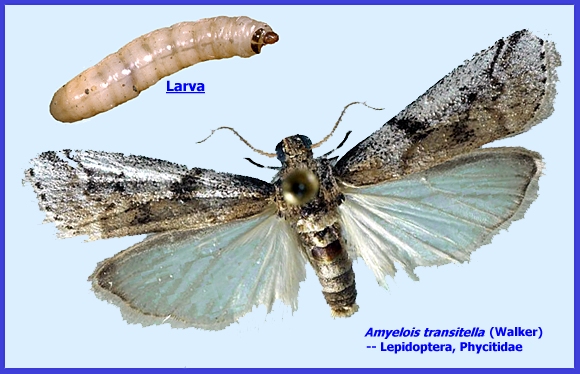
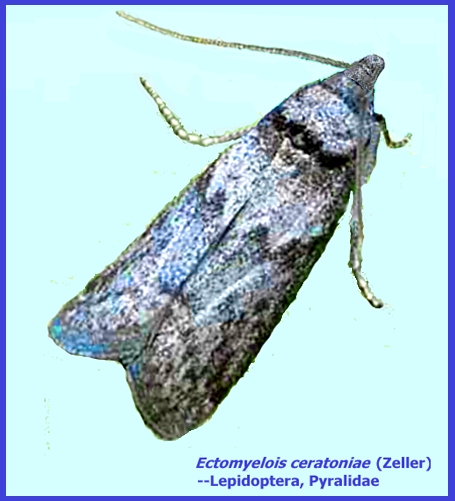
NAVEL ORANGEWORM Amyelois transitella (Walker) --
Lepidoptera, Phycitidae & CAROB MOTH Ectomyelois
ceratoniae (Zeller) -- Lepidoptera, Pyralidae (Contacts) ----- CLICK on Photo to enlarge &
search for Subject Matter with Ctrl/F. GO TO ALL: Bio-Control Cases
One external larval parasitoid, Goniozus
emigratus (Rohwer) and one
internal egg-larval parasitoid, Copidosomopsis
plethorica Caltagirone,
which are dominant on navel orangeworm, Amyelois transitella, in south
Texas, Mexico, and one imported external larval parasitoid, Goniozus
legneri Gordh from Uruguay and Argentina, were successfully established
in irrigated and nonirrigated almond orchards in California's Central Valley
in 1979-86 (Caltagirone 1966, 1964; Legner & Silveira-Guido 1983).
Goniozus legneri was also
established on carob moth, Ectomyelois
ceratoniae, infesting plants with seed pods along the southern California
coast. Separate k-value analyses indicated
significant regulation of their navel orangeworm host during the warm summer
season. Variable percentages of
field-collected larvae of the navel orangeworm and the imported parasitoids
have required significantly longer developmental periods to the adult stage
than those in laboratory control cultures.
These differences indicate diapause in the host triggered by several
seasonally varying factors, and a diapause in the parasitoids triggered by
hormonal changes in the host.
Possible latitudinal effects on diapause are also observed. The ability of the imported parasitoids to
diapause with their host enables their permanent establishment and ability to
reduce host population densities to economic levels (Legner 1983b).
The relationship between residual almond mummies on densities of the
navel orangeworm and parasitism has been demonstrated (Legner 1983a).
The two imported Goniozus
parasitoids have also been shown capable of regulating navel orangeworm at
low densities (Legner & Silveira-Guido 1983,
Legner & Gordh 1992). Superimposed upon the whole system is a
diapausing mechanism in both the navel orangeworm and the parasitoids (Legner
1983b).
Efforts are now required that would tie together all these forces into
a sound, reliable integrated management, which would allow growers to make
reasonable decisions on whether or not to remove mummied almonds, or to use
within season sprays. Nevertheless,
although growers have the capacity to recognize the value of predators in
animal populations such as the deer/wolves interactions as demonstrated in
Yellowstone National Park, they seem incapable of fathoming similar
interactions among insect populations.
This is probably due to the considerably smaller size of the animals
in the latter case.
Populations of navel orangeworm have been followed since 1979 in six
almond orchards near Paso Robles, Hilmar, Chowchilla, Selma, Westley and
Atwater, to determine the impact of the parasitoids. A clear drop in the average density of
navel orangeworm in all orchards is coincident with the establishment of the
three parasitoids (Legner & Gordh 1992). However, the almond reject levels are not
always below the economic threshold of 5% in all orchards. Careful investigations show that invariably
such rejects are due to other causes, such as ant activity and fungus
infections. In certain years, the
peach twig borer has been found to be the principal cause, which subsequently
stimulates oviposition by navel orangeworm moths. Packing plant appraisals frequently attribute damage incited by
twig borer to the navel orangeworm.
In the Atwater almond orchard, the grower has sustained a reject level
of 2 ½ percent or less for many years.
Commercial insectaries have begun to harvest Goniozus legneri
in this orchard for introductions elsewhere.
However, in 2005 the orchard became under threat of removal by eminent
domain from human population expansion in the area. Copidosomopsis plethoricus
and Goniozus legneri, <PHOTO>and to a lesser extent Goniozus emigratus
overwinter in release orchards year after year. However, only Copidosomopsis
can consistently be recovered at all times of the year. The Goniozus
species are not recovered in significant numbers until early summer. However, adults of the latter are
frequently observed in large numbers during autumn and early spring
months. Goniozus legneri
has been reared from codling moth and oriental fruit moth in peaches in the
Paso Robles area in addition to navel orangeworm from almonds. Field data suggest that a certain number
of old mummied nuts is necessary to maintain a desirable synchrony of these
parasitoids with navel orangeworm to produce the lowest average densities
(below 4% damage at harvest). In
fact, at Paso Robles mummies often exceed 1,000 per tree through the winter
months, and produce navel orangeworm densities at harvest at below 1% on
soft-shelled varieties. Pest management in almond orchards
frequently involves periodic releases of Goniozus legneri and/or Copidosomopsis
plethoricus to reestablish balances that were disrupted by
insecticidal drift or by the absence of overwintering mummied fruit refuges.
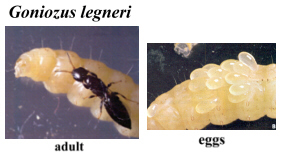
Goniozus legneri --The discovery of Goniozus
legneri <PHOTO> in
South America involved making initial contact with Dr. José Pastrana of the
University of Buenos Aires.
Arrangements were made for Dr. Legner to meet with Dr. Pastrana in
Punta del Este, Uruguay in 1977. The
navel orangeworm was not a common insect at higher latitudes in South
America, and Dr. Pastrana only recalled having studied it in his collections
from central Argentina. He advised
Dr. Legner to travel to Concordia, Argentina to inquire there.
In Concordia, Dr. Aquiles Silveira-Guido accompanied Dr. Legner, where
both of them searched through collections in a Christian monastery serving
also as an experiment station there.
A dusty room, filled to the ceiling with wooden insect collection
boxes, was searched intensively.
Several specimens of the navel orangeworm were found from collections
made in 1938, and from the host coral tree, Erythrinia crista-galli.
This knowledge enabled a further search in the wild on this host tree.
(also see efl-210, efl-258).
Subsequently, collections were continued in Argentina and Uruguay with
the aid of Dr. Silveira-Guido. Goniozus legneri turned out to be the
most frequently collected parasitoid from navel orangeworm and the imported
carob moth, Ectomyelois ceratoniae,
with other parasitoid species of only ca. 5% occurrence being Temelucha sp, Coccygonimus sp. and Venturia canescens (Graven-Stein), Bracon sp. & Copidosoma sp. Cultures sent to Riverside, California were attempted, but Goniozus legneri remains the most
succssful importation. Cultures of Goniozus legneri were also sent to
Dr. Ahmed El-Heneidy in Egypt and Dr. Shmul Gothilf in Israel, and successful
establishment on carob moth were recorded (Gothilf 1978 & 1987; Shoeb et
al. 2005). Later, G. legneri
also became established on carob moth in Iran (Ehteshami 2010a, 2010b)
Collections were also made from Texas where it was found that Pentalitomastix (Copidosoma) plethorica)
parasitized navel orangeworm on Nonpareil almonds as far north as Brownwood
(33 deg. N. lat.) and on Texas ebony and western soapberry seeds along the
Gulf of Mexico coast and throughout south Texas. At the latitude of Corpus Christi, another parasitoid, a
biparental strain of Goniozus emigratus
was found attacking this host at low densities in all seasons on western
soapberry and Texas ebony. Although
identified as G. emigratus by Gordh
& Hawkins (1981), its biparental behavior and fecundity differed
significantly from the uniparental Hawaiian form to indicate its possible
sibling status. PEST MANAGEMENT
The control of this pest with parasitic insects depends heavily on the
perpetuation of parasitoids in orchards.
This can only be accomplished by a careful understanding of the
dynamics involved. Storing rejected
almonds in protective shelters during winter months increases parasitoid
abundance. This will allow the
parasitoids to reproduce in large numbers for subsequent spread thru out an
orchard in the spring when outdoor temperatures rise. An almond reject level of 4% is optimum
for this system, although lower levels are often achieved. Surrounding orchards of pistachios that
harbor navel orangeworms but where parasitoid populations are not favored may
disrupt the balances achieved in almond orchards. Complete sanitation of an orchard (i.e., removal of
rejected almonds) is counter productive to the successful biological
suppression of the pest as this also eliminates natural enemies. [For current status as of 2010 please
refer to Legner 2010].
Finally, those growers who are unaware of animal population
interactions and are habituated to insecticidal controls may be responsive
only to yearly natural enemy releases in their orchards. Although continuous contact and discussion
between grower and researcher may mitigate the problem, researchers must be
aware that data from such orchards may be lost. RESULTS
& CONCLUSIONS
Establishment of Goniozus legneri occurred quickly following
liberations in California, Egypt and Israel in almond orchards. The parasitoid then spread to neighboring
countries, such as Iran. Carob moth
populations also descended to low levels.
In California an infestation of carob moth in California date groves
was not controlled by G. legneri, however, as relative humidity levels
there were believed to be too low for
parasitoid survival. REFERENCES: Abbas, M.S.T., Shidi,
R.H., Jumah, S. and Al-Khatry, S.A.
2008. Utilization of Goniozus
sp. (Hym.: Bethylidae) as a bio-control agent against the lesser date
moth, Batreachedra amydaraula (Meyrick) (lep.: Batrachedridae) in date
palm orchards in Sultanate of Oman. Egyptian Journal of
Biological Pest Control 18:47-50. Abbas, M.S.T., Al-Khatry, S.A.,
Shidi, R.H.; Al-Ajmi, and Najat, A.
2014. Natural enemies of the
lesser date moth, Batrachedra amydraula Meyrick (Lepidoptera: Batrachedridae)
with special reference to its parasitoid Goniozus sp. Egyptian
Journal of Biological Pest Control 24:
293-296. Bellows, T. S. & T. W. Fisher (eds.). 1999. Handbook
of Biological Control: Principles and
Applications. Academic Press, San
Diego, New York. 1046 p. Butler, G.D, Jr., and Schmidt, K.M. 1985. Goniozus legneri (Hymenoptera: Bethylidae): development,
oviposition, and longevity in relation to temperature.
_ Annals of the Entomological Society of America_ 78: 373–375. Caltagirone,
L. E. 1966. A new Pentalitomastix from Mexico. The Pan Pacific Entomol. 42: 145-151. Caltagirone, L. E., K. P. Shea and G. L.
Finney. 1964. Parasites to aid control of navel
orangeworm. Calif. Agric. 19(1): 10-12. Conference
(Iran):. 2010. First record of Goniozus legneri Gordh
(Hymenoptera: Bethylidae), the larval ectoparasitoid of carob moth, in
Iran. Iranian
Plant Protection Congress, July 2010, Tehran: Vol. 19. July 2010. Ehteshami, F.., M
Aleosfoor, H. Allahyari, M.
Alichi, M. A. Akrami & M. Kiani. 2010a. First record of Goniozus
legneri Gordh (Hymenoptera:
Bethylidae), the larval ectoparasitoid of carob moth, in Iran. Proceedings of 19th Iranian Plant Protection
Congress, 31 July-3 August 2010, Iranian
Research Institute of Plant Protection, Tehran, 123 pp. Ehteshami, F.., M Aleosfoor, H. Allahyari, M. Alichi, M. A. Akrami & M. Kiani. 2010b. Primary investigation on the biology of Goniozus legneri Gordh (Hymenoptera:Bethylidae), a
larval ectoparasitoid of carob moth, on Ectomyelois ceratoniae (Zeller). Proceedings of 19th Iranian Plant Protection Congress, 31 July-3 August 2010,
Iranian; Research Institute of Plant Protection, Tehran, 605 pp El-Basha, N.A. and
Mandour, N.S. 2006. Effect of Goniozus legneri Gordh
(Hymenoptera: Bethylidae) on the life table of Palpita unionalis Hb. (Lepidoptera: Pyralidae). Egyptian
Journal of Biological Pest Control 16: 5-11. Etiam, A.
2001. Oviposition behavior and
development of immature stages of Parasierola swirskiana, a parasitoid
of the lesser moth Batrachedra amydraula. Phytoparasitica 29:
405-412. Garrido, S., Cichon, L., Fernández, D. and Azevedo,
C. 2005. Primera cita de la especie Goniozus legneri
(Hymenoptera: Bethylidae) en el Alto Valle de Río Negro, Patagonia Argentina.
Revue de Societe Entomologique Argentina 64: 14-16. Gordh, G.
1982. A new species of Goniozus imported into California for
the biological control of navel orangeworm [Hymenoptera: Bethylidae;
Lepidoptera: Pyralidae]. Entomol.
News 93: 136-138. Gordh, G.
and Evans, H. E. 1976. A new species of Goniozus imported into California from Ethiopia
for the biological control of pink bollworm and some notes on the taxonomic
status of Parasierola and Goniozus (Hymenoptera: Bethylidae). Proceedings
of the Entomological Society of Washington 78: 479-489. Gordh, G. & B. Hawkins. 1981.
Goniozus emigratus (Rohwer), a primary external
parasite of Paramyelois transitella (Walker), and
comments on bethylids attacking
Lepidoptera [Hymenoptera: Bethylidae; Lepidoptera: Pyralidae]. J. Kansas Entomol. Soc. 54:
787-803. Gothilf, S.
1978. Establishment of the
imported parasite Pentalitomastix plethoricus [Hym: Encyrtidae] on Ectomyelois ceratoniae [Lep: Phycitidae]
in Israel. Entomophaga
23: 299-302. Gothilf, S. and Mazor,
M. 1987. Release and recovery of imported parasites of the carob moth Spectrobates
ceratoniae (Lepidoptera: Pyralidae) in Israel. Israel
Journal of Entomology 21: 19-23. 211. Legner, E.
F. 1983a. Influence of
residual Nonpareil almond mummies on densities of the navel orangeworm and
parasitization. J. Econ.
Entomol. 76: 473-475. 209. Legner, E. F. 1983b. Patterns of field diapause in the navel
orangeworm (Lepidoptera: Phycitidae) and three imported parasites. Ann. Entomol. Soc. Amer. 76: 503-506. 258. Legner, E. F. & G. Gordh. 1992.
Lower navel orangeworm (Lepidoptera: Phycitidae) population densities
following establishment of Goniozus legneri
(Hymenoptera: Bethylidae) in
California. J. Econ.
Ent. 85(6): 2153-60. 210. Legner, E. F. & A. Silveira-Guido. 1983. Establishment of Goniozus emigratus and Goniozus legneri [Hym: Bethylidae] on navel
orangeworm, Amyelois transitella
[Lep: Phycitidae] in California and biological control potential. Entomophaga 28: 97-106. 240.
Legner, E. F. and Warkentin, E.F. 1988. Parasitization of Goniozus
legneri (Hymenoptera: Bethylidae) at increasing parasite and host, Amyelois transitella
(Lepidoptera: Phycitidae), densities. Annals of the Entomological Society
of America 81: 774–776. 205. Legner, E. F., G. Gordh, A. Silveira-Guido & M.
E. Badgley. 1982.
New larvicidal wasp to attempt control of navel orangeworm. Almond
Facts 47(3): 56-58. 203. Legner, E. F., G. Gordh, A.
Silveira-Guido & M. E. Badgley.
1982. New wasp may help
control navel orangeworm. Calif.
Agric. 38(5-6): 1, 3-5. Shoeb, M.
A., Abul-Fadl, H .A. and El-Heneidy, A. H.
2005. Biological aspects of
the ecto-larval parasitoid, Goniozus legneri Gordh on different insect
hosts under laboratory conditions. Egyptian Journal of Biological Pest
Control 15: 5-9 |