FILE: <ch-73.htm> GENERAL INDEX [Navigate
to MAIN MENU ]
|
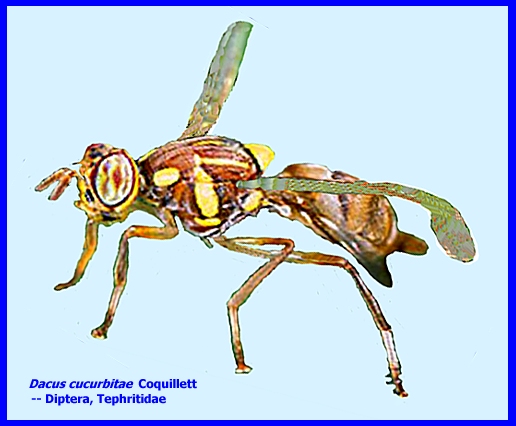
MELON FLY Dacus cucurbitae
Coquillett -- Diptera, Tephritidae (Contacts) ----- CLICK on Photo to enlarge &
search for Subject Matter with Ctrl/F. GO TO ALL: Bio-Control Cases
Because
melons and other perishable crops are available in the field for only a short
period, these plants form an unstable resource to which the biology and life
cycle of D. cucurbitae are well
adapted. Consequently, parasitoids of
the fly must be able to follow the short-lived and localized fly populations
throughout their range if efficient control is to be achieved. In Hawaii, control had been possible
because the presence of Momordica
balsamina, the fruits of
which constituted a stable wild host for D.
cucurbitae and its
parasitoids. Changes in agricultural
practices and increased land use, however, reduced the areas where M. balsamina grew abundantly, thereby reducing the reservoirs
of the natural enemies and making it more difficult for the natural enemies
to reach the cultivated fields. The
main fly population now had its origin in culti9vated fruits where
parasitization was much lower than in the fruits of M. balsamina: 1% for tomatoes, 0-16.5% for melons, and
0.2-6.5% for cucumbers vs. 20-37.8% for M.
balsamina (Nishida
1955). Thus, a change in the
diversity of the habitat proved detrimental to this biological control
project (Kogan et al. 1999). Please
refer to the following for greater detail on biological control effort, and
biologies of host and natural enemies (Back & Pemberton 1917, Willard
1920, Yashiro 1936, Hutson 1939, McBride & Tanada 1949, Nishida &
Haramoto 1953, Clausen 1956, Nishida & Bess 1957, Clausen et al. 1965). REFERENCES: [Additional references may be
found at: MELVYL
Library ] Back, E. A. & C. E. Pemberton. 1917.
The melon fly in Hawaii. U. S.
Dept. Agric. Bull. 491. 64 p. Clausen, C.
P. 1956. Biological control
of fruit flies. J. Econ.
Ent. 49: 766-68. Clausen, C.
P. 1978. Introduced
Parasites and Predators of Arthropod Pests and Weeds: A World Review. U. S. Dept. Agric., Agric. Handbk. 480. 545 p. Clausen, C. P., D. W. Clancy & Q. C.
Chock. 1965. Biological control of the Oriental fruit
fly (Dacus dorsalis Hendel) and other
fruit flies in Hawaii. U. S. Dept.
Agric. Tech. Bull. 1322. 102p. Fullaway, D. T. 1920. The melon
fly: its control in Hawaii by a
parasite introduced from India.
Hawaii For. Agric. 17: 101-105. Hutson, J.
C. 1939a. Report on the work
of the entomological division. Ceylon
Dir. Agric. Admin. Rept., 1937. p. D37-D42 Hutson, J.
C. 1939b. Report on the work
of the entomological division. Ceylon
Dir. Agric. Admin. Rept., 1938. p. D36-D41 Kogan, M., D. Gerling & J. V. Maddox. 1999.
Enhancement of Biological Control in Transient Agricultural
Environments. In: Bellows, T. S.
& T. W. Fisher (eds.), Handbook of
Biological Control: Principles and
Applications. Academic Press, San
Diego, New York. 1046 p. McBride, O.
C. & Y. Tanada. 1949. A
revised list of host plants of the melon fly in Hawaii. Hawaii. Ent. Soc. Proc. 13: 411-21. Newell, I. M., W. C. Mitchell & F. L.
Rathburn. 1952. Infestation norms for Dacus cucurbitae
in Momordica balsamina, and seasonal
differences in activity of the parasite Opius
fletcheri. Proc. Hawaii Ent. Soc. 14: 497-508. Nishida, T.
1955. Natural enemies of the
melon fly, Dacus cucurbitae Coq. in Hawaii. Ann. Ent. Soc. Amer. 48: 171-78. Nishida, T.
& H. A. Bess. 1950.
Applied ecology in melon fly control.
J. Econ. Ent. 43: 877-83. Nishida, T.
& H. A. Bess. 1957.
Studies on the ecology and control of the melon fly Dacus (Strumeta) cucurbitae
Coquillett (Diptera: Tephritidae).
Hawaii Agric. Expt. Sta. Tech. Bull.
44 p. Nishida, T.
& F. Haramoto. 1953.
Immunity of Dacus cucurbitae to attack by certain
parasites of Dacus dorsalis. J. Econ. Ent. 46: 61-4. Willard, H. F.
1920. Opius fletcheri
as a parasite of the melon fly in Hawaii. J. Agric. Res. 20:
423-38. Yashiro, H.
1936. Outline of the work of
establishing Opius fletcheri Silv. in Ishigaki
Island, Loochoo. Nojikairyoshiryo
109: 149-52. [in Japanese]. |