FILE: <ch-65.htm> GENERAL INDEX [Navigate
to MAIN MENU ]
|
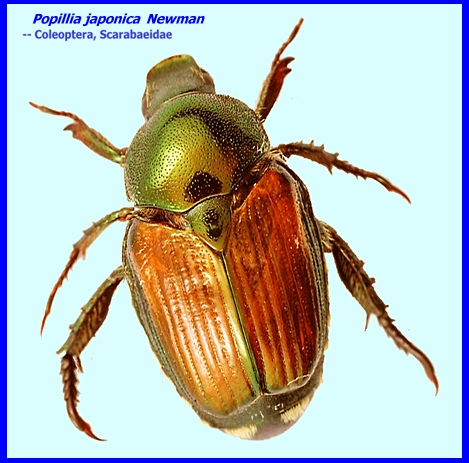
JAPANESE BEETLE Popillia japonica
Newman -- Coleoptera, Scarabaeidae (Contacts) ----- CLICK on Photo to enlarge &
search for Subject Matter with Ctrl/F. GO TO ALL: Bio-Control Cases
Bacillus popilliae Dutky
is the most effective natural control agent of Japanese beetle (Tashiro
1987). This bacterium was first
identified in central New Jersey in 1933 by White (1941), and was called
milky spore disease because of the milky color of infected grubs hemolymph, a
sporulation occurs. When large
quantities of B. popilliae spores are ingested,
the grubs become infected. They may
live and continue to feed for weeks or months after infection, but eventually
weaken and die. A high concentration
of spores is released into the soil from dead grubs, and infect other grubs
upon ingestion. A commercially
available formulation of spore powder, sold as Milky Spore or Japanese Beetle
Attack may be applied by depositing ca. 2g of spore powder at intervals of
1.5 to 3 m on turfgrass areas with high population densities of the grubs
(Tashiro 1987). As discussed in an
earlier section, the Japanese beetle has a tachinid parasitoid, Hyperecteina aldrichi Mesn., which is the
principal agent holding the beetle density down in northern Japan. In the eastern United States, although the
tachinid is established permanently, it was not able to maintain the beetle
at a low density. The climate in
America precluded synchronization of the life cycles of the host and
parasitoid. The tachinid emerges
earlier in the spring than the beetle and dies before it can find adult
beetles to parasitize. This is
thought to be due to the heavier show cover and cold in Japan which delays
the emergence of both species until the sudden onset of spring, when both
parasitoid and host emerge from the soil together. In America, the soil warms up earlier and more gradually due to
the lack of such heavy snow. This
results in the early and fatal emergence of many of the tachinid parasitoids. For further details
on biological control and biologies of hosts and natural enemies, please see
the following (King & Holloway 1930a,b; Holloway 1931, King 1931, Clausen
et al. 1927, 1933; Burrell 1931,
Balock 1934, Gardner 1934, 1938; Brunson 1934, 1938; Gardner & Parker
1940, White 1940, King & Parker 1941, 1950; Beard 1945, Ladd & McCabe
1956, Fleming 1958, Sabrosky & Arnaud 1965, Clausen 1978). REFERENCES: [Additional references may be found at: MELVYL
Library ] Balock, J. W. 1934. The status of Tiphia vernalis
Rohwer, an imported parasite of the Japanese beetle, at the close of
1933. J. Econ. Ent. 27: 491-96. Beard, R. L. 1945. Studies on the milky disease of Japanese
beetle larvae. Conn. Agric. Expt.
Sta. Bull. 491: 505-83. Brunson, M. H. 1934. The fluctuation of the population of Tiphia popilliavora Rohwer in the field and its possible
causes. J. Econ.
Ent. 27: 514-18. Brunson, M. H. 1938. Influence of Japanese beetle instar on the
sex and population of the parasite Popillia
japonica. J. Agric. Res. 57: 379-86. Burrell, R. W. 1931. Dexia
ventralis Aldrich, an
imported parasite of the Japanese beetle.
J. Agric. Res. 43: 323-36. Clausen, C. P. 1978. Scarabaeidae. In: C. P. Clausen (ed.), Introduced Parasites
and Predators of Arthropod Pests and Weeds:
A World Review. U. S. Dept.
Agric., Agric. Handbk. No. 480. 545
p. Clausen, C. P., J. L. King & C. Teranishi. 1927.
The parasites of Popillia
japonica in Japan and Chosen
(Korea) and their introduction into the United States. U. S. Dept. Agric. Dept. Bull. 1429. 55 p. Clausen, C. P., H. A. Jaynes & T. R.
Gardner. 1933.
Further investigations of the parasites of Popillia japonica
in the Far East. U. S. Dept. Agric.
Tech. Bull. 366. 58 p. Dahlsten, D. L. & R. W. Hall. 1999. Biological control
of insects in outdoor urban environments.
In: Bellows, T. S.
& T. W. Fisher (eds.), Handbook of
Biological Control: Principles and
Applications. Academic Press, San
Diego, New York. 1046 p Fleming, W. E. 1958. Biological control of the Japanese beetle,
especially with entomogenous diseases.
10th Internatl. Cong. Ent. Proc. (1956) 3: 115-25. Fleming, W. E. 1968. Biological control of Japanese
beetle. USDA Tech. Bull. No.
1383. 78 p. Fleming, W. E. 1972. Biology of Japanese beetle. USDA Tech. Bull. No. 1449. 78 p. Gardner, T. R. 1934. Comparative oviposition efficiency and
collection costs of imported versus established Tiphia vernalis
Rohwer, a parasite of the Japanese beetle.
J. Econ. Ent. 27: 497-98. Gardner, T. R. 1938. Influence of feeding habits of Tiphia vernalis on the parasitization of the Japanese
beetle. J. Econ.
Ent. 31: 204-07. Gardner, T. R. & L. B. Parker. 1940. Investigations of
the parasites of Popillia japonica and related Scarabaeidae
in the Far East from 1929- to 1933, inclusive. U. S. Dept. Agric. Tech. Bull. 738. 36 p. Holloway, J. K.
1931. Temperature as a factor
in the activity and development of the Chinese strain of Tiphia popilliavora
(Rohw.), in New Jersey and Pennsylvania.
New York Ent. Soc. J. 39:
555-64. King, J. L. 1931. The present status of the established
parasites of Popillia japonica Newman. J. Econ. Ent. 24: 453-62. King, J. L. & J. K. Holloway. 1930a. The
establishment and colonization of Tiphia
popilliavora, a parasite of
the Japanese beetle. J. Econ.
Ent. 23: 266-74. King, J. L. & J. K. Holloway. 1930b. Tiphia popilliavora Rohwer, a parasite of the Japanese
beetle. U. S. Dept. Agric. Cir.
145. 11 p. King, J. L. & L. B. Parker.
1941. Summary of Japanese
beetle parasite liberations, including the year 1940. U. S. Dept. Agric. Bur. Ent. & Plant
Quar. Surv. Bull. 21: 127-37. King, J. L. & L. B. Parker.
1950. The spring Tiphia, and imported enemy of
the Japanese beetle. U. S. Dept.
Agric., Bur. Ent. & Plant Quar. E-799. 8 p. Ladd, T. L., Jr. and P. J. McCabe. 1956. The status of Tiphia vernalis Rohwer, a parasite of the Japanese beetle, in
southern New Jersey and southeastern Pennsylvania in 1963. J. Econ. Ent. 59: 480. Sabrosky, C. W. & P. H. Arnaud. 1965. Family
Tachinidae. In: A. Stone, C.
W. Sabrosky, W. W. Wirth, R. H. Foote & J. R. Coulson (eds.), A Catalogue
of the Diptera of America North of Mexico.
U. S. Dept. Agric., Agric. Handb. 276: 961-1108. Tashiro, H. 1987. Turfgrass Insects of the United States and
Canada. Comstock Publ. Assoc.,
Cornell Univ. Press, Ithaca, New York.
White, R. T. 1940. The relation of ants to the Japanese
beetle and its established parasites.
New York Ent. Soc. J. 48:
85-99. White, R. T. 1941. Development of milky disease of Japanese
beetle larvae under field conditions.
J. Econ. Ent. 34: 213-15. |