FILE: <ch-62.htm>
GENERAL INDEX [Navigate
to MAIN MENU ]
|
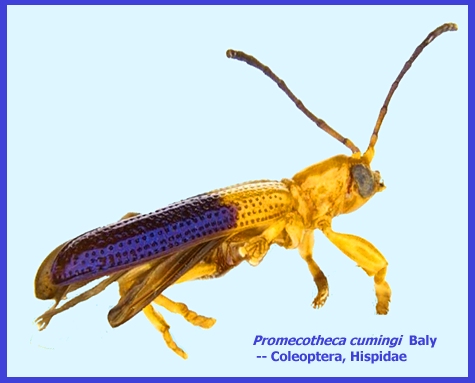
HISPID BEETLE Promecotheca cumingi Baly -- Coleoptera, Hispidae (Contacts) ----- CLICK on Photo to enlarge &
search for Subject Matter with Ctrl/F. GO TO ALL: Bio-Control Cases Simmonds
(1976) suggests that in this example there was a complete reversal of roles
played by the two parasitoids in controlling Promecotheca in Sri Lanka and Fiji, although the ultimate
practical result was the same. Had
detailed ecological investigation preceded parasitoid introduction it is
possible that a consideration of details of climatic preferences,
host-preferences, life-cycle, etc. of both hosts and parasitoids might have
indicated the usefulness in Sri Lanka of Dimmockia
rather than Pediobius. But, this is by no means certain. What is certain is that such a detailed
study would have deferred the ultimate successful biological control of Promecotheca by more than a
year at least, during which time the increase of the pest and subsequent
losses from chemical control, etc. would have been considerable, and it would
have taken a longer time, with consequent increases losses, to effect
biological control and complete recovery of the palms (Simmonds 1976). Although it might be argued that the introduction
of natural enemies in this manner is scientifically unacceptable, it must be
born in mind that the ultimate unpredictability of the result of such
introductions should be left to the natural enemies themselves to determine
which is more suited to a new environment (Simmonds 1976). REFERENCES: [Additional references may be
found at: MELVYL
Library ] Fernando,
H. E. 1972. The coconut leaf
beetle Promecotheca cumingi and its control. Coconut Planters Rev. 6: 152-56. Simmonds, F. J. 1972. Approaches to
biological control problems. Entomophaga
17: 251-. Taylor, T.
H. C. 1973. The biological
control of an insect in Fiji. An
account of the coconut leaf-mining beetle and its parasite complex. Imperial Inst. Ent., London. 239 p. Simmonds, F. J. 1976. Some recent
puzzles in biological control.
Entomophaga 21: 327-32. |
|
|