FILE: <ch-55.htm> GENERAL INDEX [Navigate to MAIN MENU ]
|
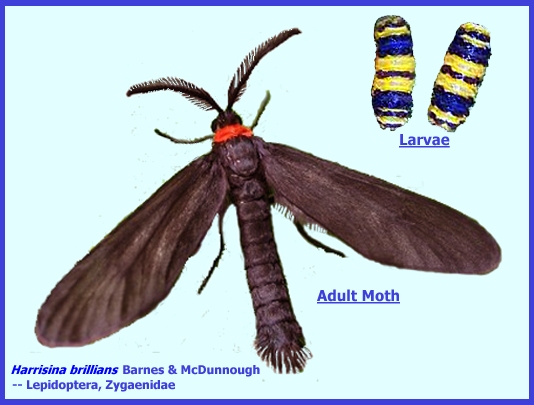
GRAPELEAF SKELETONIZER (Western) Harrisina brillians Barnes & McDunnough -- Lepidoptera, Zygaenidae (Contacts) ---- CLICK on Photo to enlarge & search for Subject Matter with Ctrl/F. GO TO ALL: Bio-Control Cases
In 1950 efforts
were initiated in the University of California to control grapeleaf
skeletonizer biologically.
Parasitoids were introduced, with two species, the braconid, Apanteles harrisinae Muesebeck and the tachinid, Ametadoria miscella (Wulp) (= Sturmia
harrisinae Coquillett) predominating
(Clausen 1961). A virulent granulosis
virus was also accidentally introduced.
Initially, Apanteles
was the most abundant of the two parasitoids and contributed to the reduction
of the infestations, but later it declined in importance because of heavy
mortality from attack by hyperparasitoids, especially Dibrachys sp. (Clausen 1978). Although a sharp decline in the number and severity of
infestations was observed in southern California, this cannot be attributed
to the activities of the two parasitoids only, because a virus disease,
probably brought in with the shipment of larvae from Arizona in 1950-51,
became established and spread rapidly (Smith et al. 1956). The virus must be credited with a major
role in control of the pest, and its rapid distribution over the infested
area was undoubtedly facilitated by mechanical transmission from place to
place via the parasitoids, contaminated by the diarrheic discharges of
diseased caterpillars( Wehrle 1939, Lange 1944, Smith & Langston 1953, Smith
et al. 1955a,b). Surveys in San
Diego County in 1982-1983 revealed that it was necessary to spray grapeleaf
skeletonizer in commercial vineyards (Flaherty et al. 1985). Abandoned untreated vineyards and backyard
vines were severely defoliated despite the activity of the imported
parasitoids. Symptoms of virus
infection were not observed in the survey.
Grapeleaf skeletonizer was not found in wild grapes, V. girdiana, except where they were in close proximity to
heavily infested commercial V.
vinifera vineyards (Flaherty
& Wilson 1992). The skeletonizer
invaded the San Joaquin Valley in 1961 (Clausen 1961), and new infestations
appeared thereafter throughout the Central Valley in spite of eradication
efforts. Renewed efforts to introduce
natural enemies were made in the 1980's, which resulted in the translocation
of parasitoids from southern California and the acquisition of new species
and strains from Torreón vicinity in Mexico (E. F. Legner and B. Villegas,
unpub. data). Extensive insecticide
treatment during introduction, however, precluded establishment in most
areas. Some success was achieved
outside the principal grape production area near Redding, with the
establishment of Apanteles
spp. and Ametadoria spp.
This insect is now regarded a serious pest of commercial vineyards and
backyard vines, as well as in wild grapes, Vitis californica
Bentham by Flaherty & Wilson (1992).
Apanteles harrisinae and A. miscella were not successfully established in the San
Joaquin Valley (Flaherty et al. 1985).
Only a few parasitoid recoveries were made at release sites which may
be related to heavy spray pressure during the introduction period (E. F.
Legner, unpub. data). Samples of
larvae taken from heavily infested and abandoned vineyards in San Diego
County showed only 13% parasitism, which is below the 42-62% reported by
Clausen in 1953-54 (Clausen 1961).
There was also no evidence of virus present. Clausen (1961) thought that the virus must be credited with the
major role in reducing grapeleaf skeletonizer populations to low levels and
exterminating many small infestations.
Flaherty et al. (1985) considered that at that time the virus was more
widespread and had reduced grapeleaf skeletonizer populations to levels that
made it more manageable by the parasitoids.
This may account for the greater parasitism reported by Clausen (1961)
and that found by Flaherty et al. (1985).
However, the present absence of virus in abandoned vineyards in San
Diego County and the absence of observable grapeleaf skeletonizer in wild
grapes is considered an enigma (Flaherty & Wilson 1992). The grapeleaf skeletonizer has shown
cyclic abundance, however, and the surveys conducted in San Diego County
could have been during one of the cyclic outbreaks. Surveys by E. F. Legner & R. W. Warkentin (unpub. data)
during other years have shown this insect to be as rare as reported by
Clausen earlier. Also, widespread application of insecticides
to vineyards in the south could be responsible for minimizing natural enemy
activity. In the San Joaquin Valley
the virus of grapeleaf skeletonizer is extremely virulent and has the
potential of becoming incorporated into an areawide biological control
effort, including wild grapes, backyard vines and commercial vineyards
(Flaherty et al. 1985). REFERENCES: [Additional references may be found at: MELVYL
Library ] Bellows, T. S. & T. W. Fisher (eds.). 1999. Handbook
of Biological Control: Principles and
Applications. Academic Press, San
Diego, New York. 1046 p. Clausen, C.
P. 1961. Biological control
of western grape leaf skeletonizer (Harrisina
brillians B. & McD.) in
California. Hilgardia
31: 613-37. Clausen, C.
P. 1978. Zyagaenidae. In: C. P. Clausen, Introduced Parasites and
Predators of Arthropod Pests and Weeds.
U. S. Dept. Agric., Agric. Handbk. No. 480. 545 p. Flaherty, D. L. & L. T. Wilson. 1992.
Biological control of insects and mites on grapes. In: Principles and Application of Biological
Control. University of California
Press, Berkeley, CA. (in press). Flaherty, D. L., L. T. Wilson, V. M. Stern
& H. Kido. 1985. Biological control in San Joaquin Valley
vineyards. p. 501-20. In: M. A. Hoy & D. C.
Herzog (eds.), Biological Control in Agricultural IPM Systems. Academic Press. 589 p. Lange, W. H.,
Jr. 1944. The western grape
leaf skeletonizer, Harrisina
brillians, in
California. Calif. State Dept. Agric.
Bull. 33: 98-104. Smith, O. J. and R. L. Langston. 1953.
Continuous laboratory propagation of western grape leaf skeletonizer
and parasites by prevention of diapause.
J. Econ. Ent. 46: 477-84. Smith, O. J., A. G. Diboll & J. H.
Rosenberger. 1955a. Laboratory studies of Pelecystoma harrisinae
(Ashmead) an adventive braconid parasite of the western grape leaf
skeletonizer. Ann. Ent. Soc.
Amer. 48: 232-37. Smith, O. J.,
P. H. Dunn & J. Rosenberger. 1955b.
Morphology and biology of Sturmia
harrisinae Coquillett
(Diptera), a parasite of the western grape leaf skeletonizer. Calif. Univ. Publ. Ent. 10: 321-58. Smith, O. J., K. M. Hughes, P. H. Dunn and I.
M. Hall. 1956. A granulosis virus disease of the western
grape leaf skeletonizer and its transmission. Canad. Ent. 88: 507-15. Wehrle, L. P.
1939. Grape Insects in
Arizona. Ariz. Agric. Expt. Sta.
Bull. 162: 274-92. |