FILE: <ch-49.htm>
GENERAL INDEX
[Navigate to
MAIN MENU ]
|
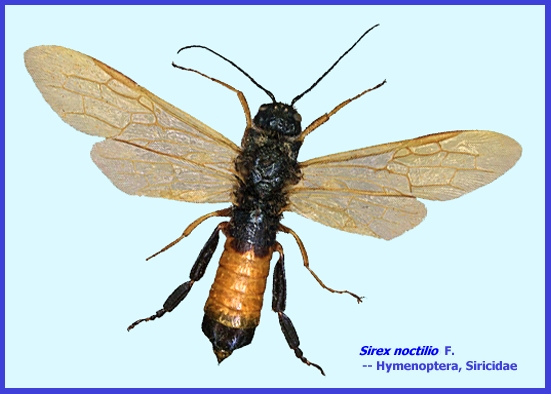
EUROPEAN WOOD WASP Sirex noctilio F. -- Hymenoptera,
Siricidae (Contacts) ---- CLICK on Photo to enlarge & search for Subject Matter with Ctrl/F. GO TO ALL: Bio-Control Cases
There is a special
relationship of S. noctilio to a symbiotic fungus,
Amylostereum
areolatum (Fr.) Boidin, that
serves as a kairomone for the parasitoids of the woodwasp. Also the parasitic nematode, Deladenus siricidicola Bedding, is wholly dependent in nature on the
woodwasp and the fungus (Bedding 1972).
Adults of S. noctilio emerge from midsummer
to late fall and mate in the upper foliage of trees. Female wood wasps oviposit by drilling
holes through the bark into the sapwood of trees that are usually predisposed
or damaged. At the time of
oviposition the symbiotic fungus is introduced (Taylor 1981). Adults live only a few days in
nature. The eggs hatch when the
surrounding area has been invaded by the fungi and this occurs when some
drying has taken place to favor the fungi.
First and second instar larvae feed exclusively on fungus and third
and fourth instars begin to tunnel into the wood. The larvae turn back toward the bark to about 5 cm from the
bark surface to enter the prepupal stage.
Pupation may not occur until the second or third year after hatching,
depending on the weather. After
pupation adults emerge in about three weeks, and each generation emerges over
a period of two to three years with the proportion of individuals emerging in
the first, second and third year varying by site (Taylor 1981). Biological control
was initiated in New Zealand in 1927 (Taylor 1981). During 1929-32 the ichneumonid, Rhyssa persuasoria L. was introduced but the control was not
satisfactory (Turnock et al. 1976).
Then Ibalia
leucospoides (Hochenw.)
(Ibalidae) was colonized in 1954-58 which resulted in improved control
(Zondag 1959). The two parasitoids
were then colonized in Tasmania. A
large scale biological control effort did not begin until 1961 following the
discovery of S. noctilio in Victoria,
Australia. A National Sirex Fund was
established, which consisted of a consortium of federal, state and private
agencies, and a committee was formed to coordinate research and control in
Victoria (Taylor 1981). A world wide
search for natural enemies was begun by the Division of Entomology, CSIRO in
1962. The search for parasitoids in
the northern hemisphere was completed by 1973, and during the 11-year period
21 species of parasitoids were sent to Tasmania for culture (Taylor 1976). The plan was to obtain all the available
parasitoids of siricids in conifers and as many strains as possible from
different climatic zones with emphasis on the Mediterranean area. This included collections of siricids in
conifers other than Pinus
and from genera and species other than Sirex
noctilio. Ten different parasitic species were
released in Tasmania and Victoria, six having become established and one
additional species, the ichneumonid Rhyssa hoferi
Rohwer, probably established (Taylor 1981).
Of the seven species two are holarctic (R. persuasoria
and I. leucospoides), two are palearctic (I. rufipes drewseni
Borries and the ichneumonid Odontocolon geniculatus
Kreichbaumer) and three are nearctic [the stephanid Schlettererius cinctipes Cresson and the
ichneumonids Megarhyssa
nortoni (Cresson) and R. hoferi]. These species tend
to be complementary, although there might be some competition within the
guild attacking larger larvae. The Ibalia species attack first or
second instar siricid larvae and the two species have different emergence
times so that they do not compete directly.
The ichneumonids attack the more developed larvae of their host and
there may be differential preference based on tree diameter (Taylor
1981). Schlettererius cinctipes
emerges after the peak emergence of the ichneumonids, while the other two are
also complementary as O. geniculatus is small, emerges
in springtime and attacks late hatching larvae that are still closer to the
bark surface. Rhyssa hoferi
is adapted to drier areas and could do well in drier climates (Taylor 1981). A parasitic
nematode, Deladenus
siricidicola, was found
in New Zealand in 1962 (Zondag 1969).
It causes female wood wasps to lay infertile eggs. Additional nematodes wee sought during
1965-75 without success (Bedding & Akhurst 1974). Different strains of the nematode have
also been released throughout wood wasp infested areas in Tasmania and
Victoria and it is well established throughout. This nematode also affects the reproduction of some of the
female parasitoids (Bedding 1967), which apparently does not adversely affect
biological control (Dahlsten & Mills 1999). The nematode is credited with reductions of wood wasp
populations to very low levels in certain areas. Conclusions Dahlsten & Mills
(1999) consider the Sirex noctilio biological control
program significant for several reasons.
A large group of organizations cooperated in a well funded, extensive
worldwide search for parasitoids as well as a research program that examined
many aspects of the host tree/Sirex/fungus/parasitoid
relationships (Taylor 1981). As with Gilpinia hercyniae there was a fortuitous introduction (the
nematode). Sirex noctilio
was introduced from the northern to the southern hemisphere and attacked an
exotic host plant Pinus radiata (native to
California). The search for
parasitoids in the north was made from S.
noctilio and its host trees
to siricids in other genera and species in Pinus as well as other conifers. The project was well planned with attention given to colonizing
strains of parasitoids suited to different climatic zones and developmental
stages of the host. It is believed that
this biological control project will eventually be completely successful
(Turnock et al. 1976), and that the combination of parasitoids and nematodes
along with sound forest management should hold S. noctilio
down to the level where losses are not serious (Taylor 1976). For details of the biologies of host,
natural enemies and biological control efforts, please see also the following
(Chrystal 1928, 1930; Chrystal & Myers 1928a,b; Myers 1928, Miller &
Clark 1935, 1937; Clark 1936, Rawlings 1951, 1952, 1953; Stilwell 1960,
Zondag & Nutall 1961, Zondag 1965, 1967; Wilson 1965, Dharmadhikari &
Achan 1965, Morgan & Stewart 1966, Taylor 1965, 1967a, 1967b;
Dharmadhikari 1967, Hocking 1967, Morgan 1968, Clausen 1978). REFERENCES: [Additional references may be found at: MELVYL
Library ] Bedding, R. A. 1967. Parasitic and free-living cycles in
entomogenous nematodes of the genus Deladenus. Nature 214: 174-75. Bedding, R. A. 1972. Biology of Deladenus siricidicola
(Neotylenchidae) an entomophagous-mycetophagous nematode parasitic in siricid
woodwasps. Nematologica 18: 482-93. Bedding, R. A. & R. J. Akhurst. 1974. Use of the
nematode Deladenus siricidicola in the biological
control of Sirex noctilio in Australia. J. Aust. Ent. Soc. 13: 129-35. Chrystal, R. N.
1928. The Sirex wood-wasps and their importance in forestry. Bull. Ent. Res. 19: 219-47. Chrystal, R. N.
1930. Studies on the Sirex parasites. The biology and postembryonic development
of Ibalia leucospoides Hochenw.
(Hymenoptera-Cynipoidea). Oxford
Univ. Mem. 11. 63 p. Chrystal, R. N. & J. G. Myers. 1928a. The Sirex wood-wasps and their
parasites. Empire Forestry J. 7: 145-54. Chrystal, R. N. & J. G. Myers. 1928b. Natural enemies
of Sirex cyaneus Fabr. in England and
their life-history. Bull. Ent. Res.
19: 66-77. Clark, A. F. 1936. Biological control of forest insect
pests. New Zeland J. Sci. & Tech.
18: 585-88. Clausen, C. P. 1978. Siricidae. In: C. P. Clausen (ed.), Introduced Parasites
and Predators of Arthropod Pests and Weeds.
U. S. Dept. Agric., Agric. Handbk. No. 480. 545 p. Dahlsten, D. L. & N. J. Mills. 1999. Biological control
of forest insects. In:
Bellows, T. S. & T. W. Fisher (eds.), Handbook of Biological Control:
Principles and Applications.
Academic Press, San Diego, New York.
1046 p Dharmadhikari, P. R.
1967. Shipments of Rhyssas persuasoria himalayensis
to Australia and New Zealand.
Commonwealth Inst. Biol. Control Contrib. Tech. Bull. 9: 77-80. Dharmadhikari, P. R. & P. D. Achan. 1965. Siricids and
their parasites from north western Himalayas in India. Commonwealth Inst. Biol. Control. Contrib.
Tech. Bull. 6: 77-80. Hocking, H. 1967. The influence of food on longevity and
oviposition in Rhyssa persuasoria (L.) (Hymenoptera:
Ichneumonidae). J. Austral. Ent. Soc.
6: 83-8. Miller, D. & A. F. Clark.
1935. Sirex noctilio
(Hymn.) and its parasite in New Zealand.
Bull. Ent. Res. 26: 149-54. Miller, D. & A. F. Clark.
1937. The establishment of Rhyssa persuasoria in New Zealand. New Zealand J. Sci. Tech. 19:
63-4. Morgan, F. D. 1968. Bionomics of Siricidae. Ann. Rev. Ent. 13: 239-56. Morgan, F. D. & N. C. Stewart. 1966a. The biology and
behaviour of the woodwasp Sirex
noctilio F. in New
Zealand. Roy. Soc. New Zealand, Zool.
Trans. 7: 195-204. Morgan, F. D. & N. C. Stewart. 1966b. The effect of Rhyssa persuasoria (L.) (Ichneumonidae) on a population of Sirex noctilio F. (Siricidae).
Roy. Soc. New Zealand, Zool. Trans. 8: 31-8. Myers, J. G. 1928. Further biological notes on Rhyssa and Ibalia, parasitizing Sirex
cyaneus Fabr. Bull. Ent. Res. 19: 317-23. Rawlings, G. B.
1951. The establishment of Ibalia leucospoides in New Zealand. New Zealand Forest Res. Notes 1, 3: 1-14. Rawlings, G. B.
1952. Progress in
establishment of Ibalia leucospoides, a parasite of Sirex noctilio, the horn-tail borer of pine. New Zealand Sci. Rev. 10: 107-08. Rawlings, G. B.
1953. Rearing of Sirex noctilio and its parasite Ibalia leucospoides. New Zealand Forestry Res. Notes 1: 20-34. Spradbery, J. P. & A. A. Kirk. 1978. Aspects of the
ecology of siricid woodwasps (Hymenoptera: Siricidae) in Europe, North Africa
and Turkey with special reference to the biological control of Sirex noctilio F. in Australia.
Bull. Ent. Res. 68: 341-59. Stillwell, M. A.
1960. Decay associated with
woodwasps in balsam fir weakened by insect attack. Forest Sci. 6: 225-31. Taylor, K. L. 1965. Research on Sirex noctilio
in Australia, with particular reference to biological control. 1th Intern. Cong. Ent. Proc. (1964): 705-06. Taylor, K. L. 1967a. The introduction, culture, liberation, and
recovery of parasites of Sirex
noctilio in Tasmania,
1962-67. Austral. Commonwealth Sci.
& Indus. Organ., Div. Ent., Tech. Paper 8. 19 p. Taylor, K. L. 1967b. Parasitism of Sirex noctilio
F. by Schlettererius cinctipes (Cresson)
(Hymenoptera: Stephanidae). Austral.
Ent. Soc. 6: 13-19. Taylor, K. L. 1976. The introduction and establishment of
insect parasitoids to control Sirex
noctilio in Australia. Entomophaga 21: 429-40. Taylor, K. L. 1981. Chapter 12. The Sirex
woodwasp: ecology and control of an
introduced forest insect, p. 231-48. In: R. L. Kitching & R. E. Jones (eds.), The Ecology of Pests:
Some Australian Case Histories. CSIRO,
Melbourne, Australia. 254 p. Turnock, W. J., K. L. Taylor, D. Schroder
& D. L. Dahlsten. 1976.
Biological control of pests of coniferous forests, p. 289-311. In: C. B. Huffaker & P. S. Messenger
(eds.), Theory and Practice of Biological Control. Academic Press, New York.
788 p. Wilson, F. 1965. Investigations into the natural enemies of
Sirex in Europe. 12th Intern. Cong. Ent. Proc.
(1964): 704-05. Zondag, R. 1959. Progress report on the establishment in
New Zealand of Ibalia leucospoides (Hochenw.) a
parasite of Sirex noctilio (F.). New Zealand For. Res. Notes 20. Zondag, R. 1965. Entomology. In: New Zealand Forestry Res. Inst. Rept.
1964: 53-62. Zondag, R. 1967. Notes on biological control of Sirex noctilio F. In: Rotorua, Forestry Res. Inst. Rept.
1966: 62-4. Zondag, R. 1969. A nematode infection of Sirex noctilio (F.) in New Zealand. New Zealand J. Sci. 12:
732-47. Zondag, R. & M. J. Nutall. 1961. Rhyssa lineata (Kirby) (Ichneumonidae: Pimplinae), a species new
to New Zealand. New Zealand Ent.
2: 3-7. |