FILE: <ch-47.htm> GENERAL INDEX
[Navigate to
MAIN MENU ]
|
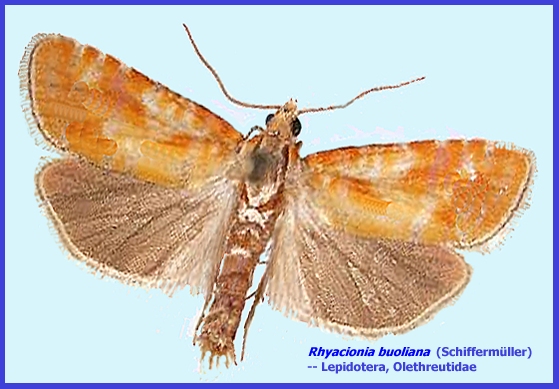
EUROPEAN PINE SHOOT MOTH Rhyacionia buoliana
(Schiffermüller) -- Olethreutidae (Contacts) ---- CLICK on Photo to enlarge & search for Subject Matter with Ctrl/F. GO TO ALL: Bio-Control Cases
In 1927, the
Commonwealth Institute of Biological Control was engaged to collect
parasitoids in Great Britain for introduction into Canada and this led to the
release of eight species during the period 1928-43 and an additional five
species from material collected in continental Europe during 1954-58 (McGugan
& Coppel 1962). Two additional
species were released during 1968-74, one from Germany and one from Argentina
(Syme 1981). A similar program of
parasitoid introductions was carried out in the New England states from
1931-37 (Dowden 1962). This program
is another example of the multiple introduction approach where emphasis is
placed on the need to provide rapid results without detailed preintroduction
studies. Of the 15 species of
parasitoids released in New England and in southern Ontario, only three
larval parasitoids, the braconid Orgilus obscurator
(Nees), and the ichneumonids Eulimneria rufifemur
(Thoms.) and Temelucha
interruptor (Grav.),
became firmly established. However,
it was not until the early 1960's that T.
interruptor was disclaimed
as a cleptoparasitoid detrimental to the
potential impact of O. obscurator (Arthur et al.
1964). Orgilus obscurator is a
specific larval parasitoid with a high fecundity and an efficient host
finding ability that permits it to avoid both superparasitism and very low
host density situations (Syme 1977). In
contrast, T. interruptor is a more general
parasitoid of Microlepidoptera and while it also has a high fecundity it is
inefficient at host finding and oviposits most successfully in host larvae
previously attacked by O. obscurator. Both parasitoids attack young host larvae
and only develop further when the host larvae approach maturity. However, the first instar larva of T. interruptor is competitively superior to that of O. obscurator, which is killed at an early stage to ensure
the successful development of the cleptoparasitoid (Schroeder 1974). Although the
biological control program against pine shoot moth in North America is
considered to be unsuccessful, there are isolated reports of high levels of
parasitism by O. obscurator followed by the
collapse of shoot moth populations at Dorcas Bay in Ontario (Syme 1971) and
near Quebec City (Béique 1960). The
occurrence of wild carrot, Daucus
carota (L.) at Dorcas Bay
where parasitism by O. obscurator reached 92% prompted
further investigations on the influence of this nectar and pollen source on
parasitism in Ontario. Syme (1977)
demonstrated the beneficial influence of flowers on the longevity and
fecundity of O. obscurator and was able to show
increased rates of parasitism and elimination of pine shoot moth populations
when the parasitoid was released into plantations where D. carota
was plentiful (Syme 1981). Please refer also
to the following refrences for details on host and natural enemy biologies
and biological control efforts (Thorpe 1930, Dowden 1934, Coppel & Arthur
1954, Watson & Arthur 1959, Arthur & Juillet 1961, Juillet 1960a,b,
1959, 1961; Harris 1960, Turnbull & Chant 1961, Pointing 1961, 1963;
Eichhorn 1965, Eichhorn et al. 1965, Schindler 1965, Pointing & Miller
1967). REFERENCES: [Additional references may be found at: MELVYL
Library ] Arthur, A. P. & J. A. Juillet. 1961.
The introduced parasites of the European pine shoot moth, Rhyacionia buoliana (Schiff.) (Lepidoptera: Olethreutidae), with a
critical evaluation of their usefulness as control agents. Canad. Ent. 93: 297-312. Arthur, A. P., J. E. R. Stainer & A. L.
Turnbull. 1964. The interaction between Orgilus obscurator (Nees) (Hymenoptera: Braconidae) and Temelucha interruptor (Grav.) (Hymenoptera: Ichneumonidae), parasites of the pine shoot moth, Rhyacionia buoliana (Schiff.) (Lepidoptera: Olethreutidae). Canad. Ent. 96: 1030-34. Béique, R.
1960. The importance of the European
pine shoot moth, Rhyacionia buoliana (Schiff.) in Quebec
City and vicinity. Canad. Ent.
92: 858-62. Coppel, H. C. & A. P. Arthur. 1954.
Notes on the introduced parasites of the European pine shoot moth, Rhyacionia buoliana (Schiff.) (Lepidoptera: Tortricidae), in
Ontario. Ent. Soc. Ontario 84th Ann. Rept.
(1953): 55-8. Dahlsten, D.
L. & N. J. Mills. 1999.
Biological Control of Forest Insects.
In: T. Bellows &
T. W. Fisher (eds.), Principles and Application of Biological Control. Academic Press, San Diego, CA. 1046 p. Dowden, P. B. 1934. Recently
introduced parasites of three important forest pests. Ann. Ent. Soc. Amer. 27: 599-603. Dowden, P. B.
1962. Parasites and predators
of forest insects liberated in the United States through 1960. USDA, Forest Service, Agric. Handbook No.
226, 70 pp. Eichhorn,
O. 1965. Uber einige lärchenschädlinge und ihre Parasiten in Japan,
Europa und Kanada. Betr. Ent. 15: 111-26. Eichhorn, O,
H. Pschorn-Walcher & D. Schröder.
1965. Neue Untersuchungen zur
biologischen Bekämpfung verschleppter Forstinsekten. 2.
Bericht über die Arbeiten der europäischen Station des Commonwealth
Institute of Biological Control, Delémont, Switzerland. Pt. II.
Anz. Schädlingsk. 38: 104-09. Harris, P.
1960. Natural mortality of the
pine shoot moth, Rhyacionia buoliana (Schiff.)
(Lepidoptera: Olethreutidae), in England.
Canad. J. Zool. 38: 755-68. Juillet, J. A.
1959. Morphology of immature
stages, life-history, and behaviour of three hymenopterous parasites of the
European pine shoot moth, Rhyacionia
buoliana (Schiff.) (Lepidoptera:
Olethreutidae). Canad. Ent. 91:
709-19. Juillet, J. A.
1960a. Immature stages, life
histories and behaviour of two hymenopterous parasites of the European pine
shoot moth, Rhyacionia buoliana (Schiff.) (Lepidoptera:
Olethreutidae). Canad. Ent. 92:
342-46. Juillet, J. A.
1960b. Resistance to low
temperatures of the overwintering stages of two introduced parasites of the
European pine shoot moth, Rhyacionia
buoliana (Schiff.) (Lepidoptera:
Olethreutidae). Canad. Ent. 92:
701-04. Juillet, J. A.
1961. Observations on the
arthropod predators of the European pine shoot moth, Rhyacionia buoliana
(Schiff.) (Lepidoptera: Olethreutidae), in Ontario. Canad. Ent. 93: 195-98. McGugan, B. M. & H. C. Coppel. 1962.
A review of the biological control attempts against insects and weeds
in Canada. II. Biological control of forest insects,
1910-1958. Commonwealth Inst. Biol.
Control Tech. Comm. No. 2: 35-216. Pointing, P. J. 1961. The biology and
behaviour of the European pine shoot moth, Ryacionia buoliana
(Schiff.), in southern Ontario. I.
Adult. Canad. Ent. 93: 1098-1112. Pointing, P. J. 1963. The biology and
behaviour of the European pine shoot moth, Ryacionia buoliana
(Schiff.), in southern Ontario.
II. Egg, larva, and pupa. Canad. Ent. 95: 844-63. Pointing, P. J. & W. E. Miller. 1967.
European pine shoot moth Rhyacionia
buoliana (Schiff.). In: Important Forest Insects and Diseases of
Mutual Concern to Canada, the United States and Mexico. Canada. Dept. Forest and Rural
Development. p. 163-66. Schindler,
U. 1965. Zur Parasitierung des Kieferknospentriebwicklers (Rhyacionia buoliana Schiff.) in Nordwestdeutschland. Ztschr. f. angew. Ent. 55: 353-64. Schroeder,
D. 1974. A study of the
interactions between the internal larval parasites of Rhyacionia buoliana
(Lepidoptera: Olethreutidae). Entomophaga
19: 145-71. Syme, P.
D. 1971. Rhyacionia buoliana (Schiff.), European pine shoot moth (Lepidoptera:
Olethreutidae). Comm. Inst. Biol.
Control Tech. Comm. 4: 194-205. Syme, P. D.
1977. Observations on the
longevity and fecundity of Orgilus
obscurator (Hymenoptera:
Braconidae) and the effects of certain foods on longevity. Canad. Ent. 109: 995-1000. Syme, P. D.
1981. Chapter 66. Rhyacionia
buoliana (Schiff.), European
pine shoot moth (Lepidoptera: Tortricidae), p. 387-94. In: J. S. Kelleher & M. A. Hulme (eds.),
Biological Control Programmes Against Insects and Weeds in Canada,
1969-1980. Commonwealth Agricultural
Bureau, London, England. 410 p. Thorpe, W. H.
1930. Observations on the
parasites of the pine-shoot moth, Rhyacionia
buoliana Schiff. Bull. Ent. Res. 21: 387-412. Turnbull, A. L. & D. A. Chant. 1961.
The practice and theory of biological control of insects in
Canada. Canad. J. Zool. 39: 697-753. Watson, W. Y. & A. P. Arthur. 1959.
Parasites of the European pine shoot moth, Rhyacionia buoliana
(Schiff.), in Ontario. Canad. Ent.
91: 478-84. |