FILE: <ch-42.htm> GENERAL INDEX [Navigate to MAIN MENU ]
|
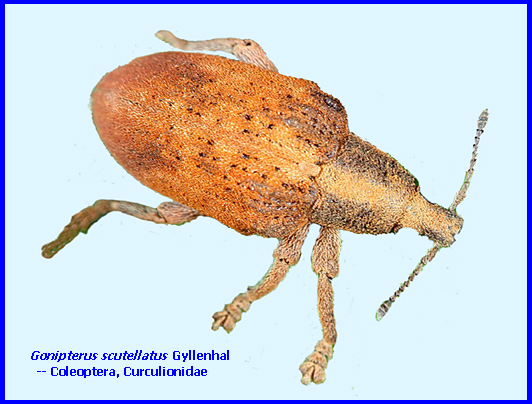
EUCALYPTUS SNOUT BEETLE Gonipterus scutellatus Gyllenhal --
Coleoptera, Curculionidae (Contacts) ---- CLICK on Photo to enlarge &
search for Subject Matter with Ctrl/F. GO TO ALL: Bio-Control Cases
Biological control began in Australia in 1926 with the discovery of an
egg parasitoid, which was shipped to Cape Town and Pretoria, South Africa
(Tooke 1955). The parasitoid, Patasson nitens (Girault), was reared at
Pretoria and released that year at Johannesburg. A total of 620,000 P.
nitens were released in all
major infested areas in South Africa by 1931. Damage fell below economic levels in all areas by 1935 except
the High Veld, where climatic conditions apparently hampered the reproduction
of the parasitoid to consistently effective numbers. At elevations above 4,000 ft, the results
are highly variable, not only in different areas but from year to year. One of the important factors bearing on
this situation is rainfall, with its influence on the time of production of
new, fresh foliage and the resultant effect on the cycle of the beetle. Damage to the trees is greatest during
summers of light rainfall. Winter
temperatures are such that no eggs are laid for 5-6 months, thus imposing a
severe handicap on the maintenance of adequate parasitoid populations. However, severe damage in the higher
elevations is now limited almost entirely Eucalyptus
viminalis (Tooks 1955,
Clausen 1978).
The parasitoid spread naturally to the north in Zimbabwe and Malawi
and increased rapidly so that the weevil no longer was injurious. Transfer of the parasitoid to East Africa
was begun in 1945 with equal success.
It was then introduced into Mauritius and in 1948 into Madagascar
where egg parasitism ranged as high as 67% within six months. In 1958 it was introduced into St. Helena
where a rapid increase in parasitism resulted in significant protection to
the eucalyptus plantations beginning in 1959 (Waters et al. 1976).
Greathead (1971) rates this project as a resounding success. I shows how rapidly an efficient
parasitoid can effect control of an introduced pest in an intensive timber
culture. Control of the weevil also
has been achieved by P. nitens in New Zealand. Introductions from Australia in 1927-29
resulted in the establishment in both North and South Islands. Subsequent records are few, but high
levels of parasitism have been observed at times and it is considered an
important factor in the regulation of weevil populations throughout the range
of the pest there (Waters et al. 1976) (also see Clark 1931, 1936; Moutia
& Vinson 1945, Kevan 1946; Moutia 1946, 1947; Frappa 1950). REFERENCES: [Additional references may be found at: MELVYL
Library ] Clark, A. F.
1931. The parasite control of Gonipterus scutellatus Gyll.
New Zealand J. Sci. & Tech. 13:
22-8. Clark, A. F.
1936. Biological control of
forest insect pests. New Zealand J.
Sci. & Tech. 18: 585-88. Clausen, C.
P. 1978. Curculionidae. In: C. P. Clausen (ed.), Introduced Parasites
and Predators of Arthropod Pests and Weeds.
U. S. Dept. Agric., Agric. Handbk. No. 480. 545 p. Frappa, C.
1950. Sur l'introduction et
l'acclimatement a Madagascar d'Anaphoidea
nitens Gir., insecte
auxiliare parasite du charancon de l'eucalyptus. Bul. Agric
(Madagascar) 2(17): 14-19. Greathead, D. J. 1971. Eucalyptus snout
beetle--Gonipterus scutellatus Gyll. Commonw. Inst. Biol. Control. Tech.
Commun. 5: 49-50. Kevan, D.
K. M. 1946. The eucalyptus
weevil in East Africa. East African
Agric. J. 12: 40-4. Moutia, L. A.
1946. Notes sur l'introduction
a Maurice de l'insecte: Anaphoidea nitens Gir., le parasite du charancon de
l'eucalyptus: Gonipterus scutellatus
Gyll. REv. AGric. Maurice 25:
211-12. Moutia, L. A.
1947. En marge de la lutte
contre loherbe conde: Cordia
macrostachya (Jacq.) Roem
and Schult.: la fourmi rouge: Solenopsis
geminata F. et le charancon
de l'eucalyptus: Gonipterus scutellatus Gyll. Rev. AGric. Maurice 26:
125-37. Moutia, L.
A. & J. Vinson. 1945.
Le charancon d l'eucalyptus, Gonipterus
scutellatus Gyll. REv. Agric. Maurice 24: 25-30. Tooke, F. G. C. 1955. The eucalyptus
snout beetle, Gonipterus scutellatus Gyll., a study of
its ecology and control by biological means.
Ent. Mem. Dep. Agric. S. Africa 3:
282 p. Waters, W. E., A. T. Drooz & H.
Pschorn-Walcher. 1976. Biological control of pests of
broad-leaved forests and woodlands. In: C. B. Huffaker & P. S. Messenger (eds.), Theory and
Practice of Biological Control.
Academic Press, New York. 511
p. |