FILE: <ch-4.htm> GENERAL INDEX [Navigate to MAIN MENU
]
|
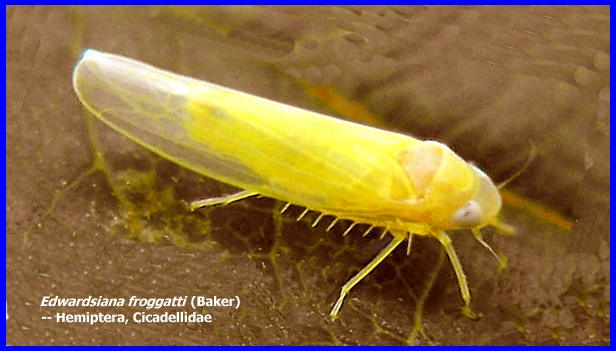
APPLE LEAFHOPPER Edwardsiana froggatti (Baker) --
Hemiptera, Cicadellidae (Contacts)
CLICK on Photo to enlarge & search for Subject Matter with Ctrl/F. GO TO ALL: Bio-Control Cases
Field-collected overwintering eggs of E. froggatti
with developing mymarid parasitoids Anagrus
armatus nigriventris Girault, were imported into Tasmania from New
Zealand during the winter of 1935.
Two colonies of adults from this material were placed in gardens of
Hobart and one in an orchard at Risdon.
The parasitoid became established (Evans 1937) but there is no further
information on a later distribution program.
The dryinid parasitoid Aphelopus typhlocybae Muesebeck was
imported into New Zealand from the United States in 1935. There were 239 adults of this
nymphal-adult parasitoid released (Dumbleton 1937), but the species did not
establish. This parasitoid frequently
attains a high parasitization rate in North America, and would be a useful
complement to A. armatus nigriventris. The
latter parasitoid was introduced into South Australia in 1940 and Western
Australia in 1943 and 1947-48, the stocks being obtained from Tasmania, but
neither colonization attempt succeeded (Wilson 1960). In Tasmania the Anagrus
populations increased rapidly following initial releases, as indicated by
high field parasitization at release sites within 18 months after release
(Evans 1937). Ten years later Miller
(1947) recorded up to 90% parasitization of the eggs and stated that the
leafhopper had not been a serious pest in the preceding years. Wilson (1960) also commented on the
reduction in seriousness of the outbreak. Anagrus armatus
nigriventris is common in
North America where it attacks the eggs of several Cicadellidae. It was found to be abundant as a
parasitoid of E. froggatti in New Zealand in
1932. Examination of field collected
overwintering eggs showed parasitization rates ranging from 78-93%,
indicating that the species is potentially a valuable control agent. However, even this high parasitization is
not sufficient to bring the pest to a consistently noneconomic level under
New Zealand conditions (Clausen 1978).
Winters are passed in the larval stage within the host eggs and the
first brood of adult emerges in November and December, at a time which is
correlated with the presence of summer eggs of the host at this Southern
Hemispheric location. The second
brood of adults is present from January to April. Two generations occur each year on leafhopper eggs on apple,
whereas on hawthorn there is only a partial third generation. Females are very short lived, and may
deposit up to 20 eggs in rapid succession.
The spring brood of adults show a preponderance of females in the
ratio of about 9:1 (Dumbleton 1934). In Canada Armstrong (1936) studied Anagrus as a parasitoid in the eggs of Typhlocyba pomaria McA. and found that it passes the winter as a
partially grown larva in the host egg and that there are two and perhaps
three generations each year.
Parasitization of the overwintering host eggs averaged 74.8% and those
of the summer brood 40.4%. The peak
period of emergence of the first brood of adults was around July and of the
second around early August. The sex
ratio of material reared during an entire season was 2.3 females to 1 male. REFERENCES: [ Additional references may be found at: MELVYL
Library ] Armstrong, T.
1936. Two parasites of the
white apple leafhopper (Typhlocyba
pomaria McA.). Ent. Soc. Ontario, Ann. Rept. 66
(1935): 16-31. Clausen, C. P.
1978. Cicadellidae. In: C. P. Clausen (ed.), Introduced Parasites
and Predators of Arthropod Pests and Weeds:
A World Review. U. S. Dept. of
Agric., Agric. Handbk. No. 480.
545 p. Dumbleton, L. J. 1934. The apple
leaf-hopper (Typhlocyba australis Frogg.). New Zealand J. Sci. Technol. 16: 30-8. Dumbleton, L. J. 1937. Apple leaf-hopper
investigations. New Zealand J. Sci.
Technol. 18: 866-77. Evans, J. W.
1937. The biological control
of the apple leaf-hopper (Typhlocyba
froggati Baker). Tasmanian J. Agric. 8: 171-73. Miller, D.
1947. Entomological
investigations. Cawthron Inst.
(Nelson, New Zealand) Ann. Rept. 1946-1947:
34-5. Wilson, F.
1960. A review of the
biological control of insects and weeds in Australia and Australian New
Guinea. Commonwealth Inst. Biol.
Control, Tech. Commun. 1: 102 p. |