FILE: <ch-39.htm> GENERAL INDEX [Navigate
to MAIN MENU
]
[For educational purposes only; do not review, quote
or abstract]
|
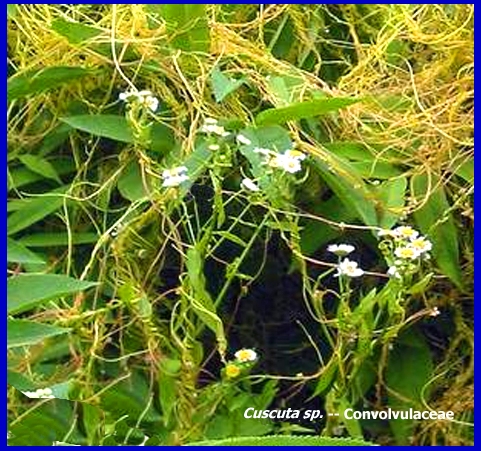
DODDER, Cuscuta spp. -- Convolvulaceae (Contacts) Two species of the parasitic plant,
dodder, Cuscuta
australis R. Brown &
C. chinensis Lamarck, has been
targeted for biological control in the Peoples' Republic of China (Wang 1986,
Goeden & Andrés 1999). These
plants are serious pests of oilseed, potato, soybean and peanuts in Shandong,
Anhui, Jilin, Hubei, Helongjiang and Liaoning Provinces and in the Xinjiang
autonomous Region, P.R.C. A
pathogenic fungus, Colleotrichum gloeosporioides,
was isolated from dodder in soybeans in Jinan, Shandong Province in
1963. Studies on biology and mass
culture were performed in 1963-66, leading to the development of a
mycoherbicide named "Lubao No. 1."
Application of this mycoherbicide grew from an initial use in soybean
in five provinces in 1966 to ca. 670,000 ha of soybeans treated in 30
provinces in the 1970's. Eighty-five
percent control of dodder was reported in all fields and soybean losses were
reduced 30-50% (Wang 1986).
Production of Lubao No. 1 was curtailed during 11 years of the
"Cultural Revolution." An
improved strain with a longer shelf-life and lower RH infection threshold is
currently in use. REFERENCES: [Additional references may be found at: MELVYL
Library ] Goeden,
R. D. & L. A. Andrés. 1999. Biological control of weeds in terrestrial
and aquatic environments. In: Bellows, T. S. & T. W. Fisher (eds.), Handbook of Biological Control: Principles and Applications. Academic Press, San Diego, New York. 1046 p Wang,
R. 1986. Current status and perspectives of biological weed control in
China. Chinese J. Biol. Contr.
1: 173-77. |