FILE: <ch-33.htm> GENERAL INDEX
[Navigate to
MAIN MENU ]
|
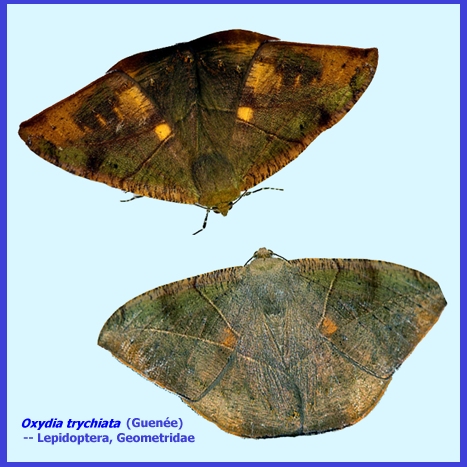
COLOMBIAN DEFOLIATOR Oxydia trychiata (Guenée) --
Lepidoptera, Geometridae (Contacts) ----- CLICK on Photo to enlarge &
search for Subject Matter with Ctrl/F. GO TO ALL: Bio-Control Cases
The egg parasitoid, T.
alsophilae (Scelionidae) has
several biological attributes that are well worth noting since they may have
influenced this unique cross genus introduction. First, its normal host, the fall cankerworm, feeds on several
broad leaved trees but its host in South America feeds on conifers. This indicates that host plant odors or
other differences between conifers and broad leaved trees are unimportant in
host egg finding. There may have been
a clue to this because the fall cankerworm feeds on several genera of
deciduous hardwoods. The parasitoid
is apparently easily to handle as changes in photoperiod and lack of cold in
the winter did not interfere with development (Drooz et al. 1977). The climate at the origin of the
parasitoid in Virginia (30° N. Lat., el. 370 m, mean winter temperature 2°C and mean
summer temperature 24°C) compared to that of the release site in
Colombia (6° N. Lat., 2340 m, temperature range 6° - 26°C with
annual mean of 16°C) shows a shift from a temperate to a tropical
climate although the extremes are about the same. The rainfall patterns in the two regions also differ. The ecological plasticity of this
parasitoid is thus demonstrated, and in addition it is long-lived (>6
months) (Drooz et al. 1977).
The parasitoid may be easily reared, which is important to a
biological control project (Drooz et al. 1977, Fedde et al. 1979), and eggs
of another species of geometrid, Abbottana clemataria
(J. E. Smith) are used because it could be propagated on artificial
diet. Around 18,000 parasitoids were
sent to and released in a pine
plantation in Colombia between October and December in 1975 (Bustillo &
Drooz 1977, Drooz et al. 1977).
Parasitization rates on O.
trychiata eggs were very
high and by the time the parasitoid had undergone three generations in April
of 1976 few adults could be found at normal emergence time. Only 13 egg masses of O. trychiata
could be found and these were 99% parasitized. By May the outbreak was controlled when larvae could not be
found in the area (Drooz et al. 1977).
It is speculated that the parasitoid maintains itself on any of the
four species of Oxydia or
other geometrids in Colombia. REFERENCES: [Additional references may be
found at: MELVYL
Library ] Bustillo,
A. E. & A. T. Drooz. 1977.
Comparative establishment of a Virginia (USA) strain of Telenomus alsophilae on Oxydia
trychiata in Colombia. J. Econ. Ent. 70: 767-70. Dahlsten, D.
L. & N. J. Mills. 1999.
Biological Control of Forest Insects.
In: Bellows, T. S.
& T. W. Fisher (eds.), Handbook of
Biological Control: Principles and
Applications. Academic Press, San
Diego, New York. 1046 p Drooz, A. T., A. E. Bustillo, G. F. Fedde and
V. H. Fedde. 1977. North American egg parasite successfully
controls a different host genus in South America. Science 197: 390-91. Fedde, G. F., V. H. Fedde & A. T.
Drooz. 1979. Biological control prospects of an egg
parasite, Telenomus alsophilae Viereck, p.
123-27. In: Current Topics
in Forest Entomology. Selected papers
from XV Intern. Cong. Ent., U. S. Dept. Agric. For. Serv. Gen. Tech.
Rept. WO-8. 174p. |