FILE: <ch-28.htm> GENERAL INDEX [Navigate to MAIN MENU ]
|
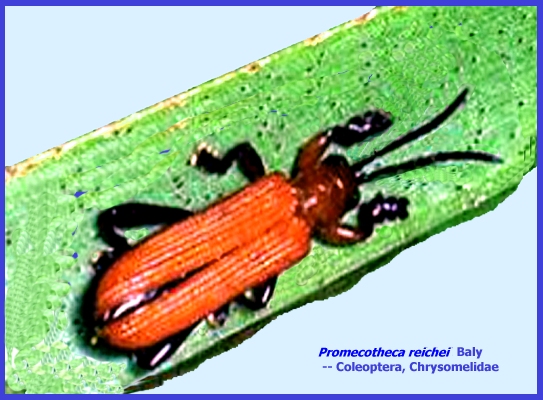
COCONUT LEAF-MINING BEETLE Promecotheca reichei Baly --
Coleoptera, Chrysomelidae (Contacts) ----- CLICK on Photo to enlarge &
search for Subject Matter with Ctrl/F. GO TO ALL: Bio-Control Cases
Detailed studies of the beetle and its natural enemies were not made
until 1929 when sufficient entomological expertise became available. It was found that all severe outbreaks had
one unusual feature in common: only
one stage of the insect was present at any one time, and there were no
overlapping generations. This was
considered atypical in the tropical climate of Fiji where reproduction can
continue year round. Studies showed
that beetle outbreaks were due to the indirect adverse effects of a predatory
mite, Pediculoides
ventricosus (Newport),
on two native parasitic species which were capable of controlling the beetle
in its absence. The mite was probably
accidentally introduced to Fiji, as it is now known to be cosmopolitan and
feeds on a great variety of insects.
This mite caused an even-brooded condition of the beetle and this
resulted in the native parasitoids being rendered ineffective because they
attacked only the larval stages and these were mostly lacking for long
periods of time because of the even-brooded situation.
The mite attacked all larval stages and the pupae of the beetle but
not adults or eggs. In dry seasons it
increased with incredible rapidity and would destroy all the beetles except
eggs and adults in a given locality.
The adults laid eggs and died and this later resulted in the
single-stage condition consisting principally of beetle larvae, but meanwhile
the predatory mite population crashed because of food shortage when only
adult beetles and eggs were present (DeBach 1974). With onset of the wet season the beetles increased very rapidly
in the absence of significant parasitism and because the mite was inactive
during wet periods. Dr. T. H. C.
Taylor concluded that the mite would have replaced the indigenous parasitoids
and done effective control had it not been decimated by wet weather each
year. In areas of Fiji with
continuous wet weather the beetle seldom became a serious pest, probably because
the mite was held down and the native parasitoids operated without
interference.
It was then considered that new parasitoids be found, those with a set
of quite definite characteristics that could cope with the single-brooded
condition. These included mainly (1)
the parasitoid should have a more rapid rate of increase relative to the pest
than the native parasitoids, and one generation must require no longer than
one month, (2) adults of the parasitoid should be able to survive the long
periods when no individuals of the pest were in a suitable stage for its
attack, and (3) it should parasitize all larval stages as well as pupae of
the host so that suitable hosts would be available over a much longer period
in each pest generation than for a parasite species which attacked only one stage,
and therefore the period during which the new parasitoid would lack suitable
hosts would be correspondingly shorter.
Also it would be good if the parasitoid were internal, very active and
capable of rapid dispersal and tolerance of the climatic conditions in
Fiji.
No candidate parasitoids with the above characteristics were known at
the time , but in 1930 R. W. Paine's investigations in Java resulted in the
discovery of a large number of parasitoids of a related species of Promecotheca (P. nuciferae Maulik). This beetle occurred throughout Java but
was never a pest. Taylor followed up
with detailed studies of the Javanese parasitoids and concluded that only one
of the parasitoids, Pleurotropis
parvulus Ferriere, met the
conditions desired in a new parasitoid, even though this species was
considered to be one of the least important of the complex controlling its
host in Java. Pleurotropis parvulus
attacks all stages of larvae as well as the pupae of Promecotheca, and many individuals develop in each host
individual giving it a high potential rate of increase with respect to the
host. The life cycle is only about
three weeks long as compared to almost 3 1/2 months for the beetle in Fiji
and more importantly, the adult parasitoids live for 5 1/2 weeks which
enables them to survive periods when suitable stages of the host are rare or
absent.
The parasitoids were shipped from Java to Fiji in six large wire-gauze
cages each containing four seedling coconut palms heavily infested with Promecotheca nuciferae of all stages. Parasitoids were included in the cages and
were able to reproduce during the voyage.
Taylor left Batavia, Java on April 17, 1933 on the S. S. Van Rees which traveled from Singapore
to Sydney via Java, New Guinea, New Hebrides and New Caledonia. It was necessary to trans-ship at Noumea,
New Caledonia on May 10 to the S.
S. Kareta in order to go on to Suva, Fiji, where he arrived
on May 14. Before arrival in Noumea
(4 days from Fiji) all palms, soil, containers, etc. were thrown overboard to
eliminate any potential pest hazards, after all parasitoids and parasitized
larvae and pupae of the host had been placed into glass tubes. From Suva it was necessary to proceed at
once on a chartered motor launch to the Lau group of islands where beetle
problems were severe. They arrived at
Nabavatu on Vanua Balavu on May 24 (37 days out of Java), where an insectary
were set up. Some 1,200 adults and
pupae of P. parvulus arrived in good
condition. Taylor also imported the
two parasitic species considered most important in Java as an additional
precaution. Only one, Dimmockia javanica Ferr., was successfully introduced, cultured and
liberated in sufficient numbers, but it failed to establish.
The first liberations of P.
parvulus were made on May
26, 1933 and were continued to April 30, 1934, when so many parasitoids were
present in the field that insectary rearing was no longer necessary. Within a year it had completely controlled
all the severe outbreaks of Promecotheca
on Vanua Balavu, Kanacea, Taveuni, Mago, Lakeba and others. Taylor recorded that it literally attained
100% parasitism on all trees, even though in many outbreaks every three over
hundreds of acres of land bore about 4,000 beetle individuals. At the first peak of the parasitoid
explosion, about 5,000 adult parasitoids were emerging per tree daily and
this continued for about 10 days (the parasitoid is gregarious). Not a single Promecotheca individual escaped in many outbreak areas and
the parasitoid dispersed so well that it controlled the pest even on isolated
coconut trees hidden in the forest (DeBach 1974).
As it turned out the parasitoid had the disadvantage of being too
effective. On small islets or very
isolated spots of coconuts it would exterminate the pest and then die out
itself. This required reintroduction
of the parasitoid if the beetle reinvaded.
However, this never occurred on larger islands or estates, and today
the coconut leaf-mining beetle is rare and of no economic importance. DeBach (1974) considers this biological
control project to be unique in the annals of biological control, because
preselection concentrated on a parasitic species that was considered of
lesser importance in its place of origin. REFERENCES: [Additional references may be found at: MELVYL
Library ] DeBach, P. 1974. Biological Control by Natural
Enemies. Cambridge University Press,
London & New York. 323 p. Taylor, T. H. C.
1936. The biological control
of the coconut leaf miner (Promecotheca
reichei Baly) in Fiji. Agric. J. Fiji 8: 17-21. Taylor, T. H. C.
1937. The biological control
of an insect in Fiji. An account of
the coconut leaf-mining beetle and its parasite complex. Imp. Inst. Ent., London. 239 p. |