FILE: <ch-24.htm> GENERAL INDEX [Navigate to MAIN MENU ]
|
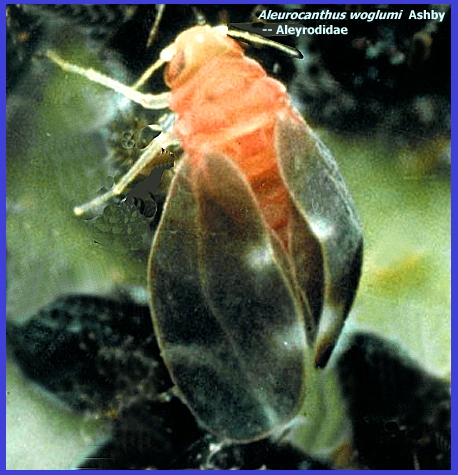
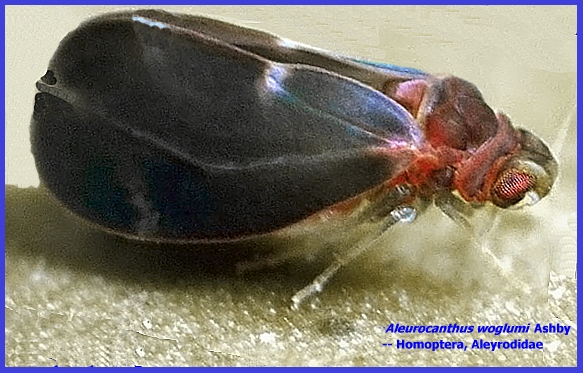
CITRUS BLACKFLY Aleurocanthus woglumi Ashby -- Homoptera, Aleyrodidae (Contacts) - ----- CLICK on Photos to enlarge
& search for Subject Matter with Ctrl/F. GO TO ALL: Bio-Control Cases This whitefly is thought
to be endemic in tropical and subtropical Asia, from where it spread to
Africa, The Seychelles Islands, Central America, The West Indies, northern
South America and Texas and Florida in the United States (Clausen 1978). Kennett et al. (1999) report that although A. woglumi was in Jamaica in 1913 from where it spread to
Cuba in 1916, Panama in 1917 and Costa Rica in 1919, biological control
efforts did not begin until the late 1920's after Silvestri (1926, 1928)
published on the parasitoids of Aleyrodidae in Asia. Exploration in southern Asia began in
1929-31, were several natural enemy species were found and sent from Malaya
to Cuba (Clausen & Berry 1932). Eretmocerus serius Silvestri was discovered
first, and it became established after release. Later attempts with Encarsia (= Prospaltella)
divergens (Silvestri) and Encarsia smithi (Silvestri) did not succeed. The Sumatran coccinellids Catana clauseni Chapin and Scymnus smithianus Clausen & Berry,
established in 1930, and although Catana
nearly eradicated the blackfly, it could not persist at low prey densities
and was eventually displaced by E.
serius. Clausen (1978) reported that C. clauseni was apparently nonexistent in Cuba after
1951. Eretmocerus serius
was then introduced into Jamaica, the Bahamas, Haiti, Costa Rica, Barbados,
the Seychelles, Kenya and South Africa during 1931-59, with generally very
good results. In 1935 Aleurocanthus
woglumi was discovered in
Mexico, and biological control efforts imported E. serius
from the Canal Zone. It did not
establish, but was reintroduced in 1943 with success (Kennett et al.
1999). Control was not as good as in
Cuba and other parts of the West Indies, except in areas with perpetual high
RH. Therefore explorations were
extended in Asia during 1948-50.
Introductions involved Encarsia
divergens and Encarsia smithi, from Malaya in 1948, which did not establish. Explorations in India and Pakistan in
1949-50 resulted in the shipment of eight parasitoids and two predators to
Mexico (Smith et al. 1964). Encarsia smithi, Encarsia clypealis
(Silvestri), Encarsia
opulenta (Silvestri) and
Amitus
hesperidum Silvestri became
established. Some control was
displayed by each one of these parasitoids as they became established
(Clausen 1978). Encarsia smithi
seemed to be the best species, becoming dominant over E. serius. Later it in turn was dominated by the
other three species (Kennett et al. 1999).
Amitus hesperidum was adapted to a
greater number of Mexican climatic zones and was very rapid in reducing
blackfly infestations. As A. woglumi became more scarce, A. hesperidum
was dominated by E. clypealis and E. opulenta. This
order of dominance was explained by Flanders (1969) on the basis of the
parasitoids' reproductive strategies as they influenced interspecific
competition. Climatic conditions
determined the spatial distribution of the three dominant species. Therefore, E. opulenta
was the overall most effective parasitoid, especially in arid regions, while E. clypealis was effective in humid areas. Amitus
hesperidum was least
effective, especially in warm arid areas.
Encarsia opulenta and/or
E. serius were sent to other countries as well. Quezada (1974) reports from El Salvador,
Wheatley (1964) from Kenya, Bedford & Thomas (1965) from South Africa and
Anonymous (1978) report from Venezuela.
Pshorn-Walcher & Bennett (1967 = Kennett et al. 1999) reported on
the work in Barbados, Dowell et al. (1979) from Florida and Summy et al.
(1983) from Texas. All resulted in
excellent biological control with either one or both parasitoids. Whenever multiple species were introduced,
E. opulenta became dominant.
In Jamaica the introduction of E.
opulenta produced overall
better biological control than when only E.
serius was present (van
Whervin 1968) (also see Edwards 1932, Clausen 1934, Delgado 1943, Richardson
1948, Shaw 1950, Abbas et al. 1955, Smith 1958, Smith et al. 1964, Jimenez
1963, 1965; Jimenez & Carillo 1968, Bennett & van Whervin 1966,
Pschorn-Walcher 1967). REFERENCES: [Additional references may be
found at: MELVYL
Library ] Anonymous.
1978. Pest control: the case of the black fly shows the
effectiveness of biological control. Noticias
Agricolas 8: 51-52. Abbas, H.
M., M. S. Khan & H. Haque. 1955.
Black fly of citrus (Aleurocanthus
woglumi Ashby) in Sind and
its control. Agric. Pakistan 6: 5-23. Bedford, E. C. G. & E. D. Thomas. 1965.
Biological control of the citrus blackfly, Aleurocanthus woglumi
(Ashby) (Homoptera: Aleyrodidae) in South Africa. J. Ent. Soc. So. Afr. 28:
117-32. Bennett, F. D. & L. W. van Whervin. 1966.
Occurrence of the citrus black fly in Barbados. Agric. Soc. Trinidad Tobago J. 66: 31-4. Clausen, C. P.
1934. The natural enemies of
Aleyrodidae in tropical Asia.
Philippine J. Sci. 53: 253-65. Clausen, C.
P. 1978. Aleyrodidae. In: Introduced Parasites and Predators of
Arthropod Pests and Weeds. U. S.
Dept. Agric. Agric. Handbk. No. 480, Washington, D.C. 545 p. Clausen, C. P.
& P. A. Berry. 1932.
The citrus blackfly in Asia, and the importation of its natural
enemies into tropical America. U. S.
Dept. Agric. Tech. Bull. No. 320. 58 p. Delgado, D
Garay, A. 1943. Control biológico de la mosca prieta de
los cítricos en la repçblica. Fitofilo 5: 1-17. Dowell, R. V., G. E. Fitzpatrick & J. A.
Reinert. 1979. Biological control of citrus blackfly in
southern Florida. Environ. Ent. 8: 595-97. Edwards, W. H.
1932. Importation into Jamaica
of a parasite (Eretmocerus serius Silv.) of the citrus
black fly (Aleurocanthus woglumi Ash.). Jamaica Dept. Sci. & Agric. Ent. Bull.
6. 12 p. Flanders, S.
E. 1969. Herbert Smith's
observations on citrus blackfly parasites in India and Mexico and the
correlated circumstances. Canad. Ent.
101: 467-80. Jimenez-Jimenez,
E. 1963. Control biológico de la mosca prieta en México. Fitofilo 16: 6-41. Jimenez-Jimenez,
E. 1965. Situación de la mosca prieta de los cítricos en México. Fitofilo 16: 6-41. Jimenez-Jimenez,
E. & T. R. Carillo. 1968. La campaña contra la mosca prieta de los
cítricos, Aleurocanthus woglumi Ashby. Fitofilo 60: 23-8. Kennett, C. E., J. A. McMurtry & J. W.
Beardsley. 1999. Biological control in subtropical and
tropical crops. In: Bellows, T. S. & T. W. Fisher (eds.), Handbook of Biological Control: Principles and Applications. Academic Press, San Diego, New York. 1046 p Pschorn-Walcher,
H. 1967. Citrus blackfly (Aleurocanthus woglumi), p. 72. In: F. J. Simmonds (ed.), Report of Work
Carried Out During 1966. Commonwealth
Inst. Biol. Control. 86 p. Pschorn-Walcher,
H. & F. D. Bennett. 1967.
The successful biological control of citrus blackfly [Aleurocanthus woglumi Ashby] in Barbados,
West Indies. PANS
A13: 375-84. Quezada, J.
R. 1974. Biological control
of Aleurocanthus woglumi (Homoptera: Aleyrodidae)
in El Salvador. Entomophaga 19: 243-54. Richardson, C. H. 1948. Present status of
the citrus blackfly and its parasite, Eretmocerus
serius at Nassau,
Bahamas. J. Econ.
Ent. 41: 980. Shaw, J. G.
1950. Eretmocerus serius
as a parasite of the citrus blackfly in Mexico. J. Econ. Ent. 43:
380-82. Silvestri,
F. 1926. Descrizione di tre specie di Prospaltella e di una di Encarsia (Hym., Chalcididae) parasite di Aleurocanthus
(Aleyrodidae). Eos 2: 179-89. Silvestri,
F. 1928. Contribuzione alla conoscenza degli Aleurodidae (Insecta:
Hemiptera) viveti su citrus in estremo oriente e dei lora parassite. Boll. Lab. Zool. Portici 21:
1-60. Smith, H.
D. 1958. Las interelaciones de los enemigos naturales de la mosca prieta
de los cítricos en México. Fitofilo 11:
31-6. Smith, H. D., H. L. Maltby & J. E.
Jimenez. 1964. Biological control of the citrus blackfly
in Mexico. U. S. Dept. Agric. Tech.
Bull. 1311. 30 p. Summy, K. R., F. E. Gilstrap, W. G. Hart, J. M.
Caballero & I. Saenz. 1983. Biological control of citrus blackfly
(Homoptera: Aleyrodidae) in Texas.
Environ. Ent. 12: 782-86. van Whervin, L. W. 1968. The introduction
of Prospaltella opulenta Silvestri into Jamaica
and its competitive displacement of Eretmocerus
serius Silvestri. PANS A14:
456-64. Wheatley, P. E. 1964. The successful
establishment of Eretmocerus
serius Silv. (Hymenoptera:
Eulophidae) in Kenya. E. Africa
Agric. For.
J. 29: 236. |