FILE: <ch-19.htm>
GENERAL INDEX {also please see <bc-37.htm>] [Navigate to MAIN MENU ]
|
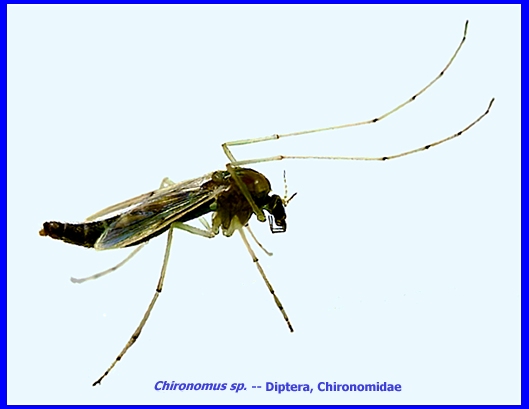
CHIRONOMID MIDGES Chironomus spp. -- Diptera, Chironomidae (Contacts) ------ CLICK on Photo to enlarge & search for Subject Matter with Ctrl/F. GO TO ALL: Bio-Control Cases
Research on the
biological control of Chironomidae has been in conjunction with mosquito
control, because the breeding habitats are often the same or similar. The same natural enemy groups were
investigated, which includes fish, hydra, planaria and various aquatic insect
predators. As with mosquitoes, fish
have given the most significant levels of control, with cichlids of the
genera Tilapia and Oreochromis being most
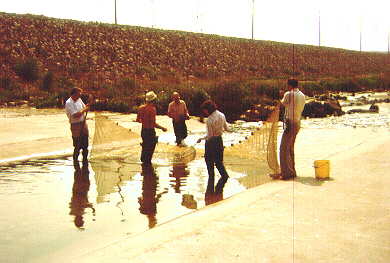
important. A permanent classical
biological control has been achieved in the principal storm drain channels of
Los Angeles with the establishment of Oreochromis
mossambica (Peters) and Oreochromis.
hornorum Trewazas there. <PHOTO>. Persistence of these subtropical cichlids
is facilitated by areas of warm water effluent that is discharged into the storm
channels from electrical power plants in winter. Benthic species of
Chironomidae are grazed to control levels in these channels, and the cichlid
populations annually reach very dense populations, which by early autumn show
signs of starvation. Pelagic
Chironomidae have increased in abundance with reduced competition for food in
the absence of benthic forms.
Fortuitously, pelagic species pose no public nuisance. Research revealed that densities of
principally Chironomus decorus Johannsen larvae,
declined markedly in detritus habitats of the urban drainages of the Los
Angeles basin, with the establishment of the cichlids. However, density changes in another group
of non-annoying midges, Cricotopus
and Tanypus species, were
not pronounced over a 9-yr study period.
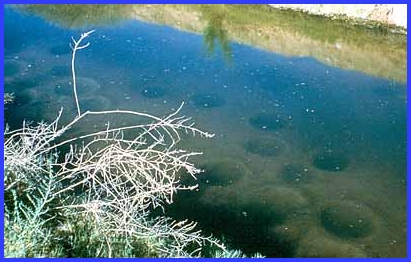
The effective foraging on Chironomidae in certain substrates by very dense populations of the species of cichlids influences the phenotypic
characteristics of such substrates to produce chironomids. Typically the insect-produced fish biomass
in autumn can exceed 4 x 10⁵ kg over a distance of 18 km of paved
river channel, a phenomenon apparently dependent indirectly on the
availability of warm water effluent from a power generating plant. The cichlids now range in the neritic zone
along the southwestern California coast, and their contribution to enhancing
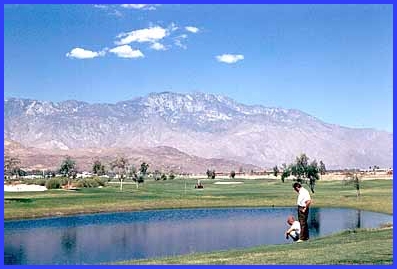
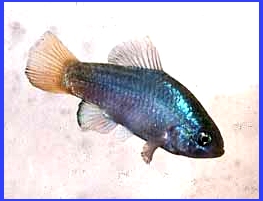
predatory marine fish biomass may be significant. A native species of
pupfish, Cyprinodon macularius
Baird & Girard, has also been shown to be an effective predator of chironomid
midges. This species might be
superior to Gambusia for
mosquito abatement as well, being able to rely on other than mosquito food in
periods of low mosquito abundance (Walters & Legner 1980). Details of
biological control efforts against Chironomidae may be found in the
references cited at the end of this section. [ Please refer also to Related Research ] REFERENCES: [Additional references may be
found at: MELVYL
Library ] Legner, E. F. 1973. Book Review,
"Biologische Schädlingsbekämpfung." by J. M. Franz. Paul Parey-Verlag, Berlin. 298 pp., 16 fig. Bull. Entomol.
Soc. Amer. 19(2): 126. Legner, E. F. 1983e. Imported cichlid behaviour in
California. Proc. Intern. Symp. on Tilapia in aquaculture,
Nazareth, Israel, 8-13 May, 1983. Tel Aviv
Univ. Publ. 59-63. 261. Legner, E. F. 1995.
Biological control of Diptera of medical and veterinary
importance. J. Vector Ecology 20(1):
59-120. Legner, E. F. & E. C. Bay.
1970a. The introduction of natural
enemies in California for the biological control of noxious flies and
gnats. Proc. Calif. Mosq. Contr.
Assoc., Inc. 37: 126-129. Legner, E. F. & R. A. Medved. 1972. Predators
investigated for the biological control of mosquitoes and midges at the
University of California, Riverside.
Proc. Calif. Mosq. Contr. Assoc., Inc. 40: 109-111. Legner, E. F. & R. A. Medved. 1973b. Influence of Tilapia mossambica (Peters), T.
zillii (Gervais) (Cichlidae)
and Mollienesia latipinna LeSueur (Poeciliidae)
on pond populations of Culex
mosquitoes and chironomid midges. J.
Amer. Mosq. Contr. Assoc. 33(3): 354-364. Legner, E. F. & R. A. Medved. 1974b. The native desert
pupfish, Cyprinodon macularius Baird and Girard, a
substitute for Gambusia
in mosquito control? Proc. Calif. Mosq. Contr. Assoc., Inc.
42: 58-59. Legner, E. F. & F. W. Pelsue. 1977. Adaptations of Tilapia to Culex and chironomid midge ecosystems in south
California. Proc. Calif. Mosq. &
Vect. Contr. Assoc., Inc. 45: 95-97. Legner, E. F. & F. W. Pelsue, Jr. 1983. Contemporary
appraisal of the population dynamics of introduced cichlid fish in south
California. Proc. Calif. Mosq. &
Vect. Contr. Assoc., Inc. 51: 38-39. Legner, E. F., R. A. Medved & W. J.
Hauser. 1975b.
Predation by the desert pupfish, Cyprinodon
macularius on Culex mosquitoes and benthic
chironomid midges. Entomophaga
20(1): 23-30. Legner, E. F., R. A. Medved & F. Pelsue. 1980b.
Changes in chironomid breeding patterns in a paved river channel
following adaptation of cichlids of the Tilapia
mossambica-hornorum complex. Ann. Entomol. Soc. Amer. 73(1): 293-299. Walters, L. L. & E. F. Legner. 1980. Impact of the
desert pupfish, Cyprinodon macularius, and Gambusia affinis on fauna in pond ecosystems. Hilgardia 48(3): 1-18. |