FILE: <ch-16.htm> GENERAL INDEX [Navigate
to MAIN MENU ]
|
CALIFORNIA RED SCALE Aonidiella aurantii (Maskell)-- Homoptera, Diaspididae (Contacts) ------
CLICK on Photo to enlarge & search for Subject Matter with Ctrl/F. GO TO ALL: Bio-Control Cases
During 1889-1947 a
variety of exotic natural enemies were introduced into California for
control, the earliest efforts emphasizing introductions of coccinellid
predators, of which more than 40 species were imported during 1889-1892
(Compere 1961). Most failed to
established and attention was then given to parasitoids. During 1900-1908 several species,
including Aspidiotiphagus
citrinus (Craw), Comperiella
bifasciata Howard and Pteroptrix
(= Casca) chinensis (Howard) were
imported from southern China, but none established (Compere 1961). One parasitoid that became associated with
the scale in southern California during this time was Aphytis chrysomphali (Mercet), although
its origin remained obscure. This
parasitoids was propagated during 1902-1904 and distributed to citrus
orchards on request, but dramatic results were not obtained (Compere 1961). Following this poor performance of A. chrysomphali, additional parasitoids in the genus Aphytis were discovered in
foreign areas, but they were erroneously believed to be the same species. During 1916-1924
additional introductions of Comperiella
bifasciata were made from Japan
(Compere 1961). It did not rear on
red scale in the laboratory so a factitious host, Chrysomphalus bifasciculatus Ferris was
used. Releases in the field did not
result in parasitism of red scale, but rather the yellow scale, Aonidiella citrina (Coquillett) (Smith
1942). Later the original host scale
in Japan was identified as Aonidiella
taxus Leonardi Chrysomphalus bifasciculatus and not A. aurantii and C.
aonidium (L.) as originally
believed. Several coccinellid
predators were imported from South Africa, Australia, South America and China
during 1918-1934 (Compere 1961). An Aphytis sp. (probably A. lingnanensis DeBach) was imported from southern China in
1924 under the erroneous name of A.
chrysomphali, but did not
become established. The endoparasitoid Habrolepis rouxi
Compere was imported from South Africa in 1937, and was widely
colonized. Establishment was obtained
in a very small area, however (Flanders 1944a). Comperiella bifasciata was tried once more
in 1940, but this time the collections were made on A. auranti
in southern China (Smith 1942), and
were then successfully propagated on that host in California (Flanders
1943a). The parasitoid eventually
spread throughout all of the southern California area except near the coast
(DeBach et al. 1955). Flanders
(1944b) and Teran & DeBach (1963) distinguished two distinct biological
races of this parasitoid, one from A.
auranti in China and the
other from A. taxus and C. bifasciculatus
in Japan, which solved the earlier puzzle. The period
1947-1949 marked many shipments of parasitized red scales being sent to
California from southern China and Taiwan.
Propagation was successful with many species, but only Aphytis lingnanensis from southern China and Encarsia (= Prospaltella) perniciosi (Tower) from Taiwan
became established (DeBach et al. 1950, DeBach 1953, Rosen & DeBach
1978). Encarsia perniciosi
readily established in the coastal areas of southern California. However, A. lingnanensis became dominant by 1958, displacing the long
established A. chrysomphali everywhere but in
a few coastal areas (DeBach & Sundby 1963). Although producing good biological control in coastal areas, A. lingnanensis was relatively ineffective in the warmer,
drier interior areas of southern California.
Explorations were
expanded in Asia during 1956-57, resulting in the importation of some new
parasitoids, including two Aphytis
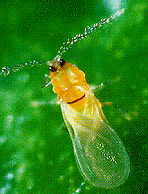
spp. (DeBach 1959). Only Aphytis melinus DeBach <PHOTO> from
northern India and Pakistan was established in California, however. Aphytis fisheri
DeBach, Aphytis
proclia (Walker), Coccobius
(= Physcus) debachi (Compere & Annecke)
and Aspidiotiphagus
citrinus were liberated but
did not become established.
Importations during 1960-1964 of Aphytis coheni
DeBach and Aphytis
holoxanthus DeBach from
Israel and Aphytis
africanus Quednau from South
Africa, all failed to establish (Rosen & DeBach 1978). Aphytis melinus spread rapidly
following liberation in 1958, and soon displaced A. lingnanensis
throughout the area. By 1964 A. melinus was the dominant parasitoid on A. aurantii in southern California except along coastal
areas, where A. lingnanensis remained common or
dominant (DeBach 1966, 1969). There
was a gradual decline in red scale abundance in southern California after
1962 which was attributed to these two parasitoids. Presently A. melinus is complemented by C. bifasciata in the interior and intermediate areas while A.
lingnanensis is complemented
by E. perniciosi in coastal areas (DeBach 1965a, 1969). Control varies from partial to complete
depending on the climatic zone in which red scale occurs. Extreme temperatures cause abnormal sex
ratios and progeny production in A.
melinus and A. lingnanensis which helps to explain some of the poor
performance witnessed with these parasitoids in certain climatic zones (Kfir
& Luck 1979). The discovery of Aphytis melinus was the result of increased taxonomic knowledge
and of previous ecological field studies with A. chrysomphali
beginning in 1946 and with A.
lingnanensis starting in
1948 (DeBach 1974). Studies with
these parasitoids showed the importance of the genus Aphytis, and led to the search for additional species from
climatic zones similar to the interior areas of southern California. Biological control
of red scale was investigated in Australia on the same pattern as that for
California. Around 1902 several
species of natural enemies were imported from different countries, but only
one species, Aphytis chrysomphali established in
Western Australia (Wilson 1960). Comperiella bifasciata became established
in the 1940's, and the subsequent importations of Aphytis melinus
in 1961 and Encarsia perniciosi in 1970 established
these parasitoids. Attempts to
establish in Australia Aphytis
lingnanensis, A. coheni, A.
riyahdi DeBach and Habrolepis sp. after 1977 were
not successful (Furness et al. 1983).
Aphytis chrysomphali was displaced by A. melinus after 1972 in the Lower Murray Valley in the
states of Victoria and South Australia (Furness et al. 1983). A decline in A. aurantii
abundance following colonization of Aphytis
melinus was documented
(Campbell 1976). In Queensland
effective biological control was caused by Aphytis lingnanensis
and Comperiella bifasciata (Smith 1978a). Importations of Aonidiella aurantii parasitoids were also made in South Africa,
France, Sicily, Cyprus, Greece, Morocco and Israel, with the same pattern of
displacement by A. melinus of A. chrysomphali
witnessed (DeBach & Argyriou 1967, Rosen 1967, Orphanides 1984). On the other hand, in Israel A. melinus displaced A.
chrysomphali, but it did not
displace A choeni (Rosen 1967); and in
South Africa A. africanus is still dominant
despite the establishment of A.
melinus, A. lingnanensis and A.
coheni (Annecke & Moran
1982). Partial to complete biological
control was reported in other countries, such as Greece (DeBach &
Argyriou 1967), France (Benassy & Bianchi 1974), Argentina (Crouzel et
al. 1974), Cyprus (Orphanides 1984), and Chile (Gonzalez 1969). For some unknown reason, Comperiella bifasciata alone was
responsible for the successful biological control witnessed in France
(Kennett et al. 1999) (also see Coquillett 1893, Coquillett & Koebele
1893, Jones 1936, Sokoloff & Klotz 1942, Campbell 1943, Jenkins 1945,
Gressitt & Flanders 1949, Bodenheimer 1951, Flanders 1953, Flanders &
Gressitt 1958, Landi & DeBach 1960, Harpaz 1961, Quednau 1964, 1965;
Quednau & Hübsch 1964, Rosen 1965, Gonzalez & Rojas 1966, Benassy
& Euverte 1967). The strategy of
managing red scale in California by 2004 had developed into a periodic
parasitoid release program in those orchards where climate posed restrictions
on the natural annual increase of the parasitoids or where insecticidal drift
from neighboring areas upset natural
balances.. The boost of adding
additional parasitoid individuals in such areas provides satisfactory red
scale control in many orchards. REFERENCES: [Additional references may be
found at: MELVYL
Library ] Annecke, D. P. & V. C. Moran. 1982. Insects and Mites
of cultivated plants in South Africa.
Butterworth & Co., South Africa.
383 p. Benassy, C. & H. Bianchi.
1974. Observations sur Aonidiella aurantii Mask. et son parasite indigene Comperiella bifasciata How. (Hymenoptera,
Encyrtidae). Bull. SROP 3: 39-50. Benassy, C. & G. Euverte. 1967.
Perspectives nouvelles dans la lutte contre Aonidiella auranti
au Maroc (Hom. Diaspididae).
Entomophaga 12: 449-59. Bodenheimer, F. S. 1951. Citrus Entomology
in the Middle East. Junk Publ., The
Hague. 663 p. Campbell, M. M.
1976. Colonization of Aphytis melinus DeBach [Hymenoptera: Aphelinidae] in Aonidiella aurantii (Mask.) [Hemiptera: Coccidae] on citrus in South
Australia. Bull. Ent. Res. 65: 659-68. Campbell, T. F.
1943. Introduction of scale
parasites from California. Austral.
Council Sci. & Indus. Res. J. 16: 41-2. Compere, H. 1961. The red scale and its natural
enemies. Hilgardia 31: 173-278. Coquillet, D. W. 1893a. Report on the
Australian insects sent by Albert Koebele to Ellwood Cooper and B. M.
LeLong. Insect Life 5: 251-54. Coquillet, D. W. & A. Koebele. 1893. The present status
of the recent Australian importations.
Insect Life 6: 24-9. Crouzel, I. S., H. G. Bimboni, M. Zanelli & E. N. Botto. 1973.
Lucha biológica contra la "cochinilla roja australiana" Aonidiella aurantii (Maskell) (Hom.: Diaspididae) en cítricos. Patología Vegetal Ser. 5(10): 251-318. DeBach, P. 1953. The establishment in California of an
oriental strain of Prospaltella
perniciosi Tower on the
California red scale. J. Econ.
Ent. 46: 1103. DeBach, P. 1959. New species and strains of Aphytis (Hymenoptera,
Eulophidae) parasitic on the California red scale, Aonidiella aurantii
(Mask.) in the Orient. Ann. Ent. Soc.
Amer. 52: 354-62. DeBach, P.
1962. Ecological adaptation of parasites and
competition between parasite species in relation to establishment and
success. 11th Intern. Cong. Ent.
2: 687-90. DeBach, P.
1965a. Some biological and ecological phenomena
associated with colonizing entomophagous insects, p. 287-306. In: H. G. Baker & G. L. Stebbins (eds.),
The Genetics of Colonizing Species.
Academic Press, Inc., New York. DeBach, P.
1965b. Weather and the success of parasites in
population regulation. Canad. Ent.
97: 848-63. DeBach, P. 1966. The competitive displacement and
coexistence principles. Ann. Rev. Ent.
11: 183-212. DeBach, P.
1969. Biological control of diaspine scale
insects on citrus in California.
Proc. 1st Intern. Citrus Symp., Riverside, Calif. 2: 801-15. DeBach, P. & L. C. Argyriou.
1967. The colonization and
success in Greece of some imported Aphytis
spp. (Hym.: Aphelinidae) parasitic on citrus scale insects (Hom.:
Diaspididae). Entomophaga 12: 325-42. DeBach, P. & R. A. Sundby. 1963.
Competitive displacement between ecological homologues. Hilgardia 34: 105-66. DeBach, P., E. J. Dietrick, C. A. Fleschner
& T. W. Fisher. 1950.
Periodic colonization of Aphytis
for control of the California red scale.
Preliminary tests, 1949. J.
Econ. Ent. 43: 783-802. DeBach, P. J. H. Landi & E. B. White. 1955.
Biological control of red scale.
Citrograph 40: 254, 271-72. Ebeling, W. 1959. Subtropical Fruit Pests. Univ. Calif. Div. Agric. Sci. 436 p. Flanders, S. E.
1943a. Mass production of the
California red scale and its parasite Comperiella
bifasciata. J. Econ. Ent. 36: 233-35. Flanders, S. E. 1944a. The introduction and establishment of Habrolepis rouxi in California.
J. Econ. Ent. 37: 444-45. Flanders, S. E. 1944b. Observations on Comperiella bifasciata,
an endoparasite of diaspine coccids. Ann. Ent. Soc.
Amer. 37: 365-71. Flanders, S. E. 1953. Variations in susceptibility of
citrus-infesting coccids to parasitization.
J. Econ. Ent. 46: 266-69. Flanders, S. E. & J. L. Gressitt. 1958. The natural control
of California red scale in China.
Calif. State Dept. Agric. Bull. 47:
23-33. Furness, G. O., G. A. Buchanan, R. S. George & N. L.
Richardson. 1983. A history of the biological and integrated
control of red scale, Aonidiella
aurantii on citrus in the
lower Murray Valley of Australia. Entomophaga
28: 199-212. Gonzalez, R. 1969. Biological control of citrus pests in
Chile. Proc. 1st Intern. Citrus
Symp., Riverside, Calif. 2: 839-47. Gonzalez, R. H. & S. P. Rojas. 1966.
Estudio analítico del control biológico de plagas agrícolas en
Chile. Agric. Tech. 26: 133-47. Gressitt, J. L. & S. E. Flanders. 1949. New developments
in the transport of beneficial insects.
J. Econ. Ent. 42: 150. Harpaz, I. 1961. Coccoidea, p.
126-75. In: Z. Avidov
(ed.), Pests of Cultivated Plants of Israel.
Magnes Press, Jerusalem. 546
p. [in Hebrew]. Jenkins, C. F. H. 1945. The citrus red scale. J. West Austral. Dept. Agric., 2nd Ser. 22: 10-18. Jones, E. P. 1396. The bionomics and ecology of red scale--Aonidiella aurantii Mask.--in Southern Rhodesia. Mazoe Citrus Expt. Sta., Ann. Rept.
1935: 11-52. Kennett, C., J. A. McMurtry & J. Beardsley. 1999.
Subtropical and tropical crops.
In: Bellows, T. S.
& T. W. Fisher (eds.), Handbook of
Biological Control: Principles and
Applications. Academic Press, San
Diego, New York. 1046 p. Kfir, R. & R. F. Luck. 1979. Effects of constant
and variable temperature extremes on sex ratio and progeny production by Aphytis melinus and A.
lingnanensis (Hymenoptera:
Aphelinidae). Ecol. Ent. 4: 335-44. Landi, J. & P. DeBach.
1960. A new technique for
shipment of natural enemies of insects.
J. Econ. Ent. 53: 970-71. Orphanides, G. M.
1984. Competitive displacement
between Aphytis spp. (Hym.
Aphelinidae) parasites of the California red scale in Cyprus. Entomophaga 29: 275-81. Quayle, H. J. 1938. Insects of Citrus and Other Subtropical
Fruits. Comstock Publishing Co.,
Ithaca, New York. 583 p. Quednau, F. W. 1964. Experimental evidence of differential
fecundity on red scale (Aonidiella
aurantii (Mask.)) in six
species of Aphytis
(Hymenoptera, Aphelinidae). South
Africa J. Agric. Sci. 7: 335-40. Quednau, F. W. & H. M. Hübsch. 1964. Factors
influencing the host-finding and host-acceptance pattern in some Aphytis species (Hymenoptera:
Aphelinidae). South Africa J. Agric.
Sci. 7: 543-53. Rosen, D. 1965. The hymenopterous parasites of citrus
armored scales in Israel (Hymenoptera: Chalcidoidea). Ann. Ent. Soc. Amer. 58:
388-96. Rosen, D. 1967. Biological and integrated control of
citrus pests in Israel. J. Econ.
Ent. 60: 1422-27. Rosen, D. & P. DeBach. 1978. Diaspididae. In: C. P. Clausen (ed.), Introduced Parasites
and Predators of Arthropod Pests and Weeds.
U.S.D.A. Agric. Handbk. No. 480, Washington, D.C. 545 p. Smith, D. 1978a. Biological control of scale insects on
citrus in southeastern Queensland. I.
Control of red scale Aonidiella
aurantii (Maskell). J. Aust. Ent. Soc. 17: 367-71. Smith, H. S. 1942. A race of Comperiella bifasciata
successfully parasitizes California red scale. J. Econ. Ent. 35:
809-12. Sokoloff, V. P. & L. J. Klotz. 1942. Attempts at mass
infection of California citrus red scale with bacteria. Phytopathology 32: 829. Terán, A. L. & P. DeBach.
1963. Observaciones sobre Comperiella bifasciata How. (Hymen.,
Encyrtidae). Rev. Agron. Noroeste Argentina 4: 5-23. Wilson, F. 1960. A review of the biological control of
insects and weeds in Australia and Australian New Guinea. Tech. Commun. No. 1, CIBC. Commonw. Agric. Bur., Farnham Royal, Slough, England. 102 p. |