FILE: <ch-13.htm> GENERAL INDEX [Navigate to MAIN MENU ]
|
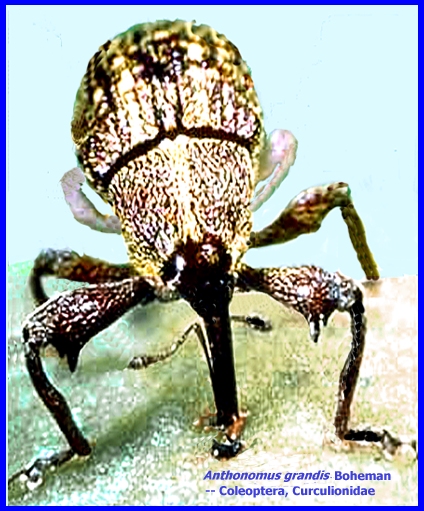
BOLL WEEVIL Anthonomus grandis Boheman-- Coleoptera, Curculionidae (Contacts) ------ CLICK on Photo to enlarge &
search for Subject Matter with Ctrl/F. GO TO ALL: Bio-Control Cases
These three types differ in their severity of attack of commercial
cotton, Gossypium hirsutum L. For example, the thurberia weevil has
infested wild cotton in parts of Arizona since 1912 with occasional small
invasions in cultivated cotton in areas where flooding has caused movement of
wild cotton bolls (D. Bryan, pers. commun., Ridgway 1982). Such infestations generally have been
found in Arizona along the Santa Cruz River northward from Tucson and into
the Casa Grande area. Occasional
infestations have been found westward along the Gila River. In 1963 a more destructive form of the
boll weevil was found in Arizona cotton, which was believed to be a new
strain migrating from Mexico.
Scattered severe infestations were found by 1965, especially in stub
cotton. Stub cotton was banned by the
Arizona Commission of Agriculture and Horticulture in 1965, and a mandatory
plow down date to provide a host-free period was adopted. Boll weevil ceased to be a problem with
the elimination of stub cotton.
Stub cotton was again permitted in Arizona in 1978, followed by an
increase of boll weevil attacks.
However, no infestations were found in planted cotton that year. In 1980 boll weevil was found infesting a
number of fields between Buckeye and Gila Bend, and by 1983 widespread boll
weevil infestations were found in both stub and planted cotton fields. This infestation eventually reached the
Imperial Valley, California where it was eradicated with insecticides (D.
Bryan, pers. commun., Ridgway 1982). Natural Biological Control
Cotton farmers in the southeastern United States relied heavily on
natural biological control to reduce populations of boll weevil and other
pests in the early 1900's (Bottrell 1976, Cross 1973; Howell 1907, 1909;
Pierce 1912); but the boll weevil was not adequately controlled (Lincoln
1969).
Over 40 species of parasitoids of the boll weevil are known (Cross
& Chestnut 1971, Cross & McGovern 1969). The most effective parasitoids are Bracon mellitor in the United States (Adams et al. 1969) and Heterolaccus
grandis in western Mexico
and Central America (Cross & Mitchell 1969). In Arizona native parasitoids are scarce, with Bracon
thurberiaphagae being the
major species (Fye 1968, Fye & Parencia 1972). A mite, Lepitus
sp., was thought to do some damage to boll weevil adults in South
Carolina (Roach & Walker 1970).
Of the few pathogens associated with boll weevils, the protozoans Mattesia grandis and Glugea gasti were most prominent (Bell & McLaughlin 1970,
McLaughlin 1966, 1967, 1969; McLaughlin & Adams 1966a,b; McLaughlin et
al. 1988, Vavra & McLaughlin 1970).
Also, a bacterium, Serratia marcescens
and other species have been studied (McLaughlin et al. 1966, Slatten &
Larson 1967). Glugea gasti
and Mattesia grandis were mass-reared on
boll weevil cultures, and by incorporation with a bait, were established in
native autumn populations to reduce spring emergence (Cross 1973, McLaughlin
& Bell 1970, McLaughlin et al. 1969).
It has been generally accepted by some that the native parasitoids of
boll weevil in northern Mexico and the United States rarely, if ever, exert
economic suppression on a population of boll weevil (Cross 1973). Thus, it was not surprising that the
introduced species Bracon
kirkpatricki (Wilkinson)
which could be reared and released in large numbers provided additional
biological control. However, others
regarded natural enemies as extremely important in suppression populations
(Bottrell 1976). Importation
of Natural Enemies
The first attempt at biological control of the boll weevil was in
1904, when the predaceous ant Ectatomma tuberculatum
(Ol.) was imported from Guatemala (Clausen et al. 1978); but establishment
was not attained. Following a search
for natural enemies on related host species in Peru during 1941-45, the
parasitoids Triaspis vestiticida Vier. and Bracon vestiticida (Vier.) were
imported into the southeastern United States (Berry 1947); but again,
establishment was unsuccessful.
Bottrell (1976) considered that the whole field of biological control
of the boll weevil needed to be reexamined and fortified with administrative
support. Of especial importance were
(1) studies of native parasitoids, pathogens and predators which attack the
boll weevil; and interspecies relationships and response to boll weevil
density and to other hosts; and the role of hyperparasitoids; (2) manipulation strategies with native
parasitoids (interplantings of cotton and wild plants that support alternate
insect hosts of boll weevil parasitoids); use of selective baits impregnated
with pathogens; (3) the discovery and importation of new natural enemies
(Bottrell 1976). It was pointed out
that although there have been several attempts to introduce natural enemies
for establishment, work in foreign exploration and introduction has been
especially neglected (Bottrell 1976).
The last attempt to find natural enemies in the mountains east of
Mazatlán in the mid 1980's resulted in the murder of the key explorer by
bandits. REFERENCES: [ Additional
references may be found at: MELVYL
Library ] Adams, C. H., W. H. Cross & H. C. Mitchell. 1969.
Biology of Bracon mellitor, a parasite of the
boll weevil. J. Econ.
Ent. 62: 889-96. Bell, M. R. & R. E. McLaughlin. 1970.
Influence of the protozoan Mattesia
grandis McLaughlin on the
toxicity to the boll weevil of four insecticides. J. Econ. Ent. 63:
266-69. Berry, P.
A. 1947. Anthonomus vestitus and its natural enemies in Peru, and their
importation into the United States. J. Econ.
Ent. 40: 802-04. Bottrell, D. G. 1976. Biological
control agents of the boll weevil.
Proc. Conf. "Boll Weevil Suppression, Management and Elimination
Technology," Feb. 13-15, 1974, Memphis, Tenn. Agric. Res. Svc, U. S. Dept. Agric. ARS-S-71: 22-5. Burke, H. R.
1968. Geographic variation and
taxonomy of Anthonomus grandis Boheman. Tex. Agr. Exp. Sta. Dep. Ent. Tech.
Rept. 152 p. Clausen, C. P.
(ed.) 1978a. Introduced
parasites and predators of arthropod pests and weeds: a world review. Agric. Handb. No. 48, U. S. Dept. Agric., Wash., D.C. 545 p. Cross, W. H.
1973. Biology, control and
eradication of the boll weevil. Ann.
Rev. Ent. 18: 17-46. Cross, W. H. & T. L. Chesnut. 1971.
Arthropod parasites of the boll weevil, Anthonomus grandis: I.
An annotated list. Ann. Ent. Soc.
Amer. 64: 516-27. Cross, W. H. & W. L. McGovern. 1969.
New parasites, Zatropis
perdubius and Megaselia aletiae, of the boll weevil, Anthonomus grandis. Ann. Ent. Soc. Amer. 62:
674. Cross, W. H. & H. C.
Mitchell. 1969. Distribution and importance of Heterolaccus grandis as a parasite of the
boll weevil. Ann. Ent. Soc.
Amer. 62: 235-36. Cross, W. H., W. L. McGovern &
H. C. Mitchell. 1969. Biology of Bracon kirkpatricki
and field releases of the parasite for control of the boll weevil. J. Econ. Ent. 62: 448-54. Fye, R. E. 1968.
The thurberia weevil in Arizona.
J. Econ. Ent. 61: 1264-68. Fye, R. E. & C. R. Parencia, Jr.
1972. The boll weevil complex in Arizona. U. S. Dept. Agric., Agric. Res. Serv.,
Prod. Res. Rep. No. 139. 24 p. Howell, A.
H. 1907. The relation of birds to the cotton boll weevil. U. S. Dept. Agric. Bur. Biol. Serv. Bull.
29. 30 p. Howell, A. H. 1909.
Destruction of the cotton boll weevil by birds in winter. U. S. Dept. Agric. Bur. Biol. Surv. Circ.
64. 5 p. Lincoln, C. 1969.
The effect of agricultural practices on insect habitats in a typical
Delta community. Proc. Tall Timbers
Conf. Ecol. Anim. Contr. Habitat Manage. 1:
13-18. McLaughlin, R. E. 1966.
Laboratory techniques for rearing disease-free insect colonies: Elimination of Mattesia grandis
McLaughlin, and Nosema sp.
from colonies of boll weevils. J. Econ. ent.
59: 401-404. McLaughlin, R. E. 1966b.
Infection of the boll weevil with Mattesia
grandis induced by a feeding
stimulant. J. Econ.
Ent. 59: 909-11. McLaughlin, R. E. 1967.
Development of the bait principle for boll weevil control. II.
Field-cage tests with a feeding stimulant and the protozoan Mattesia grandis. J.
Invertebr. Path. 9: 70-7. McLaughlin, R. E. 1969.
Glugea gasti sp. n., a microsporidian pathogen of the boll weevil, Anthonomus grandis. J.
Protozool. 16: 84-92. McLaughlin, R. E. & C. H.
Adams. 1966. Infection of Bracon mellitor
by Mattesia grandis. Ann. Ent. Soc. Amer. 59:
800-02. McLaughlin, R. E. & M. R.
Bell. 1970. Mass production in vivo of two protozoan pathogens, Mattesia grandis and Glugea
gasti, of the boll weevil, Anthonomus grandis. J.
Invertebr. Path. 16: 84-8. McLaughlin, R. E., M. R. Bell &
S. D. Veal. 1966. Bacterial and fungi associated with the
dead boll weevils (Anthonomus
grandis) in a natural
population. J. Invertebr. Path.
8: 401-08. McLaughlin, R. E., T. C. Cleveland,
R. J. Daum & M. R. Bell.
1969. Development of the bait
principle for boll weevil control.
IV. Field tests with a bait
containing a feeding stimulant and the sporozoans Glugea gasti
and Mattesia grandis. J. Invertebr. Path. 13: 429-441. Pierce, W. D. 1912.
The insect enemies of the cotton boll weevil. U. S. Dept. Agric. Bur. Ent. Bull. 100. 99 p. Roach, S. H. & J. T.
Walker. 1970. A parasitic mite found on boll weevils
near Florence, South Carolina in 1968.
J. Econ. Ent. 63: 646-47. Slatten, B. H. & A. D.
Larson. 1967. Mechanism of pathogenicity of Serratia marcescens.
I. Virulence for the adult
boll weevil. J. Invertebr. Path.
9: 78-81. Vavra, J. & R. E.
McLaughlin. 1970. The fine structure of some developmental
stages of Mattesia grandis McLaughlin, a parasite
of the boll weevil, Anthonomus
grandis Boheman. J. Protozool. 17: 483-96. Warner, R. E. 1966.
Taxonomy of the subspecies of Anthonomus
grandis. Ann. Ent. Soc. Amer. 59: 1073-88. Warner, R. E. & C. E. Smith,
Jr. 1968. Boll weevil found in pre-Columbian cotton from Mexico. Science 162: 911-12. |