File:
<odysseus.htm> <Archeology> <Index> Next►
[Basque words
are shown in Bold Green Italics]
|
Odysseus
and the Sea Peoples (Contacts) Edo Nyland in studying the
writings of Homer noted that he writes that Odysseus was the king of the
small island of Ithaka, today still called Ithaki by the Greek inhabitants.
It is ocated west of the Greek mainland in the Ionian Sea. In Odysseus' own
words, Homer provides us with a clear description of the island and its
location; however, this description does not seem to fit the island of Ithaki
in Greece. Furthermore, Nyland (2002) noted that
modern Ithaki shows no archaeological evidence of the palace and village as
described in the epic. Also, Homer's description of the climate of Odysseus'
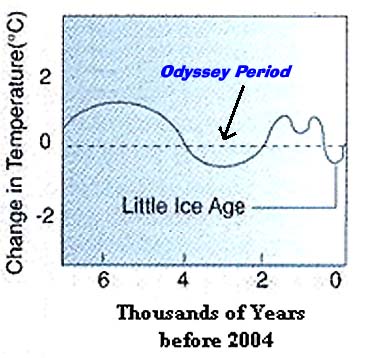
home island in no way seems to belong in the Mediterranean. [Note: at the time the Odyssey was believed to have
taken place around 1186-1177 B.C., the earth’s average temperature was about
one degree Centigrade COLDER than by the year 2000—See Climate. Thus, the Mediterranean region then could
have resembled more northerly climates of modern times.]
He tells us about storms, fog, tides, hoarfrost, and the endless gray ocean,
all with distinctive north Atlantic characteristics. Translator Lattimore
wrote:
"Homer seems to know his
Ithaka, and what it is like, only he does not seem to know where it is.
Listen to Odysseus himself who ought to know": "I am at home in sunny Ithaka. There
is a mountain there that stands tall, leaf-trembling Neritos, and there are
islands settled around it, lying one very close to the other. There is Doulichion
and Same, wooded Zakinthos, but my island lies low and away, last of all on
the water toward the dark, with the rest below facing east and sunshine"
(IX: 21-26). Lattimore then comments: "This simply will not do for Ithaka,
though it has the landmarks, for it lies tucked close in against the eastern
side of the far larger Kephallenia" (Odyssey p.14). To Lattimore
and other classicists it is obvious that there is something wrong here. As we
will see later, Odysseus' description, quoted above, contains some evidence
needed to show the real location of Homer's Ithaka; it is not in Greece at
all, in fact it is nowhere near it, as Homer himself admits when he writes
that: "The name of Ithaka has gone even to Troy, though
they say that it is very far from Achaian country" (XIII: 248-9). Ithaki was part of the Achaian
region, but Ithaka was not. We are also told that Odysseus is married to
Penelope and that they have a young son, Telemachus. Penelope, which means: .pe - ene - elo - ope Odysseus then leaves his devoted
wife and child and, according to Homer, joins the Achaeans in their brutal
attack on Troy, where he supposedly spends the next ten years fighting. This
blood and gore episode is the topic of another of Homer's epics, the Iliad.
We know that Troy existed and archaeologists have shown that the ruins of the
town show plenty of evidence of violent destruction by fire, war and
earthquake. Also, the historical records found in Egypt and elsewhere appear
to support the fighting in Asia Minor and provide likely dates for Odysseus'
travels. The trouble is that these dates do not correspond to the date the
excavating archaeologist assigned to the Troy of the Iliad, as will be
explained. Odysseus' subsequent history certainly does not support Homer's
insistence that Odysseus was an Achaian or a Greek. THE ODYSSEY SUBDIVIDED The epic which was passed on to us
through the ages, can be subdivided in chronological order starting with his
departure from Troy and arrival on Kalypso's island; then from there to the
land of the Phaiakians and Odysseus' homecoming on Ithaka. A:
The Great Wanderings, as told by Odysseus, from Book IX: 37 to the end of
XII. B:
The Homecoming, as told by Homer, Book V to VIII and XIII: 1-187. C:
The Telemachy, Book I to IV. D:
The Murder of the Suitors, Book XIII: 187 to the end of XXIV A: THE GREAT WANDERINGS In spite of being only one week
sailing away from his supposed home on Ithaki, it took Odysseus ten years to
get there. The citadel of Troy had been conquered, the people massacred and
the young women acquired as slaves or concubines by some of the Achaean
chiefs, but apparently none by Odysseus or his men, because when Odysseus'
ships leave Troy they sail into a very different world of adventure, of fairy
tales and magic and head strong women in positions of command, and they meet
strange and wild characters. The women taken from the Kikonians are no longer
mentioned. He loses eleven of his twelve ships with all the crewmembers when
giant cannibals pelted them with huge rocks from the cliffs above in the
"beautiful harbor". Any other captain who met with such a fate
would surely have returned back home but not Odysseus; he manages to escape
and sails on with one ship and crew to an unknown island where Odysseus climbs
a steep mountain and sees the sea all around him. From his high perch, he
sees smoke rising in the middle of the island and after a day or two meets a
lovely Goddess called Kirke (the Latin spelling Circe did not appear until
some six centuries after Homer lived). She then proceeds to turn half of the
crew into pigs but relents, when Odysseus draws his sword, and orders her to
return the men to human shape. The two then go happily to bed and after their
love making is done, Kirke takes command and gives the great Odysseus a
number of tasks to do, which he meekly accomplishes with great fear in his
heart. Certainly a rather strange scenario. Following Kirke's orders, he sails
away, visits Hades where he meets Teiresias, the seer and keeper of Hades,
the underworld, who retained his powers even in the land of death. During his
visit to Hades Odysseus meets his mother and other deceased ancestors, his
fallen Troy comrades and sails back to Kirke. In all this activity Homer
seems to omit critical detail; the reasons which explain why all this is
happening are not there. Kirke then gives Odysseus a new set of instructions
that take him to the island where the alluring Sirens sing, after which he
sails onto Charybdis where he loses six of his best seamen to a six-headed
monster lurking in a cave above the water. When he reaches land, he has a big
meal of beef at the expense of Helios' holy cattle, gets shipwrecked and in
the accident sees all his remaining crew drown. Then he drifts alone for nine
days on some flotsam that he manages to save from the wreck before the
amorous nymph Kalypso, who proceeds to keep him for seven years, supposedly
as a love-slave, rescues him. No explanation of any kind is given for this
time of imprisonment. It is all very nebulous and confusing, however, much
good information had been supplied for Kirke's island, geographical,
mythological and linguistic, but the story does not seem to flow logically
because again there are major gaps in the story. Up to now, all these roving
adventures have been told in the first person, but his stay with Kalypso
signals the end of the "Great Wanderings" and Odysseus' own story
telling. B: THE HOMECOMING OR NOSTOI When he leaves Kalypso, Homer
tells the story from then on in the third person. This part is called the
"Nostoi" or Homecoming, even though it really is part of the Great
Wanderings. Ordered by Zeus, Kalypso gives Odysseus the tools and the
necessary wood to build a small sailboat which he sails due east for 18 days,
to the land of the oar-loving Phaiakians, following an accurate star bearing.
Homer then tells the story of the difficult trip to the Phaiakians and the
warm welcome Odysseus received there. He tells about the adventures and his
hosts apparently like Odysseus so much that they load him with treasures; but
Homer gives no explanation why these were given. The Phaiakians deliver him
back to Ithaka, which appears to be described as only an overnight trip away,
certainly not the very long way to Greece. In all secrecy, Odysseus is put
ashore with his treasures and the Goddess Athena comes to help him carry it
all into a beautiful and very deep cave which cuts clear through the island
from north to south. Deep in the cave they store it all in a niche and place
a large rock in front. What were these treasures and why was the Goddess
Athena involved in taking care of them? They must have been very important
and probably related to the early religion. Is there a chance that some of
the treasures may still be where she and Odysseus placed them? This
possibility may exist because the location of the cave is now known and may
not have been entered or explored for centuries. C: THE MURDER OF THE SUITORS In the last section of the
Odyssey, Homer suddenly turns our hero into a bloodthirsty murderer who kills
108 unarmed young men, the flower of the island. The only reason given is
that they ate some of Odysseus' sheep and pigs, and had vied for the hand of
Penelope, the still beautiful wife of Odysseus, after his 20 year absence (10
fighting at Troy, ca 10 away on the Wanderings). Throughout the years
that Odysseus was away on his wanderings, they had always respected
Penelope's person and her privacy and were at worst no more than a bad
nuisance, which makes the grisly murders so totally out of character for
Odysseus. The story does not ring true, no matter what way you slice it. When
the epic, centuries later, was translated into Latin, the awful murder
episode was used by some Roman to give Odysseus a derogatory new name: Ulysses, uli-is.-.se-es. uli - is. - .se - es. Whoever made up this name did an
enormous injustice to this great and courageous individual. When the Greek
island off the west coast of Greece was chosen to be Odysseus' home, Homer
named it Ithaka, meaning "Senseless deluge of death". The meaning
of the name tells us that even the person who made up the name agreed that
the mass murder was totally unwarranted. As a matter of interest, the name
Ithaki, used by the modern population, comes from izakide meaning coexistent, referring to its proximity with the
much larger island Kefallinia lying west of Ithaki. D: THE TELEMACHY Translator Richmond Lattimore has
his doubts about the authenticity of the Telemachy, the four books of the
Odyssey which tell about Odysseus' faithful son Telemachus, who searches far and
wide for information about his father, and in the process nearly gets
finished off by the suitors who had lain in wait for him when he returns from
his trip to sandy Pylos. Compared with the wanderings, this part of the
Odyssey is disjointed and artificial, as Lattimore says in his
"Introduction". "The obviousness of the
joins and the bulk of the material not specifically related to Odysseus in
Books III - IV, his absence from Books I - II, have suggested that the
Telemachy was an independent poem which was, at some stage, incorporated more
or less wholly in the Odyssey" (p.4). A Canaanite legend describes the
same brawling and killing tactics, specifically the throwing of furniture, as
used by Odysseus and Telemachus when they supposedly were massacring the
suiters of Penelope: She fights violently, She hurls chairs
at the soldiers, Male domination had turned the
caring priestesses into brawlers and fighters. Everything in the Odyssey
points to the conclusion that the Telemachy cannot be part of Odysseus' epic
voyage. Odysseus was not married, he had neither son nor wife, otherwise he
would never have been chosen for a starring role in the Sacred Marriage,
about which much more later. It appears obvious that the ancient Canaanite
legend was adapted by Homer and included in the Odyssey for a very specific
purpose. With all the additions and alterations in the original epic and the
pall of brutality this has cast over Odysseus' character, our hero was never
given the chance to set the record straight, All indications therefore are
that neither wife Penelope, nor his son Telemachos, belong in the epic and
they will no longer be mentioned. THE REAL ODYSSEUS It will soon become clear to the
reader that Odysseus could not have belonged to the patriarchal,
woman-despising new world of the eastern Mediterranean sky gods. Homer
repeatedly tried to convince us of this, by inserting Zeus as the all-knowing
supreme father, philanderer and rapist, assisted by a variety of less
important deities who did his bidding. Instead, Odysseus clearly belonged to
the earlier trusting and caring world of the Great Goddess, who was still
adored in much of Europe and especially on the Atlantic islands of Britain,
Ireland and in Scandinavia. The Goddess Athena who sheltered him during his
adventures had no father Zeus to supervise her, because she was the Goddess
Ashera herself, in her role as protectress of the sailors. Zeus was only
fully introduced to the Greek people after Homer had identified and described
him in his epics. In a way, the two books by Homer were like a bible for the
classical Greeks, designed and written to provide the people with an entirely
fictitious pre-history designed to bury the true religion and accomplishments
of the people of.the Goddess. The new legends and the pantheon created to
cover up the illustrious past could hardly be called a religion, not even a
cult, in spite of all the beautiful statues which were made of the heroes,
gods and goddesses. Based on historical and archaeological
information, and the writings in the Odyssey, Nyland
(2002) discussed how Odysseus was a
Pict born on Barra in the village of Borve. Being a skillful sailor and a
smart tactician, be was placed in charge of the fleet of ships from the
Hebridean islands and NW Ireland, assembled to be sent to the Near East to
once and for all destroy the unwanted upstart pre-Judaic patriarchal
religion. Many battles were fought, all initially very successful, but
Egypt's Ramses III turned the last one into terrible tragedy, as depicted by
the pharaoh in such elaborate detail on his Medinet Habu temple. An effort is
made to describe these happenings, the difficult times Odysseus lived in, and
how the tribes thrived and worshiped in his island civilization of the
Goddess. HOMER’S IDENTITY Everyone studying Homer's writing
has been asking the same question. Even though there is next to nothing to go
by, many suggestions have been made over the centuries. He has been called a blind
poet as Wilkins comments: "According
to some, Homer was in fact the blind bard Demodocus, who sings the end of the
Trojan War at the court of Alcinous (Odysseus IIX: 44-108). This would amount
to Homer having 'signed' his work.... For the ancients, the mention of
blindness merely referred to the capacity of clairvoyance of many seers and
poets, for it was believed that the blind could 'see' the future because they
were more receptive than other people". (Page 269) To others he was an illiterate
memory man, who dictated his oral wisdom to a scribe. Others say that Homer
represented several people because of the different writing styles and the
sheer size of the epics. However, Nyland (2002)
showed that the Odyssey was a much older epic, orally passed on, which played
mostly in the North Atlantic and which was deliberately altered, probably by
Homer himself, and mutilated for the single purpose of destroying all
references to the Neolithic Goddess religion and civilization of the
Atlantic, which was guided by women. Homer's orders must have been to
eliminate the memory of the enormous effort of the Sea Peoples to wipe the
upstart patriarchy off the face of the earth. Wherever possible, male
domination, female subservience and helplessness, male chivalry and
aggressiveness is stressed by Homer, while prominent and independent women in
positions of command such as Kirke, Medea and Kalypso are reduced to witches,
magicians and eccentrics. Stories belonging in other countries, such as the
massacre of the Kikones, the mass murder of the suitors and the blinding of
the wheel-eyed Cyclops, were inserted to give the impression that Odysseus
was firmly located in the aggressive camp of the male sky gods. All these
tales were blended masterfully into one most readable fairy tale, using a
characteristic style of poetry, which we now have as the Odyssey. It is
therefore clear that Homer cannot have been the blind, illiterate poet who
simply passed on his memorized knowledge to a scribe. Instead, he may well
have been a highly literate priest of the new proto-Judaic religion of the
jealous sky gods. His assigned task would then have been to mask and distort
the true origin of, and the history told in, the original travelogue. However,
some parts of the older story he removed can at least be partly recovered by
reading between the lines, by translating the original names and words used,
and by tieing in information given to us in other documents, on tablets,
using legends and inscribed on temples. Although the wanderings took place
approximately 1180 B.C., Odysseus' travel account may not have been written
until about 750 or 700 B.C. The name Homer is usually said to have originated
from 'homeros' normally accepted to be a Greek word meaning
"hostage", which could have been a pseudonym for one person or even
a group of "gogogizonak" (memory men), however, hostage is also a rather
inappropriate name for a literary giant. In the universal language underlying
Greek, using the VCV Formula vowel-interlocking formula, "Homer" is the
agglutination of three words: ho - ome - er. LINGUISTIC ARCHAEOLOGY
In Nyland’s (2002) book, words and names used
by Homer are decoded and translated. They are an important part of the
solution of the question "Where did Odysseus go?" The explanation of
the system of translation used is discussed elsewhere in this homepage, under
Ogam. The reader, who is interested in knowing how the people who first wrote
the epic assembled the names, is urged to read the chapter on Linguistic
Archaeology first. Decoding the meaning of the words is no exact science, it
was not intended to be, and only that much can be deducted from them as the
composition of the names permit. However, the highly organized and logical
structure of the ancient language (Genesis 11:1) that we call Basque today,
makes this process in general feasible.
Sometimes more than one logical translation appears but this is
something that cannot be avoided but solutions are possible with practice. |