Astronomy Press Releases
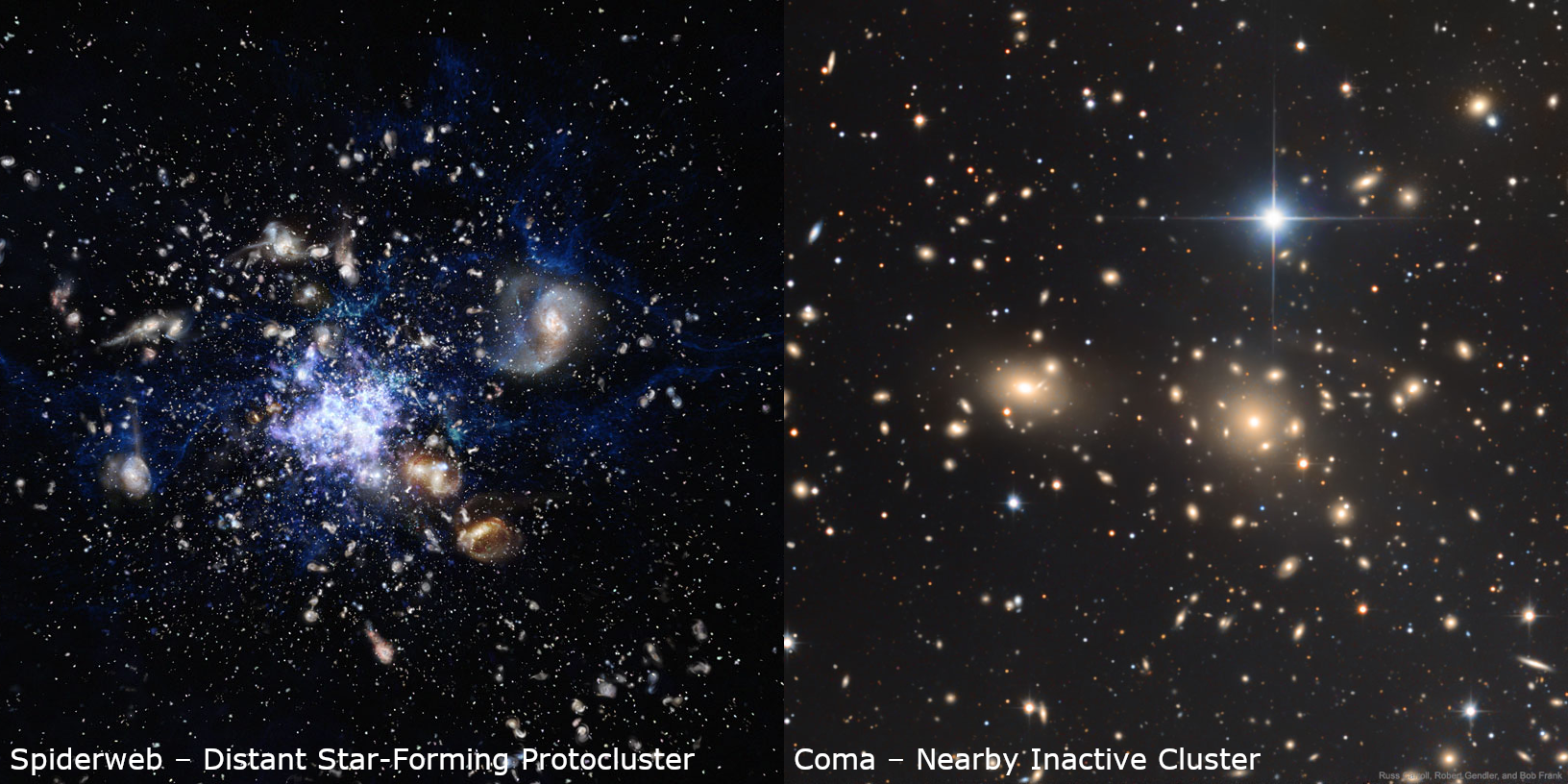
"Surprisingly High Fraction of Dead Galaxies found in Ancient Galactic City." UCR Press Release about MAGAZ3NE J095924+022537, a newborn galaxy cluster (protocluster) seen as it appeared when the Universe was less than 2 billion years old. All protoclusters discovered up until now in the early Universe have been found to contain vigorously star-forming galaxies (left). But incredibly, unlike those other protoclusters, many of the galaxies in MAGAZ3NE J0959 appear to have already stopped forming stars. The inactive galaxies in MAGAZ3NE J0959 appear similar to the many inactive galaxies found in the nearby Coma cluster (right). At the heart of MAGAZ3NE J0959 is an ultramassive galaxy that has already formed a mass of more than 200 billion suns. Why this ultramassive galaxy and so many of its neighbors formed most of their stars and then became inactive when the universe was still so young, in contrast to the vigorously star-forming galaxies found in all the other known protoclusters from the same time, is a big mystery. MAGAZ3NE J0959 was discovered from the ground-based W. M. Keck Observatory, but the advent of powerful new capabilities, like the recently-launched James Webb Space Telescope, should soon reveal whether there are other protoclusters like MAGAZ3NE J0959 packed with dead galaxies waiting to be found. The paper was led by my graduate student, Ian McConachie, 2022
"Surprisingly High Fraction of Dead Galaxies found in Ancient Galactic City", W. M. Keck Observatory Press Release about MAGAZ3NE J0959, 2022
"Astronomers Find Burned Out Galaxies in Ancient Universe", Tufts University Press Release about MAGAZ3NE J0959, 2022
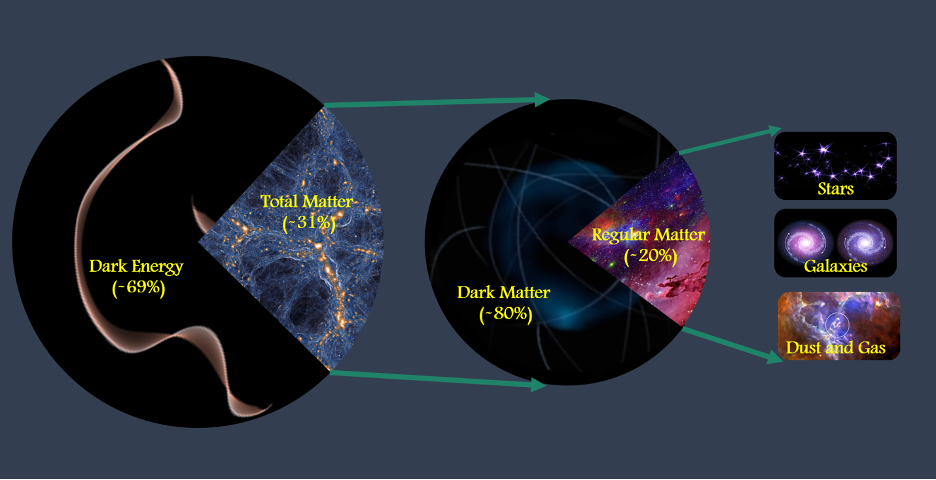
"Scientists Precisely Measure Total Amount of Matter in the Universe". UCR Press Release about our measurement of the total amount of matter in the Universe. We created a new cluster catalog from Sloan Digital Sky Survey (SDSS) observations using the new galaxy orbit technique we developed (GalWeight). By comparing the number of clusters in our new catalog with simulations, we were able to determine that matter makes up about 31% of the total amount of matter and energy in the Universe, with the remainder consisting of dark energy. Our measurement is one of the most precise measurements ever made using the galaxy cluster technique, and is the first use of the galaxy orbit technique to obtain a value in agreement with those obtained by non-cluster techniques (cosmic microwave background anisotropies, baryon acoustic oscillations, Type Ia supernovae, or gravitational lensing). By combining our measurement with measurements obtained from non-cluster techniques, we were able to determine a best combined value and conclude that matter makes up 31.5+/-1.3% of the total amount of matter and energy in the Universe. The paper was led by my graduate student, Mohamed Abdullah, and the story was picked up by many major media outlets, 2020
Our measurement of the total amount of matter in the Universe was selected as one of the ten biggest non-COVID University of California science stories of 2020
Interview with Agence-France Presse (world's oldest and third-largest news agency) about our measurement of the total amount of matter in the Universe, 2020
"Astronomers Discover Unusual Monster Galaxy in the Very Early Universe", UCR Press Release about "XMM-2599", an ultramassive galaxy which formed most of its stars in a huge frenzy when the universe was less than 1 billion years old, and then quenched (stopped forming stars) by the time the universe was only 1.8 billion years old. While rare, galaxies as massive as XMM-2599 are predicted to exist by current-generation simulations but none are predicted to be so quenched at this early epoch, posing a challenge to our current understanding of how massive galaxies form and quench in the early Universe. The paper was led by my postdoc, Ben Forrest, and the story was picked up by many major media outlets (CNN, USA Today, Science Daily, CNET, Forbes) and resulted in interviews with the British Broadcasting Corporation (BBC), Canadian Broadcasting Corporation (CBC), and Sky & Telescope, 2020
"Astronomers Discover Unusual Monster Galaxy in the Very Early Universe", W. M. Keck Observatory Press Release about XMM-2599, 2020
"Ancient Giant Galaxy Grew Fast and Died Young", Scientific American Article about XMM-2599, 2020
Two Live Radio Interviews about XMM-2599, BBC, Newsday, 2020
Podcast about XMM-2599, The Cosmic Companion, 2020
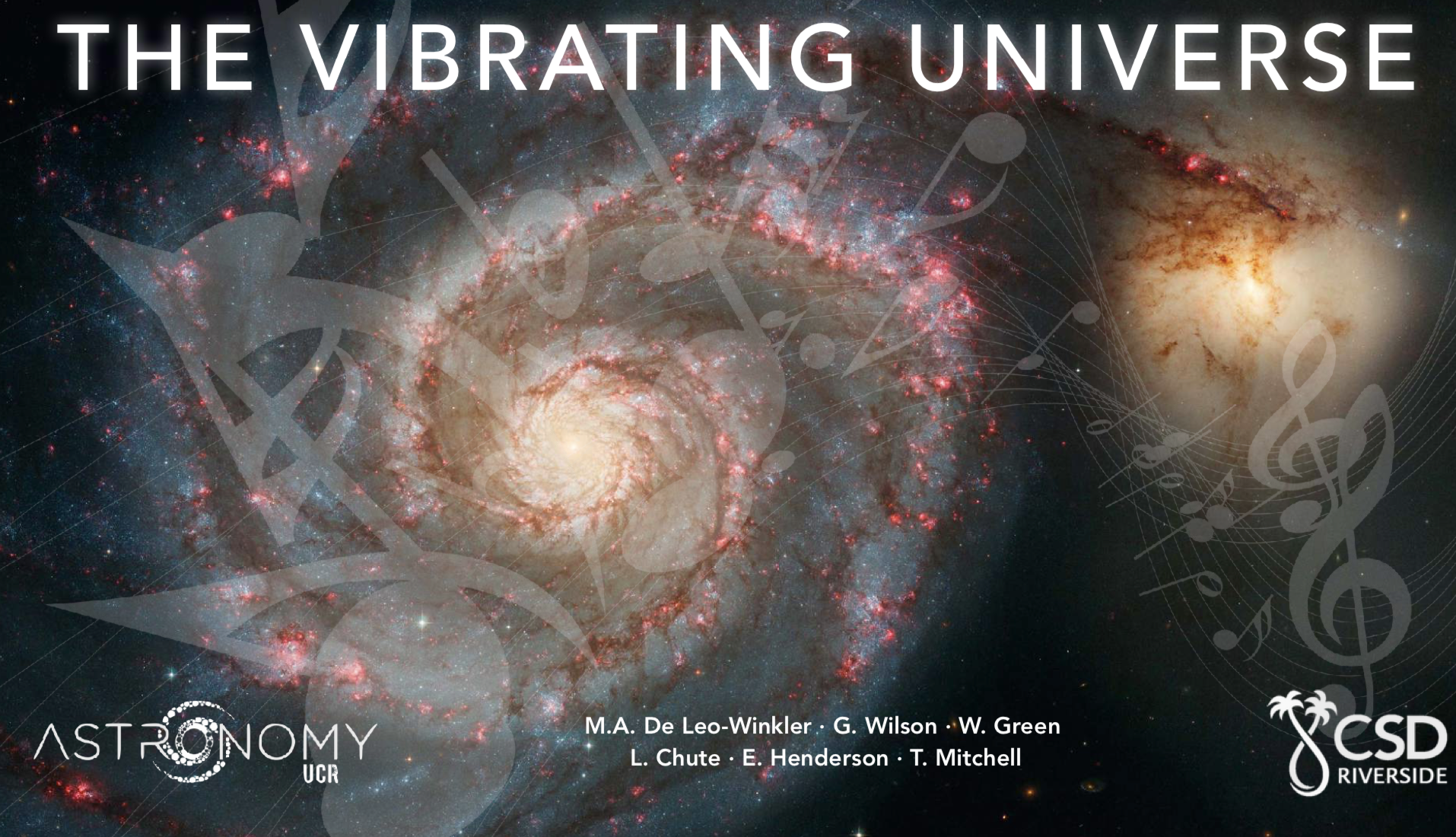
"The Vibrating Universe: Making Astronomy Accessible to the Deaf", UCR Press Release describing an astronomy workshop we developed for students with hearing loss at the California School for the Deaf, Riverside, 2019
"New Insight into Why Galaxies Stop Forming Stars", W. M. Keck Observatory Press Release describing the best measurement ever made of the quenching timescale. By comparing observations of distant SpARCS clusters to nearby clusters, we were able to measure how the quenching timescale varies across 70 percent of the history of the Universe. The paper was led by my graduate student, Ryan Foltz, and concluded that a dynamical process such as gas stripping is more likely to be responsible for the quenching than strangulation or outflows, 2018
"UCR astronomers get Best Measure Yet of How Fast Star Formation Stopped in Galaxy Clusters in the Early Universe", UCR Press Release describing the SpARCS quenching timescale measurement and our conclusions, 2018
"Study provides new insight into why galaxies stop forming stars", UCR Astronomy Press Release describing observations and conclusions about the quenching timescale from the SpARCS survey, 2018
"UCR-led Team Develops New Cosmological Tool for Weighing Galaxy Clusters", UCR Astronomy Press Release describing a new cosmological tool, GalWeight, we developed which uses galaxy orbits to "weigh" clusters. In the paper which was led by my graduate student, Mohamed Abdullah, we showed that our new technique is 98% accurate in correctly assigning cluster membership and that its performance compares very favorably to the four most widely used existing techniques, 2018
"Scientists get Best Measure of Star-forming Material in Galaxy Clusters in Early Universe", W. M. Keck Observatory Press Release describing how the SpARCS team were able to make the most precise measurement to date of the amount of fuel available to form stars in galaxy clusters in the early Universe. Surprisingly, we discovered that, compared to field galaxies, cluster galaxies have higher amounts of molecular gas relative to stars. It has long been known that when a galaxy falls into a cluster, interactions with other cluster galaxies and hot gas accelerate the shut off of its star formation relative to that of a similar field galaxy (via the process known as environmental quenching). If cluster galaxies have more fuel available to them one might expect them to be forming more stars than field galaxies and yet, intriguingly, they are not, 2017
"Scientists get Best Measure of Star-forming Material in Galaxy Clusters in Early Universe", UCR Astronomy Press Release describing the SpARCS team's measurement of the amount of fuel available to form stars in galaxy clusters in the early Universe, 2017
"How a UCR team finds Galaxies Far, Far Away", Riverside Press-Enterprise newspaper article describing the SpARCS survey and findings from the survey's newly-discovered high-redshift sample, 2016
"How a UCR team finds Galaxies Far, Far Away", Riverside Weekly newspaper article describing the SpARCS survey and findings from the survey's newly-discovered high-redshift sample, 2016
"Cosmic Neighbors Inhibit Star Formation, Even in the Early Universe". W. M. Keck Observatory Press Release describing the discovery of four new SpARCS clusters. These are some of the most distant clusters of galaxies ever found, and are seen as they appeared when the Universe was only 4 billion years old. This new SpARCS sample has provided the best measurement to date of when and how fast galaxy clusters stop forming stars in the early Universe, finding that about 30 percent of galaxies which would normally be forming stars have been quenched in these distant clusters, 2016
"Cosmic Neighbors Inhibit Star formation, Even in the Early Universe". UCR Press Release describing the discovery of four new SpARCS clusters, 2016
"Astrophotography as a Gateway to Science". UCR Press Release describing how introducing astrophotography projects into my "History of the Universe" undergraduate breadth class resulted in students reporting better understanding of the material and also greatly reduced math anxiety, 2016
"Astrophotography as a Gateway to Science". UCR Astronomy Press Release describing astrophotography projects, 2016
"Did Neighborhood Harassment or Strangulation Stop Galaxies from Forming Stars?". UCR Astronomy Press Release describing results from a paper led by my graduate student Ryan Folz. We compared observations from the GCLASS survey of 10 galaxy-rich SpARCS clusters to a previously published sample of gas-rich X-ray selected clusters at the same distance/epoch. Remarkably, we learned that the galaxies in both samples had stopped forming stars at approximately the same time. This suggests that neither interactions with other galaxies nor interactions with hot gas are primarily responsible for turning off star formation off that, rather, another yet to be determined quenching mechanism which does not depend either on the cluster galaxies or the hot gas may is the culprit, 2015
"Massive Galaxy Cluster Found to Be Bursting with New Stars". UCR press release about a huge amount of star formation found to be occurring in a distant galaxy cluster discovered by the SpARCS team, 2015
"Prodigious "Brightest Cluster Galaxy" Discovered Churning Trillions of Stars". W. M. Keck Observatory press release about a huge amount of star formation found to be occurring in a distant galaxy cluster discovered by the SpARCS team, 2015
"NASA Telescopes Find Galaxy Cluster with "Vibrant Heart" Discovered Churning Trillions of Stars". NASA press release about a huge amount of star formation found to be occurring in a distant galaxy cluster discovered by the SpARCS team, 2015
"UCR Researchers Discover Galaxy Cluster". Article in UCR Highlander student newspaper about a huge amount of star formation found to be occurring in a distant galaxy cluster discovered by the SpARCS team, 2015
Pedagogy
Astronomy for the Deaf
Designers of informal STEM education and public outreach activities often overlook people with hearing loss. Motivated to develop an activity specifically for the deaf community, Dr. Mario De Leo-Winkler and I teamed with teachers at the California School for the Deaf, Riverside (CSDR), to design "The Vibrating Universe" astronomy workshop for deaf students. The "Vibrating Universe" workshop used a sound stage so that CSDR students could "feel" vibrations from rockets, stars, galaxies, supernovae, and even the remnants of the Big Bang itself.
The CSDR teachers, Dr. De Leo-Winkler and I published our experiences as "The Vibrating Universe: Astronomy for the Deaf" in the peer-reviewed Journal of Science Education and Technology
UCR Press Release
UCR Astronomy Press Release
There are dozens of similar sound stages in the U.S. alone. Our workshop could easily be adapted to include other astronomical phenomena or to focus on another scientific discipline. Educators interested in using our "Vibrating Universe" materials (slides, audio and video clips) and assessment methods can obtain them here.
I am very proud to report that, Ms. Elizabeth Henderson, a Science Teacher at CSDR and core collaborator on "The Vibrating Universe", won the 2018 Presidential Award for Excellence in Mathematics and Science Teaching, one of the highest honors bestowed by the U.S. government in the field of K-12 education.
Astrophotography as a Science Gateway
Because of the big, wide-ranging philosophical questions it asks and the beautiful images it generates, Astronomy creates a sense of wonder and awe in most people. For those reasons, Astronomy is considered by many to be a gateway into science.
Over 200,000 non-science major students enroll in introductory astronomy elective classes every year in the U.S. alone, and for many college students, it is their only encounter with a natural science. Given its interdisciplinary links astronomy, therefore, is a particularly appropriate vehicle for teaching science to a wide audience.
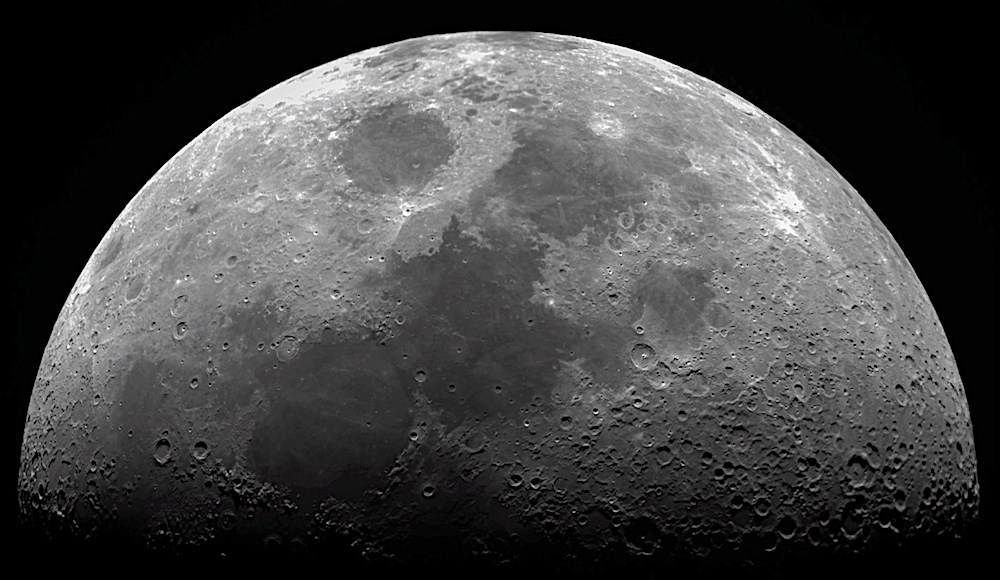
In collaboration with Dr. Mario De Leo-Winkler and Professor Gabriela Canalizo, I created hands-on astrophotography projects which I offered for extra credit as part of my "History of the Universe" undergraduate class. A high percentage of students majoring in social sciences, humanities, and arts take this course. They reported that the hands-on projects resulted in them having a better understanding of how astronomical instruments work, and of data reduction and image processing techniques. They also reported greatly reduced math anxiety. We believe that astrophotography is as an effective educational tool to engage non-science majors in science, and for producing future amateur astronomers and citizen scientists.
We published our experiences as "Astrophotography, a Portal for Engaging Non-STEM Majors in Science", in the peer-reviewed "International Journal of STEM Education".
UCR Press Release
UCR Astronomy Press Release
UCR Classes Taught
PHYS 005, Lower Level Undergraduate, "History of the Universe"
PHYS 111, Upper Level Undergraduate, "Astrophysics and Stellar Astronomy"
PHYS 166, Upper Level Undergraduate, "Cosmology"
PHYS 218, Graduate, "Introduction to Astrophysics"
PHYS 215, Graduate, "Dynamics and Evolution of Galaxies"
Astronomy Resources for K12 Educators
"Cool Cosmos"- The Infrared Universe
NASA's "The Educator's Corner"
- includes Lesson Plans, Posters and Information/Activity Booklets, DVD-ROMS, Data
Suitable for Students to Analyze, Links to Education Resources
NASA Science For Educators
- NASA searchable database of space science products for use in classrooms, science museums,
planetariums, and other settings.
NSF Astronomy and Space Classroom Resources
- a variety of Astronomy resources including Hands-on Labs.
NSF Physics Classroom Resources
- a variety of Physics resources including Hands-on Labs.
"The Physics Classroom"
- Online High School Physics Tutorials
American Astronomical Society (AAS) K-12 Resources
- links to "especially effective astronomy activities designed for K-12 classes and science projects"
National Science Teachers Association
- a comprehensive list of resources for science teachers
"Imagine The Universe"
- NASA website intended for students age 14 and up