File:
<westva.htm> <Migrations
Index> Bronze
Index <Archeology Index> <Home>
Next►
|
THE HORSE CREEK PETROGLYPH
OF WEST VIRGINIA [Contacts]
An ancient language form that
originated in the African area among the most ancient civilizations has been
studied by Nyland
(2001). He found that Ogam
inscriptions found in North America seem to be closely related to the ancient
language, which he called Saharan, but more appropriately might be Igbo
West African. It appears that
these languages have very ancient origins.
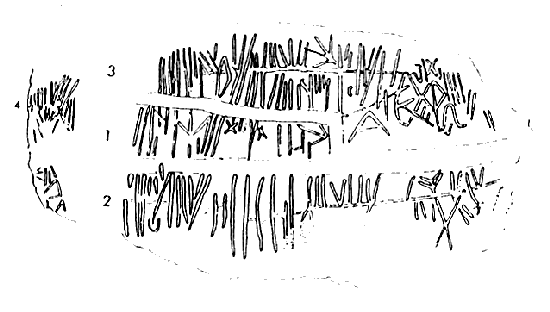
Following is a discussion of the translation of the Horse Creek
Petroglyph of West Virginia, depicting a bison hunt where the animals were
killed by driving them off a cliff:
Top line: RGHMKUIHMNMKSBDLKSTUIGNMOIDIAAIOSAMFLL The
migration passed by like a powerful mirage, quietly undulating and moving
unsuspectingly a short distance, peacefully.
To bring about a disturbance we advanced rattling branches and
shouting. I remember that a whole
wave happened to pass by and we fell back in fear (to avoid) the bad-tempered
stampede of the frightened herd of bison (moving into) the entrance of the
narrow wooden-fenced passage and into the abyss in flight. Come and help! The clan mother was pleased with our co-operative effort. Middle line: MGNTLGMIATGEANBT Club
blows in abundant measure (were needed) because many which had fallen into
the ravine resisted with obviously broken legs. Brothers, come and help the
slaughterer to finish them off. Bottom line: BHGTOIRGLGGBMOITKDIAHFKIOND
Having prevented escape by running away, we made the usual
preparations by the edge of the
stream and happily rejoiced in dividing the welcome riches into three parts
by plentiful butchering. At first unaccustomed (to the task) we undeniably had to pay attention. We were as busy as
possible and so happily exhausted that (we didn't notice) the noise of the
thunder coming in our direction. The eye: TLMDSDIADIONL In spite
of (being( some distance away, the clan mother, just in time, reached the
cattle shelter during a period of silence to sensibly wait out the
approaching thunder. Your dear Friend The Horse Creek Ogam
inscription was first published in the March 1983 issue of Wonderful West Virginia. The
transliteration from the Ogam script to our characters was done by Dr. Barry
Fell, professor emeritus from Harvard University, a difficult job well done.
He also made an attempt at translation, assuming that the writing was in the
Gaelic language, which it was not. The result of this effort was published in
the same article but was severely criticized by a number of academics. The letter
sequence as transliterated by Dr. Fell is as follows (his c's are shown here
as k's): Top line: RGHMKUIHMNMKSBDLKSTUIGNMOIDIAAIOSAMFLL Middle line: MGNTLGMIATGEANBT Bottom line: BHGTOIRGLGGBMOITKDIAHFKIOND The eye: TLMDSDIADIONL This
Petroglyph may well be the longest known Ogam inscription in the world. Ogam
writing is always done in a severely abbreviated manner, in which each
consonant of the inscription represents a full word. If possible, the author
of the inscription used words which began with vowel-consonant-vowel (VCV,
occasionally VCCV). The drafting of an Ogam inscription is an exacting task;
first the words are selected and abbreviated to their first three letters and
arranged as: VCV1-V1CV2-V2CV3-V3CV4-V4 etc. The words are so chosen that the
vowels on either side of the hyphens are identical. I called this the
"VCV interlocking formula" and is used in almost all Ogam
inscriptions. It is this vowel-interlocking feature of the formula that
allows the restoration of the missing vowels. When the design was completed,
all but a few of the vowels and h's were eliminated, creating an apparently
unintelligible jumble of consonants with a few vowels sprinkled here and
there. The main body of the Horse Creek Petroglyph has only two breaks in the
interlocking, which were used by the author to create three lines, top,
middle and bottom. Carefully designed
Ogam inscriptions contain a "translation key", a place to begin
deciphering, often in the form of a complete VCV which expresses a key word
in the inscription. This is the case here in the VCV: idi, located in the top
line, which means "ox or bison". It was not until a full year after
having translated the inscription that I noticed the entire Petroglyph was
also arranged in the shape of a bison, complete with the characteristic hump
formed by the top line, with the eyes and mouth outlined by smaller
characters, all artistically arranged. See the issue of Wonderful West Virginia. In the following
translation, the letters provided in the inscription have been inserted in
the VCV vowel interlocking formula. In most cases the consonants stand alone,
but flanked by dots which represent the missing vowels. As the key word idi
suggested, the language of the inscription is Basque. Working systematically
with a good quality Basque dictionary such as Aulestia's, the words can be
restored and translated with considerable confidence. . All Basque words are
shown in italics. Basque has no "c" and our "sh" is
written as "x". Top Line: RGHMKUIHMNMKSBDLKSTUIGNMOIDIAAIOSAMFLL All the Ogam letters analyzed up to and including IDI to provide
an example of the process used: Fell's reading: RGHMKUIHMNMKSBDLKSTUIGNMOIDIAAIOSAMFLL Nyland's
reading: RGHMKUIHMNMKSBDLKSTUIGNMOIDIAOOSIEAMFLL
The migration passed
by like a powerful mirage, quietly undulating and moving unsuspectingly a
short distance, peacefully. To bring about a disturbance we advanced rattling
branches and shouting. I remember that a whole wave happened to pass by and
we fell back in fear (to avoid) the bad-tempered stampede of the frightened
herd of bison (moving into) the entrance of the narrow wooden-fenced passage
and into the abyss in flight. Come and help! The clan-mother was pleased with
our co-operative effort. Middle Line: MGNTLGMIATGEANBT
Club blows in
abundant measure (were needed) because many which had fallen into the ravine
resisted with obviously broken legs. Brothers, come and help the slaughterer
to finish them off. Bottom Line: (BHGTOIRGLGGBMOITKDIAHFKIOND)
Having prevented escape by running away, we made the usual
preparations by the edge of the stream and happily rejoiced in dividing the
welcome riches into three parts by plentiful butchering. At first
unaccustomed (to the task) we undeniably had to pay attention. We were as
busy as possible and so happily exhausted that (we didn't notice) the noise
of the thunder coming in our direction. The next line of the
inscription (TLMDSDIADIONL), in smaller Ogam characters, is located just left
of the top line and forms the eye and forehead of the bison. The translation
indicates that it belongs after the three lines of the main inscription.
Another small Petroglyph, identified by Dr. Fell as written in Libyan Ogam,
forms the nostrils and mouth, but these have not yet been transliterated, to
my knowledge. TLMDSDIADIONL
In spite of (being) some distance
away, the clan mother, just in time, reached the cattle shelter during a
period of silence, to sensibly wait out the approaching thunder. Your dear Friend. This long inscription was signed with
"L" which could be an abbreviation for laguntxo (your dear friend),
lagun (comrade), lagunarte (group of friends) etc. and was used to end a
letter. The word "ama" is mentioned twice in the text, which may
mean: mother, priestess or clan mother. It is suggested that the author of
this inscription was a Gnostic Christian monk, who was trained in Ogam
writing in Irish tradition, and that the ama mentioned referred to the head
of the matrilineally organized clan. The symbol that Dr. Fell interprets as
the Greek letter “omega” is probably a sketch of the ground plan of the
wooden fence, while his "alpha" character may illustrate the
A-frame type of construction used to build the bison fence. Concrete evidence of these people has
been found in ancient graves which contained crucifixes and pendants with
crosses, discussed by archaeologist R.L.Pyle in his book: All That Remains (p53-57). Based on
archaeological information and the type of Ogam used, I estimate the date of
the inscription to be between 600 and 700 A.D. It appears from the description of St.
Brendan's travels in the Navigatio that the early Irish evangelists, who were
Gnostic Christians (centered in Alexandria), were experienced ocean sailors
and had no problems maintaining contact with their brethern across the
Atlantic. This changed when Roman Catholic Christians (based in Rome), being
the landlubber variety, took control in Ireland and left the colonies in
America to fend for themselves. Judging by the many megalithic stone
structures left by these people in New Hampshire, Pennsylvania, Vermont, New
York, Massachusetts, Virginia etc. (Boland and Fell) it is well possible that
this colonization effort started centuries earlier. Robert Pyle mentions that
in the Saga of Eric the Red the Norsemen saw men dressed in white robes in
what appeared to be an Irish ecclesiastical procession. Several centuries
later, early American settlers were astonished to see many native Indians with
fair skin and blue eyes (Pyle p66). These people were quickly absorbed by the
new wave of immigrants and are even today proudly remembered as ancestors of
some of the "earliest" American families. The name "Brendan" is of
interest. It derives from "brenda-an": barrenda (to spy, to
explore) and anai (religious brother, monk) i.e. exploring monk. It is now
desirable that the other East Coast Ogam inscriptions are deciphered. I have
no doubt that they are all written in the same language. Some will be
difficult because too many vowels were removed from them, which makes
accurate translation a challenge but none are impossible. The Basque language
is very logically, almost mathematically, arranged. These problematical Ogam inscriptions may lend themselves to
computer decoding. A completely new chapter in the history of North America
waits to be written. |